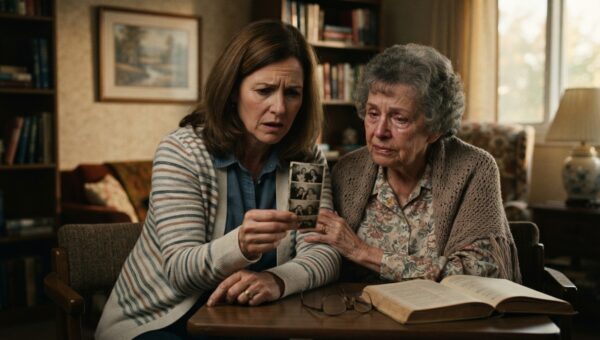
The linoleum under my socks was cold, the way it always got right around five o’clock in October, but I barely noticed it because Reid’s voice was coming through the receiver like sandpaper. Don’t you dare take her in, my son Reid said on the phone. She made her bed.
Outside the screen door, Paige stood on the grey wooden planks with a black plastic trash bag in her fist and fourteen dollars wedged into the pocket of her oversized windbreaker.
She was seventeen, three months along, and her chin had that stubborn little tilt that always meant she was trying not to throw up or start crying. Reid said if I helped her, he’d cut me off too, and mean it this time, like our relationship was something he could put on layaway and cancel whenever the payments got inconvenient.
I raised three kids on a waitress wage at the old diner down by the marina, sliding plates of fried cod and refilling endless mugs of black coffee until my feet felt like lead weights. I know how fast a girl can fall when the ground gives out under her, and I know how hard it is to claw your way back to level earth once you are down. I also know what being soft once cost me long ago, back when my sister Clara came knocking on my door with a suitcase and a black eye, and I told her she had to work things out with her husband because I could not afford the scandal or the extra mouth to feed.
Clara never did come back after that, not really, and the sound of her bus pulling away down the highway has lived in the back of my mind for forty years like a dull toothache.
Paige stared down at the porch boards and whispered, I’ll go, Grandma. I just didn’t know where else.
Her voice sounded thin, almost like she was talking to herself instead of me, and the way her shoulder hitched against the doorframe made my chest ache with a sudden, sharp pinch. The last bus to the shelter over on 4th Street left in forty minutes, and the neighborhood past the gravel lot got mean and dark after the streetlamps flickered on. I looked at the little plastic bag holding all she owned in the world, fourteen damp dollars and three old school notebooks, and I knew what kind of night she would have out there if I let her walk down that driveway.
I picked up my car keys from the laminate counter and let the heavy brass ring drop back down with a sharp clink against the phone stand.
Get inside, Paige, I said, and I pushed the screen door open so the rusty spring could whine the way it had since Reid was ten years old.
Reid called back twice while I was boiling water for tea and telling Paige to drop her trash bag by the coat rack in the hall. I let the phone ring out the first time, listening to the little electronic chirp bounce off the walls of my quiet kitchen, but by the second time I reached over and flipped the switch on the wall box so the whole thing went dead silent. You cannot negotiate with a man who thinks mercy is a weakness, and Reid had spent the last ten years convincing himself that his success was a fortress he had built entirely alone, with no help from anyone who had ever slipped up or needed a hand.
He sent a text twenty minutes later while we were sitting at the small round table with our mugs between our hands. You are dead to me, Grandma, or something very close to it, typed out with all the cold punctuation of a man who wanted to make sure every word left a mark.
Paige looked down at the blue rim of her mug and wouldn’t touch her tea, her fingers turning the ceramic round and round until her knuckles looked white and pinched.
He means it, she whispered. Dad never bluffs about stuff like that. He told me last week that if I messed up his promotion dinner with the regional manager, I was out on my ear. I just didn’t think he would actually pack my winter coat into a Hefty bag and set it by the garage.
I reached across the oilcloth tablecloth and put my hand over hers, feeling how cold her skin was even inside a warm kitchen.
Your father is terrified, Paige, I said, and my voice sounded rougher than I meant it to, rasped out by too many years of shouting over the grill at the diner. He spent his whole life being scared of being poor again. He thinks if he keeps everything neat and follows every rule the company hands down, the floor won’t ever drop out from under him. But life doesn’t care about his rules, and neither do babies.
She let out a dry, shaky sort of breath that wasn’t quite a laugh and wasn’t quite a sob. He acts like I did it to spite him.
People usually think other people’s mistakes are a personal insult when they are too proud to admit they are just scared of catching the same bad luck, I told her, and I stood up to put another log into the woodstove because the autumn damp was starting to seep through the floorboards.
The next two days passed in a strange kind of quiet, the kind that settles over a house when a storm is sitting right on top of the roof but hasn’t broken yet. Reid didn’t call, and neither did my younger daughter Mavis, who lived down in Portland and mostly took her cues from whatever Reid said was respectable. I spent my mornings helping Paige set up her laptop on the dining room table so she could finish her high school credits online through the county extension program, and in the afternoons we went through my pantry to see what we could stretch into a decent supper.
She had fourteen dollars and change in that little coin purse, and she kept trying to hand it to me every time I bought a carton of milk or a loaf of rye bread at the corner market.
I’ve got grocery money, Paige, I told her on the third morning while we were shelling peas over an enamel bowl. You keep your change for your vitamins and whatever else you’re going to need come spring.
That was when the front gate latch clicked, hard and sharp, the way Reid always let it drop when he was in one of his righteous moods.
I didn’t rush to the door. I just wiped my hands on my apron, smoothed down the front of my cardigan, and walked out into the small front hallway just as his fist came down on the wood with three heavy thuds. He didn’t wait for me to turn the deadbolt; he pushed his way in the second I cracked the door, his jaw set so tight his chin looked like a block of granite under his expensive wool coat.
You’ve lost your mind, Ma, Reid said, his voice dropping into that low, flat rumble he must have learned from some management seminar downtown. You’re seventy-four years old and you’re taking on an infant and a girl who couldn’t even keep her life straight for six months.
I stood right there in the narrow hallway with my arms folded across my chest, blocking the entrance to the kitchen where Paige was sitting out of sight.
Take your coat off or get out, Reid, I said, and I didn’t raise my voice an inch because there wasn’t any need to.
He stared at me like I had lost my senses, his eyes darting toward the kitchen archway where the shadow of Paige’s shoulder showed against the wallpaper.
I came here to tell you once, and only once, he said, his voice shaking just a little bit underneath the anger. You call Mavis, you tell her you’ve made a mistake, and you let me take Paige to the family shelter in Eugene where she belongs. If you keep her here, don’t ask me for a dime when your water heater goes out, and don’t expect me at Thanksgiving. I am done cleaning up after other people’s carelessness.
I looked at him standing there in his polished leather shoes, smelling of high-octane gasoline and expensive aftershave, and for a second I didn’t see my son at all. I saw my father, twenty-five years dead, standing by the kitchen stove in his grease-stained overalls, telling me that Clara made her bed and now she could lie in it while the rain came through the roof. Reid had polished the boots and changed the title, but it was the exact same song, sung by a man who thought that if he was cruel enough to the weak ones, the world would finally let him sit at the head of the table.
You raised three kids on a waitress wage, Ma, Reid said, his voice softening just a fraction, trying that old trick where he sounded like the boy who used to skin his knee on the back steps. You taught us that you don’t get anything in this life unless you work yourself to the bone for it. Why are you coddling her now?
Because I was wrong the first time, Reid, I told him, and the words came out quiet and steady, like dropping lead sinkers into a calm pond. I was wrong when I told Clara she couldn’t stay here. I was wrong every time I thought being hard was the same thing as being strong. And I am not going to sit here and watch you do the same coward’s trick to your own flesh and blood just so you can sleep better at your country club meetings.
His face went hard and gray in the dim light of the hallway, all the warmth draining out of his skin until he looked like a stranger who had knocked on the wrong door by mistake.
You’re making a mistake you can’t undo, Ma, he whispered.
I’ve made plenty of them, I said. This is the first one I’m fixing.
He didn’t say another word after that. He turned around on his heel, yanked the front door open so hard the glass rattled in the frame, and walked down the gravel path without looking back once. I listened to his sedan engine roar to life in the driveway, gravel spitting against the fender, and then the red tail lights cut through the dark before turning south toward the highway.
When I walked back into the kitchen, Paige was standing by the sink with her head down, her fingers gripping the edge of the laminate counter so hard her knuckles were grey.
He’s really not coming back, is he? she asked, and her voice sounded smaller than seventeen, smaller than a child who had just realized the floor really was gone.
He’s got a lot of pride to trip over first, I said, and I reached out and took the bowl of shelled peas from her hands, setting them down on the table. But the door is still on its hinges, and the stove still works.
By November the rain had set in for good, turning the Oregon hills around the town into fifty different shades of wet slate and moss. The house smelled constantly of drying laundry on the rack by the stove and cinnamon tea that Paige liked to brew with a little honey she bought with her own allowance money. We didn’t talk much about Reid after that first week, except when a piece of mail came addressed to me with his handwriting on it, which I dropped straight into the wastebasket without opening.
One afternoon while the rain was hitting the kitchen window in steady, gray sheets, Paige was standing by the sink washing the lunch dishes while I dried them with a flour-sack towel that had belonged to my mother. A newly hung white lace curtain, the one I’d bought off clearance at the dry goods store down on Main Street, blew softly in the breeze coming through the gap in the window above the sink, reflecting the pale afternoon sun as it finally broke through the clouds. Paige reached for a saucer, her belly just starting to show a little roundness under her grey flannel shirt, and we worked side by side in companionable silence, the sound of the water running over the porcelain the only noise in the room. I looked down at her hands, strong and steady where they held the sponge, and I knew that whatever else happened come winter, the porch light was going to stay on every single night until morning.