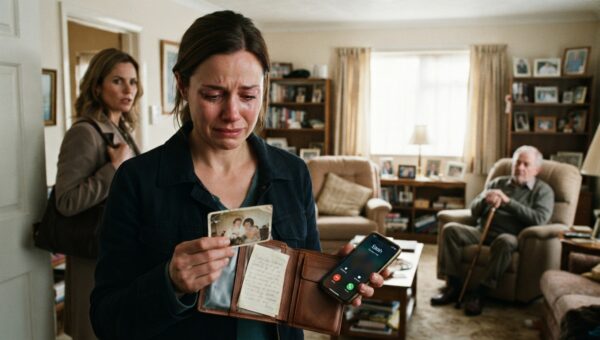
The envelope from the university bursar’s office sat right on top of my mail pile on a Tuesday afternoon, smelling faintly of cheap copier toner and old paper. I was thirty years old, working three shifts a week in the pediatric ward at Mercy Hospital, and my rent had just gone up by forty dollars. When I tore the flap open, I expected a standard alumni donation request or some bureaucratic mix-up regarding my old nursing school financial aid ledger.
Instead, the letter stated plainly that my anonymous tuition donor had passed away the previous month, and per his explicit instructions filed with their legal department twenty-one years prior, his identity was now being released to me.
My father had walked out of our front door on a rainy Tuesday morning in October when I was nine years old, carrying a single brown suitcase and never looking back. No goodbye note on the kitchen counter, no birthday cards arriving in the rural mail slot, and certainly no phone calls on holidays to check if we were eating. My mother had scraped by working two jobs at the local dry cleaners and the diner off the interstate, her hands perpetually smelling of heavy starch and grease, while I grew up learning how to lock the deadbolt twice before twilight. By the time I turned twenty-two and stared down a $34,000 per semester nursing school bill I had no earthly way of paying, I had long since stopped wondering if he even remembered my name.
Then came the anonymous scholarship that covered every single dollar of my tuition across four grueling years, totaling $68,000 without a single missed semester. I had always imagined some wealthy retired doctor or some church foundation board member signing off on those checks from a high-rise office downtown. The university letter listed a name I hadn’t spoken out loud in over two decades, along with a street address located just six miles north of my cramped second-floor apartment.
I didn’t change out of my hospital scrubs. I just grabbed my car keys, walked down the creaking metal stairs to my rusted sedan, and drove straight through the late afternoon traffic with my hands gripping the steering wheel so tight my knuckles turned gray. The address led me to a modest, single-story ranch house tucked behind a row of overgrown boxwood hedges on Elm Street, its white paint peeling slightly around the window frames.
A woman in her sixties with kind, tired eyes and a faded cotton apron answered my knock before I could even raise my hand to strike the wood again. She didn’t look surprised to see me standing on her porch in my light blue scrubs; she looked like someone who had been waiting by the front window for a very long time.
She just looked at me for a long second, her breath catching slightly in the humid afternoon air. “You have his chin,” she said softly, stepping back to hold the screen door open. “I’m Martha. Come on inside, honey.”
The living room smelled of instant coffee and old paperbacks, quiet and dim with the heavy curtains drawn against the sun. There were no framed family portraits on the walls, only a few landscapes of the state park two counties over and a small wooden bookcase crammed with worn paperbacks.
Martha motioned me toward a plaid armchair, but I stayed standing right by the entryway, my pulse pounding in my ears like a drumbeat.
“I got the letter from the university today,” I said, my voice sounding harsher than I intended in the quiet room. “I need to know why.”
Martha walked over to the side table and picked up a battered shoebox with a faded green lid, the kind people used for cheap sneakers back in the eighties. She set it down on the coffee table with a soft thud that seemed to echo off the walls.
“He never stopped paying attention,” Martha said, her voice barely above a whisper as she traced the edge of the cardboard lid with her thumb. “Every single semester when those checks cleared, he sat right at this kitchen table and checked the ledger three times. He wouldn’t let me buy a new television or fix the leak in the garage roof because he was terrified of missing a payment deadline for your books.”
I crossed my arms tightly over my chest, feeling the cold knot of old anger flare up in my ribs despite the heat in the room. “If he wanted to pay for my school, why didn’t he just come home? Why didn’t he pick up the phone once in twenty years? You don’t get to abandon a nine-year-old child and then play guardian angel from six miles away.”
Martha didn’t flinch. She just looked up at me with a steady, sorrowful gaze that made my throat tighten up. “He watched every graduation from the parking lot,” she said quietly. “He sat out in that old blue pickup truck with the windows rolled up halfway down the block during your high school ceremony, and he did the exact same thing when you got your nursing pin at the civic center. He wanted to come in. I told him you’d forgive him if he just walked through those doors and told you the truth. He said you shouldn’t have to.”
The words hung in the stale air between us, heavy and impossible to process all at once. I stared down at the shoebox on the table, my fingers twitching with a sudden, overwhelming urge to push it away and walk right back out to my car.
“Open it,” Martha murmured, nudging the lid an inch loose. “He kept everything. Every single piece of paper the school ever sent home.”
I knelt down on the worn carpet because my knees suddenly felt too weak to hold my weight, and I lifted the cardboard lid off the box. The first thing I saw was a stack of elementary school report cards, neatly pressed and arranged by year, with every A circled in red ink that had faded to a dull rust color over the decades. Underneath those lay a handful of folded class pictures from the fourth and fifth grade, my awkward bangs and missing front teeth staring back up at me from a time I barely remembered as my own.
My hand brushed against a stiff piece of cardstock near the bottom of the box, and I pulled it out into the dim light. It was my wedding announcement from two years prior, clipped directly from the Sunday edition of the local paper, with a small circle drawn around my name in pencil. Beside it sat a receipt from a local bakery for a single slice of vanilla cake dated the exact afternoon of my courthouse ceremony.
“He sat in his truck across the street from the courthouse,” Martha said softly, her voice breaking just a little as she watched my hands shake. “He wouldn’t go inside because he was scared his face would ruin your day. But he bought a piece of cake and ate it in the parking lot so he could toast to you by himself.”
I felt a hot tear slip down my cheek, hitting the edge of the newspaper clipping with a tiny, dark spot. The anger I had carried like a shield for more than twenty years felt like it was dissolving into something much more terrifying, leaving behind a vast, hollow space where my certainty used to live.
“There’s one more thing at the bottom,” Martha whispered, pointing a trembling finger toward a folded yellow paper tucked beneath an old envelope. “He told me to give you that if you ever came through this door.”
I reached deep down into the corner of the shoebox and pulled out the yellowed slip of paper, its edges frayed from being folded and unfolded a thousand times. It was an official hospital blood bank ledger from Mercy Hospital, dated twenty-three years earlier, back when I was seven years old and rushed into the emergency room following a severe playground accident that nearly cost me my spleen. I remembered the sterile white lights of the trauma bay and the terrifying sound of my mother crying in the hallway, but I had never known who provided the rare-type blood that saved my life during the emergency transfusion.
I looked down at the donor registry number on the faded form, and then at the signature scrawled across the bottom line in familiar, slanted handwriting. It was his name.
My father had sat in the very same hospital where I now worked as a registered nurse, donating his own blood to keep me alive when I was seven, just as he had done the night I was born. When he walked out of our lives two years later, it hadn’t been out of cold indifference or a sudden burst of cruelty; it had been the final, desperate act of a man who believed his very presence was a shadow that would only bring ruin to the people he loved most.
Martha sat quietly on the sofa, her hands folded in her lap, letting the silence settle over the room like a blanket. I didn’t say anything for a long time, just holding the hospital receipt in one hand and the school photograph in the other, letting the years of bitter resentment finally give way to the staggering weight of his quiet, unbroken devotion.
When I finally stood up to leave, Martha walked me to the front door and handed me the shoebox wrapped tightly in brown parcel paper. I drove back to my apartment through the quiet evening streets, the dashboard lights casting a pale green glow across my steering wheel.
Back in my small kitchen, I placed the shoebox on the wooden table right beside my nursing shift schedule and the Mercy Hospital badge clipped to my lanyard. The soft amber light from my kitchen lamp fell across the hospital receipt and the childhood school photo resting side by side, illuminating the invisible threads that had held my life together all along.