The morning fog down by the harbor was hanging low enough to blur the tops of the cedar trees when I picked up the cardboard box from my front step. It was just a regular brown Amazon package, taped across the top with clear plastic, but the ink on the shipping label caught my eye because the last name was the same as mine.
That is not a common name around this part of the Oregon coast, so I figured some delivery driver had mixed up our routes again, the way they always did when the college kids were home for the term.
I set the kettle on the back burner and looked at the address. Fourteen miles inland, up past the old lumber mill where the road turns narrow and gravelly. I could have dropped it at the post office during my lunch hour, but I had the whole Saturday morning free, and honestly, I just wanted an excuse to drive out past the water before the rain started. I tossed the box onto the passenger seat of my sedan, right next to my canvas grocery bags, and backed out of the drive.
The drive took twenty minutes through the gray drizzle. When I pulled up to the small ranch house with the peeling white trim, I noticed a child’s blue bicycle lying sideways in the damp grass by the mailbox.
I walked up the three wooden steps and knocked on the screen door.
A woman with dark hair pulled back into a loose clip answered almost immediately. She was wearing a faded gray sweatshirt and holding a wooden spoon, like she had been stirring soup on the stove. She looked at me, then down at the box in my hands, and her whole face softened into an easy, neighborly smile.
“Oh, bless you,” she said, her voice warm and tired. “Michael must have used the old address again. He’s terrible with numbers since they changed the zip codes out on the highway.”
My thumb tightened against the cardboard edge. I stayed very still, because my brain kind of stopped working for a second.
“Michael?” I asked.
She laughed, a short, light sound that had no bad intentions in it at all. “My husband. Michael. He’s always losing track of where we get our mail dropped.”
I didn’t say anything. I just slowly raised my left hand, the one with the six-thousand-two-hundred-dollar Zales engagement ring that Michael had slipped onto my finger six months ago after three years of us talking about a future together. The diamond caught the gray morning light coming through the screen.
The woman’s smile didn’t vanish all at once; it just cracked. She looked at my hand, then up at my face, and her eyes went wide. She reached down instinctively and touched her own left hand, where an identical diamond sat on her ring finger. I knew that exact mounting by heart because I had helped him pick the size out from the catalog after dinner one night when we were looking at house plans.
She whispered, her voice dropping down to almost nothing. “He bought you the same ring?”
I looked straight into her eyes, and the cold truth settled into my chest like a weight of lead. “He told me you were dead.”
She stared at me, the blood draining right out of her cheeks until she looked gray. “What?”
“He told me you died of breast cancer in 2019,” I said, and my own voice sounded like it was coming from the bottom of an empty well. “He cried about it on our second date.
He cried every time he talked about the hospital bills. He told me he hadn’t touched your side of the closet in four years.”
The woman reached out and gripped the wooden frame of the screen door so hard her knuckles turned white. “We’ve been married eleven years,” she said, and every word sounded like it was being pulled out of her teeth. “My name is Elena. We have two kids. He’s been an out-of-town consulting engineer for three years, traveling up and down the coast. He was just home on Thursday.”
The kitchen behind her smelled like onions and woodsmoke. Through the open door, I could hear a little girl’s voice singing a song from the living room television. I stood there on that damp wooden porch, holding a stranger’s package, and realized that every single memory I had of the last thirty-six months was built out of painted cardboard.
Elena didn’t scream or start crying. She just pushed the screen door open wider and stepped back.
“Get inside,” she said. Her voice was shaking, but her eyes were hard as river stones. “Before I lose my mind.”
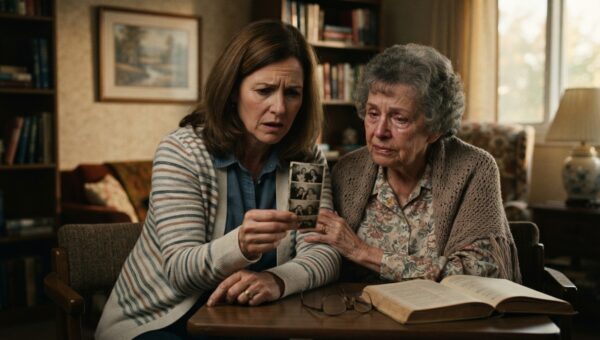
We sat at her kitchen table while the rain started beating harder against the small window over the sink. Elena didn’t make coffee, and I didn’t offer to help. We just laid our left hands flat on the scarred laminate table side by side, right next to a half-empty box of cereal and a plastic cup with a pink straw. The rings were identical. Not similar, not close. The same six-prong setting, the same little imperfections in the gold band where the jeweler had sized mine down three sizes in the back room of the mall store.
Elena pulled out her phone and started scrolling through her camera roll, showing me pictures from vacations I thought I was the only one he shared.
“Look at this one,” she said, turning the screen toward me. “July of last year. He told me he was in Seattle for a three-day bridge inspection.”
I looked at the photo. Michael was standing on a dock with an ice cream cone in his hand, wearing the blue windbreaker I bought him for his birthday.
“He was with me in Cannon Beach that weekend,” I whispered. “We stayed in a little cabin right on the water. He told me he had to take a work call on the deck for an hour.”
“He was taking a work call,” Elena said, her mouth twisting into something bitter. “To me. Telling me the client dinner was running late.”
We spent two hours at that table, trading dates like we were doing inventory on a shipwreck. Every business trip, every sudden weekend emergency, every funeral anniversary where he needed space to grieve alone in his apartment, it all mapped out onto a calendar of double bookings. The man had two separate lives running on parallel tracks, synchronized by a schedule so precise it made my stomach turn. He had two sets of everything. Two toothbrushes, two winter coats, two women who trusted him enough to let him hold their hands in the dark.
At eleven o’clock, Elena’s phone buzzed on the table. The screen lit up with his name: Michael.
Elena looked at me, her hand hovering over the glass. “Do you want to?”
“Answer it,” I said. “Put it on speaker.”
She hit the button and laid the phone flat between us.
“Hey, honey,” Michael’s voice came through the speaker, smooth and easy, sounding like the man I thought I knew better than anyone else in the world. “Flight out of Portland got delayed. I’m going to be late getting home tonight. Don’t wait up for dinner, okay?”
Elena didn’t blink. “Where are you landing, Michael?”
There was a second of dead silence on the line. The kind of silence where you can hear a man’s brain calculating which lie is currently active in which file.
“Seattle,” he said, and his voice had lost that easy warmth, replaced by a careful, measured cadence. “Client meeting ran long. Why?”
“That’s funny,” Elena said, her voice terrifyingly quiet. “Because I’m sitting in the kitchen with someone who says you’re supposed to be in Astoria this weekend.”
Silence again. Longer this time. You could hear the faint hum of traffic in the background wherever he was sitting, probably idling in some parking lot fifty miles away.
“Elena,” he started, his voice dropping into that low, pleading register he always used when he wanted me to drop an argument. “Let me explain. It’s not, “
“Don’t,” I said, leaning down toward the phone so he could hear every syllable of my voice. “Don’t you dare start with the explanations, Michael. I’m sitting right here looking at your wife’s wedding ring. The one that matches the one you put on my finger.”
The line went completely dead. Not disconnected, just silent. Like he had dropped the phone onto the floorboards of his truck.
“He’s coming,” Elena said, standing up so fast her chair scraped loudly against the linoleum. “He keeps a spare set of keys in his truck console. He thinks he can talk his way out of anything if he’s standing right in front of you.”
“Good,” I said. “Let him come.”
We didn’t wait in the kitchen. We moved out to the front porch and sat on the wooden steps while the rain settled into a steady, gray drizzle that soaked through my sweater. We didn’t talk much while we waited. We just watched the gravel drive, two women connected by a man who wasn’t worth either of us.
It took forty minutes for his gray sedan to turn off the highway and crunch up the gravel drive. He pulled up right behind my car, cut the engine, and sat there for a second with his hands on the steering wheel, looking at both of our vehicles parked side by side like a neon sign pointing straight at his disaster.
When he opened the door and stepped out, he looked older than he did on Tuesday. His shoulders were slightly rounded, and he had that familiar look of practiced exhaustion on his face, the one that used to make me want to wrap my arms around him and tell him he worked too hard.
He stopped ten feet from the bottom of the steps. His eyes flicked from Elena to me, and for a second, his mouth opened like he was going to say something, but no sound came out.
“Michael,” Elena said, and she didn’t even stand up. She just looked at him the way you look at a stray dog that tracked mud across a clean floor.
“Look, I can explain,” he stammered, taking a half-step forward and holding out his hands, palms up, the way he always did when he was trying to smooth over a disagreement. “It’s complicated. You don’t understand the pressure I’ve been under, “
“We understand plenty,” I said. I stood up, reached into my pocket, and pulled off the six-thousand-two-hundred-dollar Zales engagement ring. I walked down the two steps and tossed it right at his feet. It hit the damp gravel with a dull little clatter and rolled until it stopped against the toe of his work boot.
Elena stood up behind me, carrying two heavy canvas duffel bags she had packed from his closet while we were waiting. She carried them out to the edge of the porch and dropped them hard onto the concrete. They landed with a heavy thud, zippers jangling against the stone.
“Your clothes are in there,” Elena said, her voice level and cold. “Don’t ever come back to this house. And don’t call my phone again or I’ll have the sheriff out here serving papers before dark.”
Michael looked down at the ring in the gravel, then up at Elena, then at me. He opened his mouth, trying to find the right words, the right lie, the right tearful performance that had kept us both hooked for years. But the well was completely dry.
“I loved you both,” he muttered, and it was the most pathetic thing I think I ever heard a grown man say.
“No, Michael,” I said, turning back toward the door. “You didn’t love either of us. You just liked the way we made your life comfortable.”
We walked back inside and let the screen door latch shut behind us with that familiar, tired rattle. I didn’t look back to see what he did next.
By the time I drove my car back down the gravel road toward the highway, the rain had stopped, leaving the trees dripping and the air smelling of salt and wet cedar. I drove straight to my own house, unlocked the front door, and walked inside.
The house was quiet. Too quiet, maybe, but for the first time in three years, the air in the rooms felt like my own.
I walked into the small mudroom by the back entrance, unzipped my coat, and reached down to pull off my boots. My left hand felt light, almost strange, without the weight of the diamond ring pressing against my knuckle. I walked over to the small wooden table by the hall mirror, laid the spare key Michael had given me right in the center of the wood, and walked into the kitchen to put the kettle on for myself.