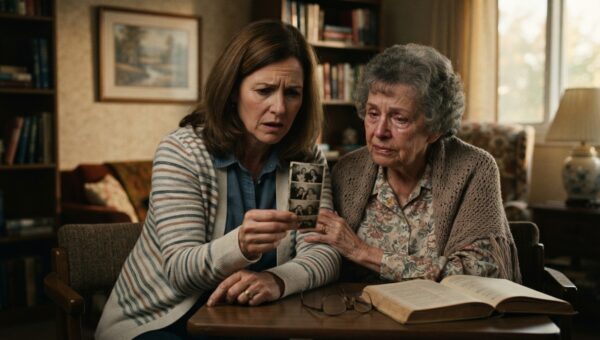
Eleven days after Richard’s funeral, the house still smelled faintly of the ham our neighbors had dropped off and the white lilies that were starting to drop their yellow pollen onto the cherry sideboard. I had the phone pressed to my ear, listening to the hum of the switchboard at the insurance company, waiting for someone to tell me where to sign so I could get the check for the final expenses and put the paperwork behind me. I just wanted the quiet back.
The agent came back on the line after a long hold that sounded like wind blowing through an empty wire. His voice was too careful, the kind of professional thinness people use when they are about to hand you something heavy. He cleared his throat once and said, Ma’am, that policy was surrendered in 2019. The $180,000 was cashed out.
I sat down on the piano bench because my knees decided they were done holding me up. My husband never told me a word. Richard was a quiet man who kept his worries in his shirt pocket like loose change, but he didn’t keep secrets about money. Not from me. We had lived in the same four-bedroom house in Amarillo for thirty-eight years, paid every dime on time, and never once borrowed against tomorrow without sitting at the kitchen table with two cups of black coffee and a yellow legal pad between us.
I asked him to repeat the year. I asked him if he had the wrong file number. The agent just gave me the policy number ending in 4091, the exact digits inked onto the blue card sitting in the metal lockbox in the back of our bedroom closet.
I didn’t wait for him to finish telling me about surrender fees or tax forms. I slammed the landline down onto the cradle so hard the plastic bell inside gave a little metallic ping. I didn’t even grab my purse from the hook by the back door. I just walked out to the sedan, pulled the keys off the sun visor where Richard always left them so they wouldn’t rattle in the console, and backed out of the drive with the tires crunching loud on the caliche gravel.
The drive down to the regional office took twenty-two minutes. I watched the roadside telephone poles tick past one by one, each of them leaning just a fraction to the left against the flat blue Texas sky.
My mind felt hollow, like an old tin bucket left out in the yard through a dry spell. I kept telling myself there was a simple clerical error. Banks lose paperwork every day. Computers scramble digits. Richard had been sick with his lungs for six months, coughing until the wallpaper shook in the hall, but back in 2019 he was still walking two miles every morning down to the feed store and back.
When I pushed through the glass double doors of the insurance office, the air conditioning hit the back of my neck like cold spring water. The young man behind the counter had a badge clipped to his pocket that said Travis. He looked about twenty-four years old and smelled like peppermint gum. He handed me the folder across the laminate counter without making eye contact, his fingers tapping a nervous little rhythm against the gray edge.
Here’s the application for the cash surrender value, Travis said, his voice dropping an octave as if he were reading a bulletin from a hospital.
Signed and processed in August of that year. Funds were wired directly to a commercial account downtown.
I pulled the single sheet of white paper out of the manila pocket. The lights in the ceiling hummed a high, thin note that seemed to vibrate right behind my teeth. My eyes went straight to the bottom right corner where the signature line cut across the gray security grid.
The name was there in black ink. Richard J. Holloway. Every stroke was neat, every loop closed tight, the letters leaning forward with that stiff, careful geometry Richard had used ever since his drafting days at the county engineering office back in the seventies. Except it wasn’t his hand. Richard had a slight tremor in his middle knuckle from a table saw accident before we even met, a tiny hitch that always made his capital Rs flare out at the bottom like a little duck tail. This signature didn’t have the hitch. It was too smooth, too practiced, drawn by someone who had probably spent an hour tracing it over a light box until they got the muscle memory down pat.
I stared at that name until the black ink started to blur into gray grease. My chest felt tight, the way it did when I climbed the stairs too fast with a basket of wet sheets. I didn’t say anything to Travis. I just folded the paper twice, tucked it into the pocket of my cardigan, and walked right back out to the car without looking at him again.
The drive home took twice as long because a gravel truck had broken down on the state road and traffic was backed up past the grain elevators. I sat behind the wheel with my hands locked at ten and two, the leather steering wheel slick with sweat, watching the heat shimmer off the asphalt in long, wavy ribbons. My brain kept turning over the same three names of people who had access to our lockbox, people who came through the back door without knocking, people who knew where we kept the spare key behind the water meter.
When I unlocked the back door, the house was dead silent except for the refrigerator clicking on in the pantry. I didn’t turn on the lights. I walked straight down the narrow hallway to the spare bedroom where Richard kept his old cedar secretary desk. The top flap had been stuck on the left side since the winter the foundation shifted, and it took a hard upward jerk with the heel of my palm to get it to drop open.
Inside was a mess of old tax receipts, packets of seed corn catalogs from twenty years ago, and a cigar box full of old birthday cards. I started pulling them out by the handful, dumping them onto the patterned rug. I didn’t care about the mess. I was looking for the handwriting. Not Richard’s. I was looking for the other one. The one that didn’t have the hitch in the R.
I found it buried at the bottom of a stack of old shoe boxes where I kept Christmas cards from the nineties. A red card with a picture of a snowy barn on the front, addressed in those same careful, looping letters that looked like they had been drawn by a draftsman with a ruler.
To Dick and Clara, wishing you both a blessed holiday season from Arthur and the girls.
Arthur Hayes.
My hand started to shake so hard I dropped the card onto the carpet. The cardboard corner hit the wool with a dull thud.
Arthur had lived two blocks over from us for thirty-six years. He was the man who brought a casserole over the afternoon my mother died. He was the man who helped Richard rebuild the transmission on the old Ford pickup in the summer of 2008, spending three weekends lying on his back on our oil-stained concrete driveway with grease smeared across his forehead. He was the man who sat at our dining table every single Christmas Day, carving the turkey with the electric knife Richard had bought him as a thank-you gift for helping us move the piano. Every year, without fail, he brought a box of pecan pralines wrapped in red foil, with a little white gift tag tied to the ribbon in those exact, meticulous, looping letters.
I sat down hard on the edge of the spare bed, my feet tangled in a heap of old greeting cards. The room smelled of old paper and cedar shavings, that dry, dead scent that accumulates when things are left in the dark too long.
The pieces didn’t just fall into place; they slammed together like iron gates in a high wind. I remembered the summer of 2019. Richard had been quiet for months, spending hours out in the metal shed behind the garden, staring at old ledgers and smoking cigarettes he had supposedly quit ten years before. He lost twelve pounds in six weeks. When I asked him what was wrong at the lumber yard or with the truck, he just rubbed the back of his neck and said Arthur was helping him straighten out some old partnership paperwork from the grading business they had tried to launch back in the nineties. Arthur had a head for figures, Richard always said. Arthur went to business school in Fort Worth for two semesters before his father’s hip went out and he had to come home to take over the hardware store.
Arthur had been the one to recommend the insurance agent. Arthur had been the one who handled the notary public when we refinanced the back pasture to pay for the new roof. Arthur was the one who patted Richard on the shoulder at the funeral home eleven days ago, his eyes swimming with genuine, greasy tears as he told me he was losing the best friend he ever had in this world.
The house seemed to get smaller around me, the walls pressing inward until I could hear the blood rushing in my ears like water in a galvanized pipe. I didn’t cry. Grief had a way of clearing the decks, leaving behind something cold and sharp and entirely functional. I gathered up the insurance surrender paper from my cardigan pocket and laid it flat on the cedar desk right next to a stack of Christmas tags from 2018, 2015, 2010, and all the way back to when our daughter was still living at home and wearing braces on her teeth.
The capital letters were identical. The way the t crossed high above the stem. The way the s curled back on itself like a sleeping dog. It was the handwriting of a man who spent his life writing price tags for fifty-pound bags of lime and three-quarter-inch galvanized bolts.
I looked at the clock on the mantel in the hall. 4:12 in the afternoon. The sun was hitting the west window, throwing long, amber bars across the floorboards.
The front gate clicked.
I knew that sound better than I knew my own heartbeat. It was the loose hinge on the cattle-guard gate that Arthur had promised to weld three separate summers and never quite got around to finishing. Footsteps came up the sidewalk, heavy and slow, the boots of a man who still thought he was calling on a lonely widow who needed a casserole warmed up in the oven.
The doorbell gave its usual two short chimes.
I didn’t move from the edge of the spare bed. I sat there with my hands resting flat on my knees, watching the shadow of a man’s hat stretch across the frosted glass of our front door.
Arthur knocked twice, the way he always did, light and familiar, like a man who owned the key. Clara? he called out through the screen, his voice carrying that familiar, gravelly warmth that had fooled half the county for four decades. You in there, honey? I brought a jar of peach preserves from the cellar. Thought you might want something sweet on your toast tonight.
The door handle rattled. He tried to push it open, but I had thrown the brass night-latch when I came back from town.
The rattling stopped. A second later, the screen door gave a little squeak as he leaned against the frame, waiting.
I stood up slowly, my joints popping in the quiet room. I picked up the insurance document in one hand and the small bundle of gift tags in the other. I walked down the narrow hall, my socks making no sound on the old runner rug, and reached out to turn the thumb-turn on the lock.
When I pulled the wood door open, Arthur was standing there on the porch with a Mason jar of yellow preserves in his left hand and his gray Stetson held against his belt buckle. He looked older than he had at the cemetery. His cheeks were gray around the stubble, and his eyes had that yellowed, watery look of a man who hadn’t slept well since the ground went down over Richard’s coffin.
He smiled, a slow, practiced curving of the lips that didn’t reach his eyes. Well, there you are, Clara. I was starting to wonder if you went off to visit Julie in Lubbock without telling anybody.
I didn’t step back to let him in. I stayed right in the middle of the threshold, my shoulder braced against the door frame.
Arthur’s smile faltered just a fraction, the way a horse’s ear twitches when it hears a rattlesnake in the brush. He shifted the jar of peaches from one hand to the other. What’s the matter, hon? You look like you’ve seen a ghost.
I didn’t raise my voice. I didn’t shake. I just reached out and laid the single sheet of insurance paperwork down on the small wicker table we kept by the front door, right on top of the stack of unopened sympathy cards. Next to it, I dropped the little white Christmas gift tag with its neat, looping letters.
Arthur looked down at the paper. His throat moved as he swallowed, a hard, dry hitch that bobbed his Adam’s apple against his collar. The red color in his face didn’t drain out all at once; it seemed to curdle, turning a dull, unhealthy gray like dishwater with grease floating on top.
What’s this about, Clara? Arthur asked, his voice dropping into that low, wheedling register he used whenever he was trying to talk the co-op manager out of a late fee on fertilizer. Richard and I had a lot of accounts back then. You know how complicated things got with the grading business.
I looked straight at him, right into those pale blue eyes I had baked pies for every Thanksgiving since the Reagan administration.
You didn’t help him with the grading business in 2019, Arthur, I said. My voice sounded like gravel grinding under a heavy tire. Richard hadn’t been on a tractor in four years. You took his insurance policy. You sat at my kitchen table and drank my coffee while you practiced his signature on a yellow legal pad until you got the little hitch in the R right.
Arthur opened his mouth to say something, some lie about partnerships or power of attorney or old debts, but the words stayed stuck in his throat like a dry crust of bread. He looked at the gift tag on the wicker table, then back at my face, and for the first time in the thirty-six years I had known him, I saw a grown man look truly, hopelessly small.
You always were a neat writer, Arthur, I said, and my hand didn’t shake once as I reached out and pushed the front door closed, one slow inch at a time, until the latch clicked home between us.