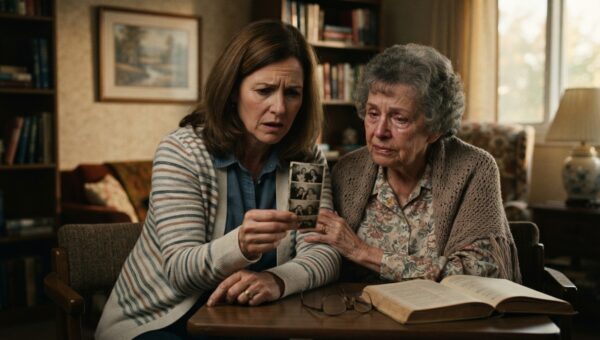
I’d been dating Michael for three years. He said his wife died in 2019. Breast cancer. He cried every time he talked about her, his voice dropping an octave, his fingers rubbing the bridge of his nose like the memory alone was enough to crush him. I believed every tear. I comforted him on anniversaries of her passing, held him while he shook in the dark, and thanked God every single day for sending me a man who knew how to love a woman that deeply after losing one.
Last Tuesday, an Amazon package showed up at my door. Wrong address. Same last name. Fourteen miles away over on the north side of town, tucked behind the old water tower where the streets all share names with native trees. I tossed it onto the passenger seat of my sedan, figuring I would drop it off on my way home from the grocery store just to be a decent human being.
I drove it over to the address on the label. It was a modest brick ranch with a faded blue front door and a tricycle lying on the patch of Bermuda grass out front. A woman answered the knock. Two kids behind her were wrestling near the hallway vent, shouting about a video game. She pushed the screen door open halfway, wiping her hands on a dishtowel tucked into the waistband of her jeans. She was wearing an engagement ring identical to mine. $6,200 from Zales.
Item number 488219. I picked that exact design out of the glass case myself three years ago, thinking it was unique because the jeweler told us they only made a limited run of that particular split-shank halo setting.
She smiled a warm, tired neighborhood smile. “Oh, Michael must not have used the wrong address again.”
I froze. “How do you know Michael?”
She laughed, a short, breathy sound that didn’t reach her eyes. “He’s my husband. We’ve been married eleven years.”
I didn’t say anything for a second, and honestly that felt worse than screaming. My brain just stopped working, the gears grinding to a dead halt as the math refused to cooperate. Three years of my life. Eleven years of hers. I slowly raised my left hand, the sunlight hitting the diamonds in the exact same way.
Her smile collapsed like a cheap tent in a gale. She stared at my finger, then back at her own, her eyes widening as the color drained right out of her cheeks. She whispered, hoarse and sudden, “He bought you the same ring?”
I looked straight into her face, my own voice shaking so bad I barely recognized it. “He told me you were…”
“Dead,” she finished for me. The word just hung there in the humid Alabama air between us, heavy and disgusting. “He told you I was dead.”
Her name was Sarah. She didn’t scream, and she didn’t slam the door in my face. Instead, she just grabbed the edge of the screen frame, her knuckles turning white, and stared at me like I was a ghost. Then she looked down at the Amazon box still resting in my hands, a simple cardboard carton containing two bulk packs of hypoallergenic laundry detergent and a box of air filters, the mundane domestic reality of a life I was never supposed to touch.
“Get inside,” she said, her voice dropping to a harsh whisper. “The kids are in the den. Get inside right now.”
I stepped across her threshold, my legs feeling hollow beneath me. The hallway smelled of cinnamon wax and damp towels, the exact same scent that clung to Michael’s duffel bag every time he came back from his out-of-town consulting gigs. For three years, I had accepted that scent as the price of dating a high-level logistics manager who had to travel across the state lines twice a week to fix broken supply chains. He had spreadsheets, corporate hotel receipts, and a carefully crafted routine that left no room for doubt.
Sarah led me past the living room where two boys, roughly eight and ten, were glued to a glowing television screen, completely oblivious to the fact that their father’s entire universe was currently imploding on the linoleum floor of the back kitchen. She didn’t turn on the overhead light. She just pulled out a metal chair from the laminate dining table and sat down hard, her hands flat on the surface.
“Sit,” she told me, pointing at the chair opposite her.
I sat down, still clutching the Amazon box like a shield. My fingers were trembling so badly I had to set the package down on the table. Sarah reached across the space between us, her left hand hovering an inch from mine before she gently touched my ring finger with the tip of her index finger. We compared them without speaking. The same sixteen pavé diamonds surrounding a one-carat oval center stone. The same tiny laser-etched serial number on the inside band, no doubt, though neither of us needed to take them off to know.
“How long?” she asked. Her voice was too calm, the kind of quiet that comes right before a thunderstorm rips the roof off a barn.
“Three years,” I said. “We met at the hardware store downtown in the spring of twenty-twenty-three. He helped me load three bags of potting soil into the back of my Subaru. He told me he was a widower. He talked about his wife who died of breast cancer in nineteen-nineteen. Wait, twenty-nineteen. He cried, Sarah. He actually cried.”
Sarah let out a bitter, ugly laugh that sounded like dry leaves scraping across concrete. “Breast cancer. God in heaven. My mother died of breast cancer in twenty-eighteen. He used my own family’s history to build his pathetic excuse.”
She stood up abruptly, walking over to the kitchen counter where a cluttered mail holder sat stuffed with envelopes, coupons, and school notices. She pulled out a laminated calendar and dropped it in front of me. It was marked up with blue and black dry-erase markers.
“Look at this,” she commanded, tapping the glass with a fingernail. “This is his travel schedule for the last six months. Every Tuesday through Thursday, he claims he is in Montgomery or Birmingham for regional client audits. But look at the weekends. Every second and fourth weekend, he says he has to fly down to the coast for emergency warehouse inspections.”
I stared at the grid of dates. The math hit me like a physical blow. Those exact emergency weekend inspections were the times Michael stayed at my townhouse, cooking breakfast in my kitchen, bringing me coffee in bed, and telling me how lucky he was to have found a second chance at happiness after losing everything.
“He was never in Montgomery,” I whispered. “He was here. With you.”
“And when he was with you, he was telling me he had to work late on corporate budgets to cover our mortgage,” Sarah said, her eyes flashing with a sudden, sharp fury that scared me more than her tears would have. “Eleven years, we’ve been married. We bought this house when the oldest was just a baby. He’s been living a double life right under my nose, and I felt guilty for asking him to help with the grocery shopping because he looked so tired all the time.”
We sat there in the quiet kitchen for nearly an hour, trading details like soldiers comparing battle scars. We didn’t yell. We didn’t throw things. We just laid out the timeline piece by piece, filling in the dark spaces where Michael had lied with terrifying precision. He had two separate phones, two separate email accounts, and a wardrobe split neatly between my spare closet and the master bedroom down the hall. He used his remote consulting job as a shield, leveraging the modern corporate landscape where nobody questions a man staring at a laptop screen until midnight.
The realization didn’t make me feel numb; it made me feel cold. The initial shock wore off, replaced by a slow, burning resolve that settled deep in my chest. He had treated both of us like interchangeable parts in a machine he built to suit his own convenience, refusing to spend even enough mental energy to buy a different engagement ring because it was easier to order two of the same item from the same catalog.
“He’s supposed to be back at my place tomorrow night,” I said quietly, looking up at Sarah. “He said he has a corporate dinner in my neighborhood.”
Sarah stopped pacing the kitchen floor. She turned around slowly, a dangerous little smile touching the corners of her mouth. Her eyes were hard as river stones.
“Tomorrow night,” she repeated, tasting the words. “He told me he had to drive down to Mobile for a three-day inventory check starting tomorrow morning.”
“Did he?”
“He packed his gray duffel bag this morning before he left for the office,” she said, her voice dropping into a steady, rhythmic cadence. “The same bag he always takes to your house.”
We didn’t need to say much more. The plan formed itself between us, born of mutual betrayal and a shared refusal to let him walk away with his lies intact. We spent the next twenty minutes coordinating our moves down to the minute. Sarah knew his banking passwords because she handled the household taxes; I had access to his secondary scheduling app because he left his tablet on my kitchen island last weekend. We weren’t just going to pack his bags and lock him out. We were going to dismantle his entire existence in one single, coordinated afternoon.
By Wednesday evening, the stage was set.
I sat at my kitchen island with the overhead pendant light casting a harsh yellow glow over the quartz countertop. My phone sat right beside my car keys, screen dark. At exactly 6:42 PM, the front door downstairs rattled as a key slid into the deadbolt. The familiar click of the latch sounded like a gunshot in the quiet apartment.
Michael stepped through the doorway, his gray duffel bag slung over one shoulder, wearing his usual blue button-down shirt with the sleeves rolled up to the elbows. He looked tired, the picture of the hardworking corporate consultant coming home to his devoted partner after a brutal day on the road.
“Hey, babe,” he said, tossing his car keys onto the entry table with practiced casualness. “Traffic on the interstate was an absolute nightmare. Took me an hour just to get past the bridge.”
He walked toward the kitchen, leaning in to press a kiss to the top of my head, but I didn’t move. I stayed seated on the stool, my hands resting flat on the counter.
He paused, sensing the wrongness in the air before he even saw my face. “What’s wrong? You look pale.”
I didn’t answer. I just reached out and slid two objects across the smooth quartz surface toward him.
The first was my left hand, held out straight with the Zales engagement ring catching the light. The second was Sarah’s ring, which she had handed to me earlier that afternoon, resting right beside mine on a small piece of black velvet.
Michael stopped dead in his tracks. The easy, tired smile slid off his face, leaving behind a slack, empty expression that made him look ten years older. He didn’t reach for the rings. He just stared at them, his throat working as he tried to swallow a dry spot.
“Where…” he started, his voice cracking on the syllable. “Where did you get that?”
From behind the pantry door off to his right, Sarah stepped out into the kitchen. She wasn’t yelling. She was holding a printed stack of joint bank statements and Michael’s corporate travel expense reports, collated and clipped together with a heavy metal binder clip.
“Hello, Michael,” Sarah said, her voice entirely level. “You left your second phone on the kitchen table at home. The one with the backup passcode you forgot I knew.”
Michael spun around, his eyes darting between the two of us like a cornered animal looking for an exit. The color left his face entirely now, not the pale of shock, but the gray skin of a man realizing the math had finally caught up with him.
“Sarah,” he choked out, taking a half-step backward until his shoulders hit the pantry door frame. “Sarah, what are you… how did you…”
“Don’t,” Sarah said, raising a single finger. “Just don’t start with the inventory checks or the client audits. We spent the last twenty-four hours comparing your receipts, your calendar invites, and your little lies about breast cancer.”
Michael opened his mouth, closed it, and then looked at me, his eyes wide and pleading, the old manipulative charm flaring up like a dying campfire trying to catch one last stick of dry wood. “Listen to me,” he whispered, stepping toward the island. “I can explain. It’s not what you think. Both of you, just let me explain how complicated things got…”
“Stop talking,” I said. My voice wasn’t loud, but it cut through the room like a razor blade. I didn’t feel angry anymore. I just felt a cold, clean emptiness that tasted like freedom. “You didn’t lose a wife in nineteen-nineteen. You didn’t lose anything except your mind if you thought you could run two houses forever.”
Sarah walked over to the entry table, picked up Michael’s heavy gray duffel bag, and dragged it across the floorboards, dumping it right at his feet. The zipper split open a few inches, spilling a folded dress shirt and a Dopp kit onto the welcome mat.
“Your things from my house are already in the trunk of my car,” Sarah said, looking down at him with an expression so utterly devoid of pity it made me shiver. “And the locks on our house were changed at two o’clock this afternoon. Your clothes are sitting in three contractor bags on the front porch.”
Michael looked down at the bag, then back up at our faces. He realized, with a final, crushing certainty, that there were no more spreadsheets to hide behind, no more fake flights to catch, and no more tears that would work on either of us. The illusion was gone, leaving only a middle-aged man standing in a hallway with nowhere left to run.
“You’re making a mistake,” he muttered, his voice dropping to a pathetic whine as he reached down to grab the strap of his bag. “You don’t understand how hard my life was.”
“We understand completely,” I said, sliding both engagement rings off the counter and dropping them into a small padded envelope I had left ready by the sink. “And now you can go explain it to someone else.”
We didn’t watch him walk out the door. We didn’t need to. When the heavy oak front door clicked shut behind him, neither of us flinched at the sound.
The next afternoon, the sun was bright and sharp over the Alabama pines as Sarah and I walked out to her sedan parked in my driveway. Two empty coffee mugs sat side-by-side on the kitchen counter inside, left right where we finished our final cup of black coffee together before she drove back north to start the rest of her life. We didn’t talk much as we walked across the asphalt under the warm afternoon sky, leaving Michael’s abandoned belongings in a single cardboard box sitting squarely on the front porch where the UPS driver would eventually find it.