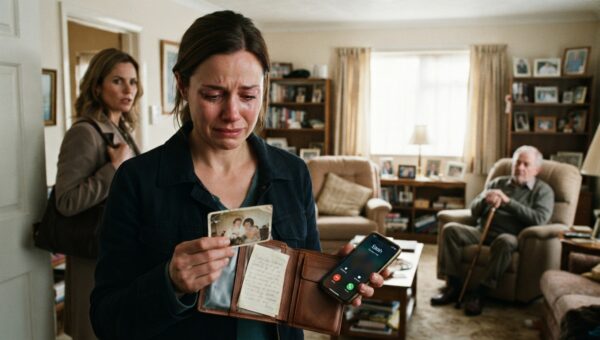
Why do we always try to make things fit when they are clearly broken? That is the question I kept asking myself while staring at the linoleum floor near the pantry door on a Tuesday afternoon in December. I had spent months convincing myself that $34,000 a year was the only problem in our house. I thought that if I just worked another extra shift at the diner, or if I clipped more coupons, the heavy, sour feeling in the living room would somehow lift.
I was wrong about almost everything, but I didn’t find out until the mail carrier dropped off a small white envelope from the elementary school.
My son Leo was six years old back then, and his class had spent the morning writing their annual letters to Santa Claus. His teacher, Mrs. Gable, had put them all in a brown manila envelope and mailed a batch of them home so the parents could keep them as little keepsakes. I pulled the folded piece of wide-lined paper out of the envelope while the kitchen kettle was still warming up on the burner. I expected to read about plastic dinosaur sets or a shiny red bicycle with hand brakes. Instead, I saw Leo’s uneven, heavy-handed printing taking up every single line.
Dear Santa, I don’t want toys. I want my mom to stop crying at night. I want the man who yells at her to go away.
He broke the kitchen table. He says bad words. Mommy says our secret. But I don’t like secrets.
I read those four sentences three separate times while standing right there by the stove. My hands started shaking so badly that the thin school paper began to rustle like dry leaves in the wind. The man Leo was talking about was Derek. Derek had moved into our small two-bedroom apartment back in August, promising that his construction jobs would help steady our finances. He had been so charming at first, bringing home takeout pizza and helping Leo build Lego towers on the rug. But the charm wore off right around the time the first utility bill came due.
By November, Derek had turned our little home into a place where we both walked on eggshells. He didn’t like the way I folded his shirts. He didn’t like how much noise Leo made when cartoons were on the television.
The broken kitchen table mentioned in the letter wasn’t an accident. It happened two weeks before, on a rainy Thursday night when Derek had slammed his fist down so hard during an argument about grocery money that the laminate cracked right down the middle and the left leg splintered under the frame. He made me cover it with a thick vinyl tablecloth so nobody would notice when the landlord came by to check the smoke detectors.
I had told Leo not to talk about it to anyone. That was the part that made my chest tighten until I could barely draw a breath. I had looked right into my little boy’s wide, frightened eyes and told him that what happened between the grown-ups stayed in the house. I had taught him to keep secrets just to keep the peace. I stood there in the quiet kitchen, staring at the blue ink of my son’s handwriting, and the rationalizations I had built up like a wall around myself simply turned to dust.
The landline phone on the wall beside the refrigerator rang twice before I managed to pick it up. My voice was tight and thin when I said hello. It was Mrs. Gable. Her voice sounded carefully measured, the way teachers sound when they are trying very hard not to panic the person on the other end of the line.
Mrs. Walker, I am so sorry to call you at home like this, but I read the letter before I slipped it into the envelope for mailing, she said. I am required by law to report certain things, you know that.
My throat went completely dry. I couldn’t even form a full sentence, so I just made a small choking sound that let her know I was listening.
Your son also told me something else when I asked him about the table during art class, Mrs. Gable continued softly, and the quiet in her voice felt heavier than any shout. He told me, The man told me if I tell anyone, he’ll make Mommy disappear.
The rest of the room seemed to tilt sideways. The kettle on the stove let out a sharp, piercing whistle, but I couldn’t even move my feet to turn the burner off. The full weight of what I had brought into our lives crashed down on me all at once. I hadn’t just invited a rude man to share our rent; I had invited a predator who was actively terrorizing a six-year-old child into absolute silence. The fear that had kept me small and quiet for months suddenly vanished, replaced by a cold, sharp, metallic rage that tasted like copper on the back of my tongue.
Thank you, Mrs. Gable, I managed to say before I hung the receiver back up on the wall. My hand was steady now. That was the funny thing about real terror turning into anger. Everything stopped shaking.
I walked over to the kitchen table and pulled off the thick vinyl tablecloth Derek insisted we use. The crack in the middle was jagged and grey, held together only by a cheap metal brace Derek had screwed in with a cordless drill. I reached down and touched the splintered wood where Leo had probably stared while eating his cereal every morning, terrified to make a single sound.
Leo came walking out of his bedroom then, dragging his favorite stuffed bear by one worn ear. He looked up at me with those big, anxious eyes, waiting for the yelling to start, waiting for the fallout from whatever trouble he had caused by telling the truth on paper.
Hey buddy, I said, keeping my voice as even and soft as I could manage. Do you want to go stay at Grandma’s house for a couple of days? Just for a fun little sleepover.
Did I do a bad thing, Mom? he asked, his lower lip trembling just a little bit.
No, sweetheart, I told him, dropping down to my knees right there on the kitchen floor so I was looking him straight in the eye. You did the bravest thing in the whole world. You didn’t do anything wrong.
I packed his small canvas duffel bag with five days’ worth of clothes, his three favorite bedtime books, and the blue dinosaur pajamas he refused to sleep without. I drove him across town to my mother’s small house before five o’clock, kissed his forehead twice, and promised him I would be right back. My mother looked at my face, saw the look in my eyes that didn’t allow for any questions or arguments, and simply took Leo by the hand without saying a word.
When I pulled back into the apartment parking lot at 5:48 in the evening, Derek’s rusted Ford pickup truck was already parked in our assigned slot. The overhead dome light was off, but I could see his silhouette through the windshield as he lit a cigarette before getting out. He slammed the truck door shut with the familiar heavy thud that used to make my stomach drop every single time I heard it.
He walked up the concrete steps with his shoulders hunched against the damp December air, carrying his work jacket over one arm. He reached for the doorknob, but it didn’t turn because I had thrown the heavy deadbolt from the inside fifteen minutes earlier.
Hey! Open up, Derek shouted, rattling the brass handle hard enough to shake the frame. What’s wrong with this lock?
I unlocked the door, pulled it open about six inches so the security chain held it taut, and looked out at him. The confusion on his face lasted for about three seconds before it turned into that familiar, ugly scowl.
What are you playing at? Let me in, it’s freezing out here, he said, stepping forward to shove his shoulder against the wood.
Your things are already packed, Derek, I said. My voice didn’t even waver. I don’t want you here anymore.
He stared at me through the narrow gap, his face flushing a dark, mottled red. He laughed a short, ugly sound that had nothing to do with humor. You think you can just throw me out? On what money, exactly? You’re making thirty-four grand a year, Loretta. You can’t even pay the water bill without my help.
I reached down and picked up the first heavy plastic trash bag I had filled with his work boots and extra jeans, and dropped it right through the open gap onto the welcome mat at his feet.
I’d rather live in my car than have you spend another night under the same roof as my son, I told him plainly. And if you don’t walk down these steps right now, I’m calling the police to report the threats you made to a six-year-old child.
The color drained right out of his face then. The blustering anger didn’t vanish entirely, but it cracked down the middle, the exact same way our kitchen table had cracked. He knew what he had said to Leo. He knew that mandatory reporters don’t mess around when kids start talking about disappearing.
You’re making a huge mistake, he muttered, backing down a step as he realized the neighbors on the second floor were watching from their open doorway across the landing.
The only mistake I made was letting you through that door in August, I said. Don’t come back.
I slammed the heavy wooden door shut, threw the deadbolt, and slid the security chain back into its groove. I stood there in the dark hallway for a long time, listening to the heavy thud of his boots walking down the metal stairs and the roar of his truck engine firing up in the lot below. He didn’t come back. He knew better than to test what I was willing to do now that my eyes were wide open.
By eight o’clock, the apartment was completely quiet except for the hum of the refrigerator. I pulled the vinyl tablecloth off the kitchen table, folded it up, and threw it straight into the kitchen trash can. The crack right down the middle of the laminate was still there, ugly and splintered, but the room didn’t feel dark anymore.
The next morning, the mail carrier dropped off a fresh batch of circulars and bills, but there was nothing from the school. I sat down at that same broken kitchen table with a clean sheet of white paper and a brand-new box of crayons I had picked up at the grocery store on my way home from my mother’s house.
Leo sat across from me a little later that afternoon after I brought him home, his small fingers wrapped around a bright yellow crayon. He didn’t say anything about the table or the man who used to yell. He just leaned down close to the paper and started drawing a big, lopsided sun with too many rays sticking out in every direction, filling the whole page with bright, warm yellow light that didn’t need any secrets at all.