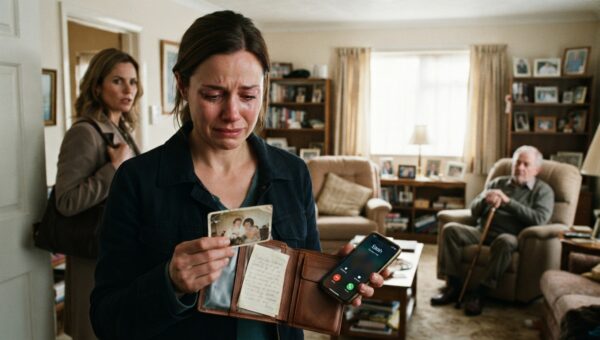
The cold on the porch that October evening always smelled of damp cedar and coal smoke from the valley mills. I remember standing there by the screen door, my fingers stiff around the handle, watching the taillights of Ephram’s station wagon cut red arcs through the autumn fog. That was the night Cordelia died upstairs in the quiet back bedroom.
Her breathing had grown shallow around midnight, just a thin, papery rattle that still catches in my ribs whenever the wind hits the eaves a certain way. By morning she was gone, and by noon the small gold Omega watch she kept in the little blue velvet tray on her nightstand had vanished into thin air. Ephram had helped me search the whole house, turning over sofa cushions and looking behind the bureau drawers with a kind of nervous diligence that made me feel bad for even suspecting an outsider. “Somebody must have slipped in through the unlocked back door while we were watching her, Dad,” he told me then, his voice shaking with the right amount of grief. I believed him because he was my only boy, and fathers are built to believe their children until the evidence forces them to do otherwise.
Four years passed behind the grease and quiet of my old workshop down on Fourth Street.
The town had changed around me, the old brick storefronts turning into antique shops and espresso bars that smelled of burnt beans, but I stayed put among the lathe shavings and the smell of boiled linseed oil. Ephram visited less and less, usually dropping by on Sunday afternoons with his wife, Brenda, their shoes clicking too loud on my worn linoleum. They would sit on the edge of the kitchen chairs like guests who had missed their bus, asking after my blood pressure and the state of my hips with a thin, practiced sort of concern. “You shouldn’t be climbing those basement stairs alone, Arthur,” Brenda would say, her fingers tapping a nervous rhythm against her leather handbag. I used to think she was just high-strung, a woman who needed everything neat and square, so I thanked her and told her I was getting along fine. I didn’t know back then that she had already spent six months visiting the county courthouse three towns over, sitting in the damp basement record rooms while I was busy turning walnut table legs in the dust.
The first real crack in the quiet appeared on a rainy Tuesday in late April when the property tax assessment arrived in the mail. My eyes aren’t what they used to be, so I sat right there at the kitchen table with my magnifying glass, squinting at the small print under the parcel owner line. It didn’t have my name. It had the name of a company called Oak Ridge Holdings LLC, with a post office box address two counties away. I sat there for a long time watching the water drip off the eaves outside the kitchen window, listening to the old clock in the hall tick off the seconds. I didn’t panic. I just put on my wool coat, walked out to my old truck, and drove straight down to the county seat to see the man who had handled my deeds since the days when the mill still ran three shifts.
Tom Henderson had gray hair that stuck out in all directions and a desk that looked like a paper mill had exploded over it. He didn’t even look up when I pushed the door open, just kept scratching away with a yellow pencil until I laid the tax bill down on the blotter between us. “Tom,” I said, and my voice sounded raspy even to me, “who owns the homeplace now?” He looked at the paper, then looked at me over the top of his bifocals, and the way his jaw went slack told me everything I needed to know before he even opened a drawer. “Arthur,” he whispered, and he reached out to touch the corner of the bill like it might bite him, “did you sign off on a quitclaim back in November?” We spent the next three hours pulling old folders from the steel cabinets, tracing signatures that looked sort of like mine if you didn’t look too close, notarized by a clerk down in Harrisburg who had never laid eyes on my workshop or my front porch. Ephram hadn’t just stolen a watch off a dead woman’s nightstand; he and Brenda had spent four years turning my whole life into paper assets they could carve up and sell off whenever the mood struck them.
By Friday afternoon, Tom had the preliminary injunctions drawn up and signed by a judge who used to buy maple bowls from me back in the seventies. “You serve these at the right moment, Arthur,” Tom had told me, sliding the heavy manila folder across the desk into my hands. “Don’t rush it. Let them show their hand completely.” I tucked the folder inside the inner pocket of my heavy winter coat, where it rested against my ribs like a block of cold oak.
That brings me to the restaurant on Saturday night, a place with white tablecloths and prices that made my old-timer’s heart stutter. Brenda had picked it, insisting we celebrate my seventy-third birthday like a proper family. The room was loud with the sound of silver hitting porcelain and people laughing over heavy red wine. I sat there in my clean flannel shirt, feeling the stiff weight of the legal folder against my left side every time I took a breath. I had ordered the trout because it was the cheapest thing on the printed card, twelve dollars less than the chicken and half the price of the prime rib Ephram and Brenda ordered without even looking at the right-hand column.
The plates came and went in a blur of gray steam and expensive butter. I watched Brenda cut her steak with short, angry little jerks of her wrist, her rings catching the overhead chandelier light. That was when I saw it. It wasn’t the candlelight or the silver that caught my eye; it was the way the gold mesh band sat just a little too loose against her pale wrist, slipping down toward her thumb every time she reached for her water glass. It was the Omega. The exact watch with the little scratch on the inside clasp where Cordelia had dropped it on the kitchen tiles back in nineteen-ninety-two. My chest went tight for a second, but it wasn’t the old grief hitting me; it was a cold, clear snap, like dry pine breaking under a boot heel. They hadn’t just taken the house; they were wearing the dead woman’s jewelry out to dinner while they waited for me to die in a rented room somewhere.
The waiter dropped the leather folder with the bill inside right between our coffee cups, the white paper sticking out just enough for everyone to see the totals. Brenda didn’t even pick it up. She just pushed it across the linen tablecloth toward me with two fingers, her diamond ring clicking against the ceramic plate. “We’re not paying for his share,” she said, her voice loud enough for the table next to us to turn and look. I didn’t say anything for a second. I just looked at the total written in black ink at the bottom of the slip: six hundred and eighty-seven dollars for two steaks, a bottle of imported wine, and my twelve-dollar trout. I looked across the table at Ephram, waiting for him to clear his throat, to say something about his dad, to show some small piece of the boy I used to take fishing down by the creek.
He just stared down at his wine glass, his face turning red around the collar, and gave a short, cowardly nod. That little nod cut deeper than any harsh word Brenda could have managed. They thought I was an old man on his last legs, someone who didn’t notice the bills or the missing deeds, someone who would just sit there and take the bill because he had nowhere else to go.
“You’ve had enough time to figure this out, Arthur,” Brenda said, leaning forward across the table, her eyes hard and bright. “We’ve carried you long enough.” I didn’t argue. I didn’t raise my voice or try to explain about the trout or the sixty-dollar wine they had polished off before the salads even landed. Instead, I reached inside my coat and let my fingers find the smooth leather edge of the folder Tom Henderson had given me. I smiled, slow and easy, the way I used to smile when a customer tried to tell me a custom table wasn’t worth the wood I put into it. “You’re right, Brenda,” I said, and the quiet in my voice made her hand stop halfway to her water glass. “Let’s settle up right now.”
I pulled the manila folder out and laid it squarely on top of the restaurant bill, right over their signed credit card slip. The cardboard was thick and stiff, stamped with the red seal of the county court and three separate pink filing notices from the prosecutor’s office. Brenda stopped chewing. Her mouth stayed half-open, her fork hovering an inch above her plate. Ephram finally looked up from his wine, his eyes darting from my face down to the bold black lettering at the top of the top page. Quitclaim Fraud Indictment. Notice of Asset Freeze. State v. Oak Ridge Holdings LLC. “What is this?” Ephram muttered, his voice cracking on the last word like a boy caught sneaking cider out of the root cellar.
I opened the folder one inch, just enough for them to see the signatures Tom Henderson had spent two days proving were forged by someone who didn’t know how to cross a capital T the way I had done since Eisenhower was in office. “That’s the bill for the house,” I told them, and the whole table seemed to go dead silent, even the waiters stopping near the service station with their trays balanced on their shoulders. “You missed a few lines on page four where you signed my name, Ephram. The state’s attorney says it carries a five-year minimum. But seeing as how it’s family, I figured we could talk about it before the sheriff serves the papers at your front door tomorrow morning.” Brenda’s face went from ruddy to the color of skim milk, her hands dropping flat against the tablecloth as if she were trying to push herself away from a fire. “You’re lying,” she whispered, but there wasn’t any fight left in her voice, just a thin, scared rattle that sounded too much like the way Cordelia used to breathe when the winter damp got into her chest.
I reached across the table, my hand steady as an old oak post, and my fingers wrapped around her wrist just above the gold mesh band of the Omega watch. She tried to pull back, but I held her there, feeling the light tick of the movement against my thumb. “Take it off, Brenda,” I said softly. She didn’t make a sound. She unhooked the tiny clasp with trembling fingers, her fingernails clicking against the metal, and dropped the watch into my open palm like an offering to a ghost. I dropped it into my shirt pocket, right where it settled against my ribs with a heavy, familiar weight. I stood up then, leaving my twelve-dollar trout untouched on the plate and the six-hundred-dollar bill sitting right beside the court injunctions. I didn’t look back at them as I walked toward the glass double doors, the heavy leather folder still tucked safely inside my jacket. Outside, the night air was cold and sharp with the smell of wet asphalt and distant woodsmoke, and as I stepped out under the streetlights, I reached into my pocket, found the crown of the watch, and gave it one quiet, steady turn.