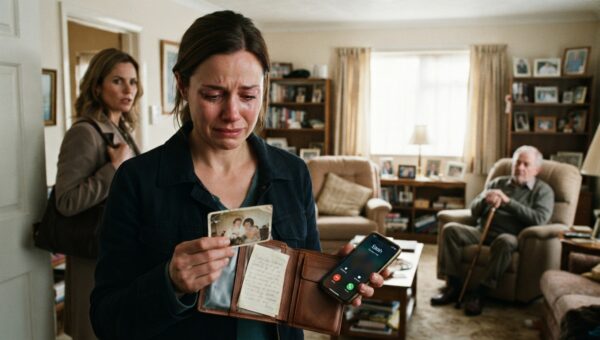
The last normal thing Clara said before our whole life cracked open was that she thought the water heater was starting to make that whistling noise again.
It was a damp Tuesday evening in November. The wind off the Hudson was rattling the loose pane in our pantry window, a familiar, nagging sound that usually meant I needed to get up, grab a tube of glazing compound from the garage, and spend twenty minutes scraping away the old dry putty.
But I didn’t get up. I stayed right there at the kitchen table with my coffee cup cooling between my hands, watching Clara across the laminate surface. She wasn’t looking at the water heater. She was staring down at the screen of her old iPad, her thumb sliding slowly across the glass with a motion that looked almost heavy, like she was trying to push a wet stone across gravel.
Fourteen months. That was how long we had been running on empty.
Every few weeks, like clockwork, the text messages would arrive on my phone. My daughter Chloe was twenty-six then, living down in the city, trying to find her footing after a publishing startup she worked for went under without paying its final two payrolls. She was proud, or at least she used to be. At first, asking us for help seemed to physically hurt her. She would call with that tight, strained hitch in her voice, explaining that the landlord was threatening eviction or that the transmission on her old Honda had given out right on the West Side Highway.
I never hesitated. I couldn’t. She was our only girl, the one who used to sit on the floor of my woodworking shop sorting brass screws by size while I sanded table legs.
When she asked for five thousand dollars for back rent, I transferred it before I even finished my morning coffee. When she needed three thousand for car repairs two months later, Clara and I pulled from our modest home improvement savings. Then came the medical bills from an emergency room visit for a bad case of bronchitis. Then four thousand for accelerated certification courses she swore she needed to land a corporate communications job. Every single time, the story made sense. Every single wire receipt was sent with a quiet prayer that this would be the last hurdle she had to clear before she finally stood on her own two feet.
We cut back everywhere. Clara stopped buying her Sunday flowers at the farmers market.
I put off getting my knee looked at by the orthopedic specialist in Albany, telling myself the ibuprofen was doing the job well enough. We thought we were being good parents. We thought we were building a bridge for her across a rough patch of water.
Then Clara couldn’t sleep last Thursday night.
She had been scrolling through some local community boards on her tablet at around two in the morning when a mutual acquaintance’s post caught her eye. There was a tagged photo from a boutique hotel pool in Bali, shot six months prior, featuring a group of young professionals smiling against a backdrop of infinity water and lush jungle. Clara tapped the tag out of idle curiosity, wondering if Chloe had any friends from college in it. The tag led to an alias profile. A private account with a playful handle that didn’t use Chloe’s real first name, but the face looking out from behind oversized sunglasses in half a dozen high-resolution carousels was unmistakably our daughter.
Clara didn’t wake me up right away. She spent the next three hours sitting in the dark at the kitchen island, pulling thread after thread until the whole sweater unraveled.
“Look at this, Arthur,” Clara whispered when she finally shook my shoulder at six in the morning. Her voice wasn’t angry. It was hollow, like someone who had just walked into an empty house and realized everyone was gone.
I sat at the table with her old tablet. I scrolled through months of digital paper. There were no cramped apartment walls. There were no grease-stained mechanic invoices or urgent medical paperwork. Instead, there was a relentless, glittering parade of excess. Chloe lounging on velvet banquettes at exclusive Meatpacking District clubs with sparklers stuck in champagne bottles. Chloe holding up a limited-edition leather handbag on a chartered yacht off the coast of Miami. Chloe stepping out of a matte-black luxury SUV in front of a five-star resort in Seminyak, wearing a silk dress that cost more than my first used pickup truck.
The dates on those posts lined up with terrifying precision against our bank statements. Exactly three days after I wired the $3,000 for her car transmission, she had posted a video of herself popping corks in a VIP booth. Exactly twenty-four hours after Clara sent her grocery money for the month she claimed she had the flu, there she was, smiling over a tray of raw oysters at a rooftop lounge overlooking Central Park.
Thirty-eight thousand dollars. Every cent we had scraped together, redirected straight into a fantasy world of VIP tables and designer labels.
We didn’t call her. We didn’t leave an angry voicemail. We simply sent a short text telling her to come home to the house in Kingston immediately, that it was an emergency, and that we needed to see her face before the sun went down.
She arrived at four in the afternoon.
I remember the sound of her Honda pulling into the gravel driveway, the familiar rattle of the loose heat shield underneath that we had paid to fix twice. When the front door opened, Chloe walked into the kitchen carrying her canvas tote bag, her hair pulled back in a hurried ponytail. She looked tired, genuinely exhausted, with dark circles under her eyes that no amount of expensive foundation could entirely hide. She took off her boots by the door just like she had when she was ten years old.
Then she saw the two of us sitting at the kitchen table. She saw the tablet resting screen-up between our coffee mugs, displaying a high-definition photo of her smiling aboard a catamaran in the tropics while wearing a white linen jumpsuit.
Chloe stopped dead in her tracks. Her hand went to her throat, her fingers curling into the fabric of her sweater.
Nobody said anything for a second, and honestly that felt worse than shouting. The old refrigerator in the corner gave its usual metallic click, and the hum of the compressor filled the quiet room.
“You want to tell us which month of your rent this was?” Clara asked. Her voice was remarkably steady, which scared me more than if she had started screaming.
Chloe didn’t run. She didn’t drop her bag and storm out. Instead, she let out a long, shuddering breath, and the defensive posture she had instinctively braced herself into simply collapsed. Her knees seemed to lose their stiffness, and she pulled out the wooden chair opposite us, sitting down with a heaviness that didn’t belong to a twenty-six-year-old. She looked at the screen, then at her mother, and finally at me.
“I knew you’d find it eventually,” Chloe whispered. Her voice was barely a rasp, stripped of all the bright, confident cadence she used when she called us for money. “I honestly thought about deleting it a hundred times. But it wouldn’t have mattered.”
“Thirty-eight thousand dollars, Chloe,” I said, and my own voice sounded like gravel grinding together. “We ate canned beans for three months so you could fly to Bali? Is that what you think your mother and I are here for? A bank with no closing time?”
She looked down at her lap, her fingers tearing at the frayed edge of her canvas bag. A single tear spilled over her lower lid, tracking straight down her cheek without a sound.
“You don’t understand the pressure,” she said.
I let out a harsh, bitter laugh that had no humor in it at all. “Pressure? You think we don’t know pressure? Your mother has been doing alterations out of the spare room until midnight just to keep our property taxes paid, and you talk to me about pressure because your VIP table didn’t come with enough champagne?”
Chloe flinched, but she didn’t look away. Her chin began to tremble. “Someone is making me this way.”
The phrase hung in the air between us like a bad smell. It sounded like something a teenager would say when caught skipping school, an evasive shift of blame that made my temper flare hot and sharp behind my ribs.
“Who?” I demanded, leaning forward until the wooden table creaked under my forearms. “Who is making you spend our retirement savings on designer clothes? Is there some landlord holding a gun to your head? Give me a name, Chloe. Right now.”
She didn’t answer immediately. Her hand reached into her coat pocket with a slow, mechanical hesitation, her fingers wrapping around her phone as if seeking some kind of anchor. The screen lit up with a dull blue glow against her palm, displaying an unread notification banner that she didn’t look at. She stared down at the glass surface for a long, agonizing moment. Her breathing grew shallow, the rise and fall of her chest turning rapid and jagged.
When she finally lifted her head, the color had completely drained from her cheeks, leaving her skin the gray-white of river stone. Her eyes were wide, fixed on mine with a look of pure, unadulterated terror that I had never seen on her face before in her entire life.
She looked at her phone again. Then she looked at me.
And she whispered a name that made my legs buckle.
The room seemed to tilt on its axis. The humming refrigerator suddenly sounded very far away, replaced by a loud, roaring static inside my ears. Clara gasped, her hand flying up to cover her mouth as if she had been physically struck.
“Julian,” Chloe whispered again, her voice dropping into a shaky register that barely carried across the table. “His name is Julian.”
Julian.
The name didn’t sound grand or imposing. It sounded ordinary, almost trivial, but the moment it dropped into our kitchen, every piece of the puzzle shifted into a terrifying new alignment. Julian was the man she had met nine months ago at a networking mixer in Manhattan, an older consultant who had supposedly taken her under his wing, helping her navigate the treacherous waters of corporate communications after her old firm collapsed. He was the one who had invited her to networking dinners, introduced her to high-net-worth clients, and promised her a fast track to a senior partnership.
“What does Julian have to do with this?” Clara managed to choke out, her fingers grabbing my sleeve so hard her knuckles turned white.
Chloe started to cry in earnest now, her shoulders shaking violently as the dam finally broke. “He doesn’t just mentor me, Mom. He owns me. Every single dollar you sent… none of it stayed in my account for more than ten minutes. As soon as the wire cleared, his assistant sent an invoice for ‘consulting retainers’ and ‘mandatory client hosting fees.’ If I didn’t pay within the hour, he sent the proofs.”
“What proofs?” I asked, my blood running cold even as I tried to reject the thought forming in my head.
Chloe pulled her phone out of her pocket with shaking fingers, unlocked it with a pass code, and slid the device across the table toward us. The screen was open to an encrypted messaging thread. I didn’t want to touch it, but my hand moved on its own, dragging the scroll bar upward.
There were photographs. Dozens of them. Images taken in dimly lit private rooms during those early networking dinners where Chloe had evidently had a little too much wine. Close-ups of her slumped against a leather sofa, looking disoriented and helpless, flanked by men whose faces were half-shadowed. And underneath the photos were text messages from a number saved under a simple J.
*That’s another five thousand for the night, Chloe. Your parents are good for it. Let’s see if they love you enough to keep you out of federal court for corporate espionage.*
There were fabricated non-disclosure agreements. Fake legal threats detailing millions of dollars in damages she supposedly owed for leaking proprietary client lists. Wire instructions routed through shell companies in the Caymans. The luxury trips, the VIP tables, the designer bags, they weren’t expressions of selfish greed at all. They were manufactured compliance. Julian had forced her to maintain an online facade of extravagant wealth and success to convince us that she was thriving, all while trapping her in a rapidly escalating cycle of fabricated debt and digital blackmail that he used to drain every cent we could spare.
“He said if I went to the police, or if I told you the truth, he would release the files to my former employers, to my friends, to everyone I’ve ever known,” Chloe sobbed, her face buried in her hands as she slumped forward until her forehead nearly touched the table. “He said he would make sure I never worked another day in this country. Every time I asked to stop, he just raised the target. He told me I was already an accomplice because I signed the first transfer.”
The anger I had felt a moment ago toward my daughter didn’t just vanish; it transformed into something darker, heavier, and entirely lethal. It was the cold, hollow fury of a father realizing someone had climbed into his house, put a cage around his child, and used her love for us as the lock and key.
I didn’t yell. I didn’t slam my fist on the table. I reached across the wood, pulled my daughter’s shaking hands away from her face, and held them both in my own calloused palms. Her skin felt ice-cold, shivering despite the warmth of the kitchen.
“Look at me, Chloe,” I said, my voice dropping into a register that brook no argument.
She raised her red, tear-stained eyes to mine.
“We are going to lock this phone right now,” I said, my thumb pressing the side button until the screen went black. “We are going to print every single one of these messages, every bank statement, every wire receipt, and we are not going to talk to a single lawyer in this town. We are driving straight to the federal building in Albany tonight.”
Clara was already moving, her chair scraping sharply against the linoleum as she rushed to the landline phone in the hallway to call our cousin who handled state police relations up in Saratoga. The fear that had gripped the room didn’t disappear, but it shifted shape. It stopped being a suffocating fog and turned into a target.
Three weeks later, the gray rain was coming down hard against the tall windows of the federal investigator’s office in downtown Albany.
The file sitting on the stainless steel consultation desk was four inches thick. It contained fourteen months of wire transfer ledgers, two hundred and twelve pages of encrypted extortion logs, and a signed deposition from Chloe detailing every single transaction, threat, and coerced meeting orchestrated by Julian and his associates. The cybercrime division had already frozen three domestic accounts linked to the shell companies, and an arrest warrant had been signed by a federal magistrate forty-eight hours prior.
Julian wasn’t a high-powered consultant. He was the front man for a coordinated digital extortion ring targeting young professionals entering the Manhattan media market, using manufactured debt traps and compromised media to bleed families dry. The thirty-eight thousand dollars we had sent wasn’t gone into the ether; it was sitting in a seized escrow account, tagged as primary evidence in a federal indictment.
We didn’t get all of it back immediately, and the legal fees were going to take years to clear, but sitting there across from the investigator in his sharp grey suit, none of that felt like the main point anymore.
Chloe was living with us again. Not because she couldn’t afford rent, but because she needed four walls that didn’t have ghosts standing in the corners. Her old bedroom upstairs still had the same pale blue walls I had painted when she was twelve, and though she spent most of her evenings sitting quietly at the kitchen island with her new phone, one with a prepaid SIM card and zero social media apps installed, the hitch in her voice was slowly starting to disappear.
That evening, the rain had finally stopped, leaving the Kingston air smelling of wet cedar and cold autumn mud.
We were standing together on the front porch just as the sun broke through a narrow gap in the gray clouds over the river, casting a long, amber stripe across the asphalt driveway. Chloe stood beside me, her shoulder pressing lightly against my arm in a quiet, instinctive gesture of safety that she hadn’t offered since she was a little girl.
She pulled her new phone from her pocket to check the time. The screen lit up for a brief second against her palm, reflecting the warm amber light of the living room lamp behind us, before she pressed the power button and slipped it back out of sight.
She didn’t look at the screen again. She just reached down, slid her fingers securely into my open palm, and let out a long, slow breath that finally sounded like she was home.