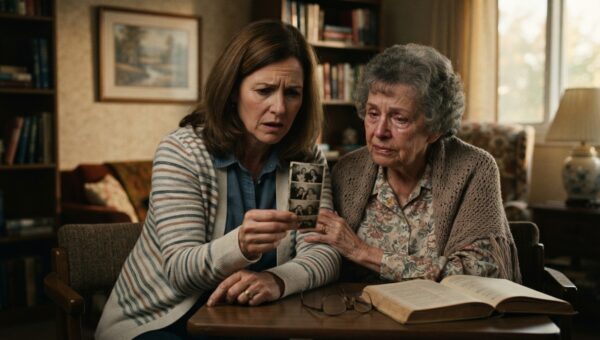
Mom always liked her tea lukewarm, sitting on the edge of that vinyl chair with her slippers tucked neatly together like she was ready to stand up if anyone made a fuss.
She had lived in the same double-wide out past the gravel pit for twenty-two years, long after the aluminum siding started to chalk off on your hands and the front screen door lost its spring so it always banged twice if you didn’t catch it with your palm.
When Dad died six years back, things changed on paper even if they looked the same on the floor.
My sister Brenda stepped right up at the kitchen table while the coffee pot was still warm, talking about power of attorney and administrative burdens with that brisk, county-clerk efficiency she picked up working for the title company in town.
She said she would handle Mom’s twenty-one hundred dollars a month from the state and the survivor benefit so Mom wouldn’t have to worry about a single form, and since Brenda lived only forty minutes away down the interstate, it made sense to let her be the point person.
I lived three states north, running a small floral shop with my husband and chasing two teenagers through high school soccer leagues, so I trusted her.
I sent Mom two hundred dollars every month by personal check just to make sure she had fresh fruit from the roadside stand or could call the repairman if the window unit air conditioner started rattling again.
Mom never mentioned the checks, but she rarely mentioned anything practical unless you asked her three times, so I didn’t think much of it until last December when the snow was piled four inches high against my front porch and I packed my suitcase to drive south for the holidays.
The drive took fourteen hours because of an ice storm outside Knoxville, and by the time I pulled my sedan onto the gravel ruts of Mom’s drive, my shoulders were locked tight from gripping the steering wheel.
Brenda wasn’t there when I let myself in with the spare brass key under the plastic toadstool.
The air inside the mobile home smelled faintly of old newspapers and radiator dust, that peculiar, flat smell of a house where the windows haven’t been pushed open in three months.
I walked straight back to the tiny galley kitchen to put the kettle on, and that was when I noticed the refrigerator door didn’t quite seal right on the magnetic strip.
I pulled it open because I wanted to find some milk for my tea, but the carton on the top shelf had puffed out at the corners like a small green pillow, expired four weeks prior by the date stamped in purple ink near the spout.
Beside it sat three dented cans of creamed corn and a half-empty jar of store-brand mayonnaise that had separated into a yellow puddle at the bottom.
There was no butter, no bread, no fresh meat, nothing in the crisper drawers except a shriveled brown carrot that snapped like a dry twig when I picked it up to look at it.
Mom came shuffling down the narrow hallway from her bedroom wrapped in that faded blue chenille bathrobe she had worn since my wedding back in nineteen-ninety-eight.
She looked smaller than she had the previous summer, her shoulders curved forward like she was carrying a sack of gravel under her nightgown, and when she kissed my cheek, her skin felt thin and dry like onion skin.
I hugged her back and felt the hard line of her shoulder blades right through the fabric, sharp enough to bruise if you squeezed too hard.
She had lost weight, eighteen pounds if she lost an ounce, and her ankles looked like white birch twigs rattling inside her house shoes.
“Brenda brings by a casserole on Sundays,” Mom said, her voice dry and papery as she lowered herself slowly onto the brown plaid sofa. “Or sometimes her husband drops off a sack of groceries from the discount club.”
I looked at the counter where a single box of saltines sat next to an empty coffee mug.
“Mom, where is your pension money going?” I asked, keeping my voice level because I didn’t want to frighten her right off the bat.
“Brenda pays the lot rent,” she said, squinting toward the little television set in the corner as if she were trying to read words that weren’t there. “And she handles the taxes on the trailer.
Everything’s taken care of, honey. Don’t you go fussing over bills on Christmas.”
I stayed quiet, but my stomach felt like it had dropped down into my boots.
The lot rent on that patch of gravel was four hundred dollars a month, and even with the propane bill and the Medicare supplement, there should have been well over a thousand dollars left over every single thirty days for fresh groceries, fruit, medicine, and maybe a new pair of slippers that didn’t have holes worn through the felt heels.
I didn’t argue with her then because she looked tired, but I didn’t unpack my suitcase either.
The next morning, while Mom was still sitting at the kitchen table with her lukewarm tea, I got into my car and drove six miles down the two-lane highway to the First National branch in town where Mom’s account had been opened back when Dad was still driving his delivery truck.
The bell above the heavy glass door chimed as I walked in, and the lobby smelled of floor wax and cold winter air brought in by the few people standing at the teller windows.
I went straight to the counter where a woman named Sandra was wiping down the laminate surface with a blue sponge.
“I need to look at my mother’s account statements,” I said, laying my ID and the power of attorney papers Brenda had sent me years ago flat on the counter. “I’m her daughter. Eleanor Vance.”
Sandra took the papers, looked down at them, and then looked up at my face with a strange, sideways sort of squint that made the hair on the back of my neck stand straight up.
She didn’t reach for the keyboard right away.
“You’re Brenda’s sister,” Sandra said, her voice dropping down an octave like she was sharing a bad rumor behind the Sunday school partition.
“Yes,” I said. “I am. My mother is Eleanor Senior. I need to see why her pantry is empty.”
Sandra sighed, a long, thin whistle of air through her teeth, and tapped three keys on her terminal before turning the flat-panel monitor slightly toward her chest so I couldn’t see the full screen at first glance.
Her face changed, that professional teller smile dropping off completely and leaving behind an expression that looked almost embarrassed for me.
“Your mother’s pension isn’t sitting in her checking account, Mrs. Vance,” she said, her fingers resting lightly on the plastic edge of the terminal. “It’s been set up on an automated monthly wire transfer to a linked account for the last six years.”
The lobby clock on the back wall clicked audibly, a heavy, mechanical sound that seemed to echo off the acoustic ceiling tiles.
“A linked account?” I asked. “Whose account?”
Sandra didn’t say the name out loud right away; she just reached into the printer tray, pulled out a three-page transaction ledger, and slid it across the grain of the wood toward my hands.
“Brenda’s,” she said quietly. “Your sister had us route eighteen hundred dollars of the twenty-one hundred every single month straight to her personal mortgage escrow down in Lake Worth, Florida.
Your mother has been left with three hundred dollars a month to cover her basic living expenses here.”
I stood there by the counter with my coat buttoned wrong, staring down at columns of numbers that didn’t seem to belong to the real world.
Eighteen hundred dollars a month, multiplied by twelve months, multiplied by six long years while Mom sat out in that rattling trailer eating canned corn and wearing the same three faded housedresses until the seams frayed out.
One hundred fifty-one thousand two hundred dollars total.
I could see the name of the bank down in Palm Beach County printed clear as day at the bottom of the wire receipts, attached to a four-bedroom colonial with a paved circular drive and a two-car garage sitting pretty in one of those gated subdivisions where the lawns look like green felt.
“She told Mom she was paying the lot rent,” I whispered, my voice sounding thin even to my own ears.
“She was paying the lot rent,” Sandra said, her eyes fixed on my hands where they were starting to shake against the counter edge. “And she was keeping the rest to pay down the principal on a three-hundred-and-forty-thousand-dollar house three counties away.
The bank manager tried to question the initial linkage back when your father passed, but Brenda brought in a signed addendum claiming she was the primary caregiver and legal custodian of the funds.”
I didn’t thank her.
I just picked up the folded ledger, tucked it into the inside pocket of my wool coat, and walked out of that bank into the bright, cold Florida sunshine that didn’t feel warm at all.
I sat in the driver’s seat of my sedan with the engine off for nearly twenty minutes, staring through the frost-speckled windshield at a pickup truck idling by the drive-through lane.
My hands were shaking so hard I couldn’t get the key into the ignition on the first try, and when I finally pulled my phone out of my purse, my thumb slipped twice on the screen before I found Brenda’s contact card.
I pressed call, and it rang three times before she answered with that bright, efficient office tone she used when she was rescheduling client appointments.
“Ellie? I thought you were staying out at Mom’s until New Year’s. Is something wrong with the furnace again?”
Her voice sounded clean, well-fed, and entirely unbothered by the fact that the temperature outside was dropping toward freezing.
“I’m sitting in the parking lot of the First National branch,” I said, and the words came out flat and hard like stones dropped into an empty bucket. “I just saw the ledger, Brenda. Six years. One hundred fifty-one thousand dollars. You took her blind pension to pay for your roof in Lake Worth while she was eating expired milk.”
There was a three-second silence on the other end of the line, just the faint hum of office machinery and someone talking in the background of her kitchen down south.
When she spoke again, the bright professional tone was gone, replaced by that cold, defensive snap I remembered from when we were kids sharing a narrow bedroom behind the grain elevator.
“Mom doesn’t need that money,” Brenda said, her voice rising just enough to cut through the static. “She barely goes anywhere. What is she going to do with twenty-one hundred dollars a month sitting in a passbook account doing nothing? She lives in a trailer that’s falling apart anyway. That house down here is an asset for the whole family, Ellie. It’s an investment.”
I gripped the steering wheel until my knuckles turned white under the skin.
“She barely EATS, Brenda,” I said, my teeth clenched so tight my jaw ached. “There is nothing in her fridge except four-week-old milk and a can of corn. She’s lost eighteen pounds. She looks like a skeleton.”
“Oh, stop being so dramatic,” Brenda snapped, her voice sharpening like a knife on a stone. “You’ve always been jealous because I was the one who stayed close enough to take care of the real paperwork while you were up north playing florist. If I hadn’t managed things, the state would have taken the lot out from under her years ago. You don’t know a thing about how much it costs to keep an elderly person secure nowadays.”
“I know what eighteen hundred dollars a month looks like,” I said. “And I know what a stolen pension looks like on a bank printout.”
“Don’t you dare threaten me,” she said, her voice dropping into that low, venomous register she used when she didn’t get her way at family gatherings. “I’m her legal representative of record. If you make a scene about this, I’ll cut off her phone service and make sure you never see her again. You hear me? I control the access.”
The line went dead with a sharp click.
I didn’t call her back.
I put the phone down on the passenger seat, turned the key until the engine caught with a low rumble, and drove straight back out the highway toward the county courthouse behind the brick water tower.
The office of Adult Protective Services was located on the second floor of the annex building, past a set of frosted glass doors that smelled faintly of lemon disinfectant and stale carpet cleaner.
A caseworker named Miller with salt-and-pepper hair and a quiet, deliberate way of moving her pens across a legal pad listened to me for twenty minutes without interrupting once.
I laid the bank ledger out on her desk, page by page, along with my own personal check stubs showing the two hundred dollars I had been sending every month to fill a pantry that my sister was systematically starving.
Miller didn’t look angry; she looked tired, the specific kind of tired that comes from seeing the same human cruelty play out in different kitchens every single Tuesday of the year.
She picked up the wire transfer printout from Lake Worth, adjusted her wire-rimmed glasses, and traced a finger down the column of figures where Brenda’s name appeared beside the monthly mortgage payments.
“This is financial exploitation under state statute four-hundred-and-something,” Miller said softly, not looking up from the paper. “And given her age and the nutritional deprivation you documented in the home, we’re looking at a severe neglect finding as well.”
“Can you stop the wire?” I asked. “Today?”
“We can freeze the account within the hour through an emergency judicial order,” Miller said, reaching for her desk phone. “And we can assign temporary protective oversight to an independent county guardian or to an immediate family member who does not reside in the state of Florida.”
By four o’clock that afternoon, two county officers and a state investigator were standing with me in Mom’s tiny living room while the sun dipped below the gravel pit and turned the sky the color of a bruised plum.
Mom was sitting on the sofa with a warm blanket over her knees that I had brought in from my car, watching us with her small, watery eyes wide and confused.
“Brenda’s going to be mad,” she whispered, her fingers twisting the fringe of the wool blanket. “She said nobody else knows how to sign the checks.”
“Nobody is signing those checks anymore, Mom,” I said, kneeling down on the worn carpet so I was looking right up into her face. “You’re going to have every dollar you earned coming right back to you starting next month.”
The investigator handed Mom a cup of hot broth I had heated up on the small electric stove using the groceries I bought at the Piggly Wiggly down the road five minutes after leaving the courthouse.
She took a small, careful sip, her lower lip trembling slightly against the rim of the ceramic mug before she swallowed and looked around the room like she was seeing the water-stained ceiling tiles for the very first time.
When the paperwork was finally signed and the county cruiser’s red taillights had faded down the gravel drive, the house grew very quiet except for the low hum of the refrigerator holding the fresh milk and vegetables I had packed into the shelves.
The next morning, the sun came up bright and sharp over the frozen weeds outside the front window, turning the frost on the aluminum skirting into millions of tiny, glittering points of light.
I walked out onto the small aluminum porch steps with two mugs of instant coffee, the metal cold and firm beneath my boots, and sat down right beside Mom where she was wrapped in her blue bathrobe.
She didn’t say anything for a long time, just watching a blue jay land on the empty bird feeder near the rusted oil drum by the property line.
Then she reached out her hand, dry and warm and steady, and laid her fingers over mine as we both watched the steam rise up into the cold winter air.