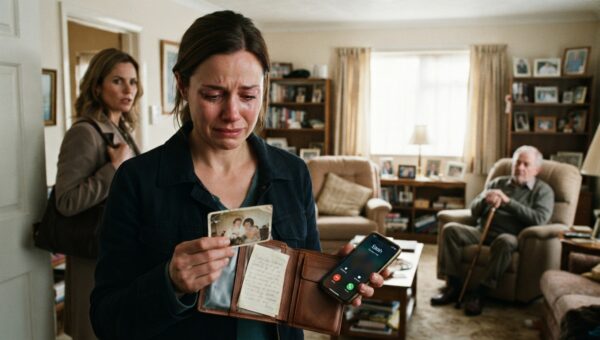
The cardboard box sat on the kitchen counter for three days before I finally tore the packing tape. It was a $199 23andMe kit wrapped in a silver bow that my husband, Roger, had handed me across the breakfast table on my fiftieth birthday with a cheerful grin. I had laughed, thinking it was just a silly way to find out if we had any distant Viking ancestors hiding in the branches, or perhaps a stray cousin from the old country.
“Go on,” Roger had said, pouring himself another cup of dark roast. “Spit in the tube and let science tell us who you really are.”
Six weeks later, an email landed in my inbox with a subject line that made my pulse hitch against my throat. The family tree update did not point toward Scandinavia or the rolling hills of Ireland. It pointed straight to a living match sitting eighty percent closer than any cousin should. A half-sibling. A woman named Patrice, born exactly three months after me in the same county hospital.
I sat at the oak kitchen table for a long time, watching the blue light of my laptop screen flicker against the wood grain. My fifty years of shared family history, every Sunday potluck, every Christmas card, every bedtime story my father told me about our proud, quiet lineage felt like a cardboard stage set ready to tip over in the wind.
I didn’t think twice before dialing my father’s number. He answered on the third ring, his voice raspy with the afternoon fatigue of a seventy-nine-year-old man who still fancied himself the patriarch of a spotless domain.
“Dad, who is Patrice?” I asked, my voice shaking harder than I wanted it to.
There was a heavy, suffocating silence on the line. Then he asked, “Where did you hear that name?”
“A DNA test,” I said.
He hung up without another word.
Ten minutes later, my mother’s cell phone number flashed across my screen, shrill and demanding. I swiped to answer, and she didn’t even give me room to draw a breath.
“How dare you dig into things that don’t concern you,” she screamed, her voice cracking with a raw, panicked fury I had never heard in all my years. “You have no idea what you are unravelling, and you need to drop this right now.”
She didn’t deny it. She just demanded obedience, the way she had my whole life whenever I crossed an invisible boundary.
But the hook was already set, and the line was pulling me under. I grabbed my car keys from the ceramic bowl by the front door, backed my sedan out of the driveway, and drove twenty-two miles through the gray suburban asphalt toward the address the genetic matching portal had provided.
The neighborhood was older than mine, with sprawling oak trees and small brick ramblers that looked like they had been built in the fifties and left to weather the decades in peace. Number 114 had a faded blue front door and a neat patch of marigolds lining the walkway. My hands were damp against the steering wheel as I killed the engine.
I walked up the concrete steps, each footfall feeling heavy, like I was wading through deep river silt. I didn’t knock. I just reached out and pressed my knuckle against the brass doorbell button before my courage could evaporate.
Inside, footsteps padded softly across hardwood floors. The latch turned with a sharp click.
When the door swung open, my brain simply stopped working for a few seconds. The woman standing on the threshold was looking at me with the exact same expression of deer-in-the-headlights terror that I knew was stamped across my own face. She had my nose. She had the same slight tilt to her hazel eyes. And right above her left eyebrow, half-hidden beneath a sweep of graying hair, sat the exact same faint, crescent-shaped birthmark that my mother had spent my entire childhood telling me was a rare gift from my maternal grandfather’s side of the family.
Neither of us spoke for a long, ringing moment. The silence between us felt louder than any words could ever be.
“You’re the match,” she whispered finally, her hand reaching up to touch her own temple instinctively.
“I’m your half-sister,” I managed to get out, my throat so tight it felt like swallowing glass.
Patrice didn’t cry, and neither did I. She just stepped back, pulled the door wide open, and motioned for me to come inside out of the cold afternoon air. Her living room smelled faintly of lemon polish and brewed chamomile tea, an ordinary domestic scent that contrasted wildly with the earthquake happening beneath our feet.
We sat across from each other at a small laminate kitchen table. Without a word, Patrice slid an old, faded leather photo album across the grain toward me. The pages were yellowed at the edges, the corners dog-eared from decades of being thumbed through by someone who was searching for ghosts.
She pointed a trembling finger at a small, black-and-white polaroid tucked into the middle of the spread. It was a picture taken at a lakeside cabin, dated the summer before we were both born. My father stood there in his late twenties, grinning broadly, wearing a plaid shirt with the sleeves rolled up. And standing right beside him, leaning into his shoulder with an easy, familiar warmth, was a woman with the same hazel eyes and the same crescent birthmark.
“That’s my mother,” Patrice said softly, watching my face for any sign of recognition. “Her name was Claire.”
The room tilted. My breath caught in my chest, and I had to grip the edge of the laminate table to keep from sliding out of the chair.
Claire. Aunt Claire.
My mother’s younger sister. The aunt I had never met, the ghost who was never spoken of at holiday dinners, the sister whose name had been quietly scrubbed from family albums and memory alike. For fifty years, I had been told that Aunt Claire had moved out west to Oregon in her twenties and tragically died in a car accident before I was even old enough to remember her. Her picture had never hung on our walls. Her grave had never been visited. She had simply been erased, excised like a malignant tumor to protect the pristine reputation of a respectable family living in a respectable town.
Fifty years ago, during a turbulent summer when both sisters were orbiting the same social circles, my father had maintained a parallel life with Claire. When both women turned up pregnant within weeks of each other, the family had faced a catastrophic social reckoning. Instead of facing the truth, they had engineered a masterpiece of deceit. Claire was bundled away in quiet exile, her child handed over to distant relatives to be raised in secret, while my mother swallowed her pride, closed ranks, and agreed to raise me alongside the lie. They had built their entire lives on a foundation of sand, wagering that the truth would stay buried beneath decades of church pews, polite smiles, and absolute silence.
I sat there at Patrice’s table, staring down at the photograph of the aunt I never knew and the father who had lied to us both every single day of our lives.
“She didn’t die in Oregon,” I whispered, the realization finally landing with a dull, heavy thud.
“No,” Patrice said, her voice steady now, carrying a quiet dignity that cut right through my shock. “She lived twenty-two miles away her whole life. She worked as a librarian. She watched you grow up from a distance in grocery store aisles and at the local parade, knowing she could never say a word.”
A cold, hard anger began to replace the numbness in my chest. It wasn’t the explosive rage of a movie villain; it was the quiet, resolute fury of a woman who realizes she has been a pawn in someone else’s game for half a century.
I stood up from the table, grabbed my purse, and looked at Patrice. The resemblance between us in the afternoon light was staggering, undeniable proof of a shared bloodline that no amount of forced silence could ever erase.
“Get your coat,” I told her.
She looked up, startled. “Where are we going?”
“To see our father,” I said.
We drove back to my parents’ house in separate cars, a two-car convoy of reckoning slicing through the suburban dusk. When we pulled into their driveway, the porch light was already on, casting a yellow glow over the manicured lawn. My mother’s sedan was parked in the garage, and through the front window, I could see the faint silhouette of my father moving across the living room.
I didn’t knock this time. I walked right up to the front door, turned the brass knob, and pushed it open. The familiar scent of lemon wax and old paper hit me instantly, the very smell of the cage they had built around me.
My parents were standing in the hallway, frozen like actors caught mid-scene when the curtains are pulled back by mistake. My mother opened her mouth to speak, her face flushing a dark, mottled crimson, but I didn’t give her the floor.
I reached into my bag, pulled out the faded polaroid from Patrice’s album, and tossed it onto the polished foyer table where it slid across the wood and came to a stop against the mail tray.
“Fifty years is a long time to keep a lie running,” I said, my voice not shaking at all anymore.
My father looked down at the photograph, his jaw working silently as the color drained completely from his face. He didn’t try to defend himself. He didn’t reach for an excuse. He just slumped against the hallway wall, a shrunken, terrified old man whose carefully constructed empire had finally collapsed under the weight of a $199 DNA kit.
My mother stepped forward, her eyes blazing with a desperate, last-ditch defiance. “You had no right to bring this back into our home,” she hissed, pointing a trembling finger at the door. “We protected this family. We kept things together when everything was falling apart.”
“You didn’t protect anything,” I told her, my voice dropping to a quiet, steady register that felt heavier than her shouting. “You just buried two innocent people in a shallow grave of your own making, and you expected us to stay down there in the dark.”
I turned around, leaving them standing alone in their sterile hallway with their secrets and their silence.
When I walked back out through the front door, the evening air was cool and crisp against my face. Patrice was waiting by the curb, leaning against the fender of her car, watching me with a look of quiet, hard-won understanding.
We didn’t go back inside. We drove down to the old diner on Fourth Street, the one with the faded neon sign buzzing against the early evening sky. We slid into a red vinyl booth near the back, right where the light from the streetlamp caught the silver rim of our water glasses.
The waitress came over a moment later, wiping down the laminate surface with a damp cloth and asking us what we wanted.
“Just two coffees,” I said, looking across the table at the woman who shared my nose, my birthmark, and my stolen history.
Patrice smiled, a small, genuine curve of her lips that looked like looking into a mirror across fifty years of lost time. We sat there together in the warm hum of the diner as the evening traffic rolled by outside, two sisters finally stepping out of the shadows, ready to learn who we really were.