The key stayed stuck in the lock for three seconds before the latch finally gave way with a dry click. I dropped my canvas duffel bag right there on the thin grey carpet of the hallway, the zipper clinking against the baseboard. The air inside Mom’s mobile home always smelled the same, a mixture of old cedar, dry dust, and the stale peppermint candies she kept in a cut-glass bowl on the side table.
It was six days before Christmas, and the highway down from Wichita had been packed with holiday traffic all the way past Oklahoma City, making my shoulders tight and my neck burn with a dull, persistent ache.
I walked straight down the narrow corridor toward the kitchen because I knew Brenda wouldn’t have the coffee pot running yet. Brenda was my older sister, the one who always handled things, the one who took over Mom’s bookkeeping the week after Dad died six winters ago. I figured Brenda would be out running errands or sitting at the kitchen island checking her real estate apps on her tablet. The house was quiet. Too quiet, honestly, and that felt wrong for a December afternoon when the sun was already dipping low behind the wire fence of the trailer park.
I pushed open the white metal door of the refrigerator to drop in the foil-wrapped ham I had brought in my cooler, and my hand just stopped right there on the handle.
The light inside was yellow and weak, casting a sickly glow over wire shelves that were mostly bare. There was a half-gallon carton of whole milk with an expiration date stamped fourteen days ago, two dented cans of creamed corn, and a small plastic tub of margarine that looked like it had been scraped down to the bottom plastic. That was it. No eggs, no bread, no fresh vegetables, nothing in the crisper drawers except a dry, brown onion skin.
I stood there for a long second, staring at the corn, trying to make my brain connect what I was seeing with what I knew. Mom’s pension from the county water department was $2,100 every single month, deposited direct. Dad had left her the policy too, plus the mobile home was paid off free and clear back in ninety-four. I sent another $200 of my own money every month just to help with her prescriptions and the electricity bill because Brenda always reminded me how expensive everything was getting down here in south Florida.
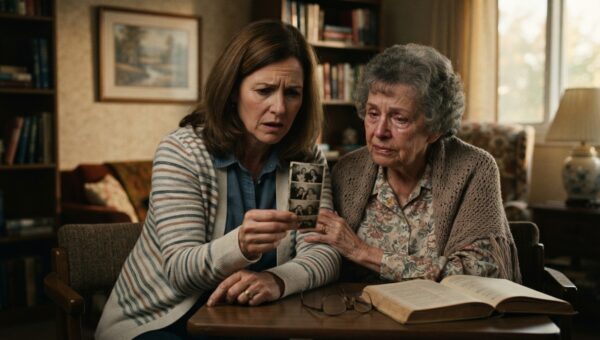
Mom came shuffling down the hall then, her fuzzy pink slippers making a soft scuffing sound against the floorboards. She looked smaller than she had back in July, her shoulders rounded under a faded green cardigan that hung off her collarbones like it belonged to someone else. She hadn’t changed out of the grey cotton housedress she wore when I called her on Tuesday. It was the same three outfits on constant rotation, washed thin at the seams. When she smiled at me, her skin looked greyish and papery, and I noticed the deep hollows under her cheekbones that weren’t there the last time I visited.
“Oh, honey,” Mom said, her voice dry and thin like old paper rustling in a drawer. “You drove all that way in the dark. I would have made some tea, but I was just saving the water.”
I reached out and pulled her into a hug, and my hands felt the ridge of her shoulder blades right through the wool of her sweater.
She felt like she weighed nothing at all, like a bird made of hollow twigs. I pulled back and looked down at her face, really looked at her, and the cold realization hit me right behind my eyes that she had dropped at least twenty pounds since summer.
“Mom, where do you keep the groceries?” I asked, trying to keep my voice even so she wouldn’t hear the edge in it. “Is there another chest freezer out on the porch?”
Mom looked down at her slippers, her thumb worrying the frayed hem of her cardigan sleeve. “Well, prices have gone up so much since the summer, you know. Brenda says everything is through the roof. She brings me a bag on Tuesdays. Just a few things. Some crackers and soup mostly.”
I walked to the counter and picked up the grocery bag sitting by the toaster. It was a single plastic sack from the discount market down on Route 1. Inside were two cans of store-brand chicken noodle soup and a sleeve of saltine crackers. That was what Brenda brought an 84-year-old woman on a fixed income that supposedly left nothing over for fresh milk or fruit.
“Brenda handles the accounts every month,” I said, mostly talking to myself while the kitchen clock ticked on the wall. “She said the pension barely covered the supplement insurance and the park lot fee.”
Mom didn’t answer. She just shuffled over to the little vinyl armchair by the television and sat down very slowly, her hands folded in her lap like she was waiting for a doctor to call her name. I didn’t unpack the ham. I didn’t take off my coat. I walked right back out to my sedan, backed out of the gravel driveway without looking in the rearview mirror, and pointed the nose of my car toward the branch office of the Southern Heritage Bank down on the highway.
The teller behind the counter was a young woman with neat blonde hair pinned back and a gold name tag that read Chloe. She looked up as I stepped to the glass, her fingers resting on a stack of deposit slips. I laid my driver’s license and Mom’s monthly statement on the counter, the one Brenda had forwarded to me in November just to keep me in the loop.
“I need to check the recent ledger entries for this account,” I said, and my voice sounded rough, like I had been swallowing sand. “I’m her daughter. I need to see where the automatic withdrawals are going.”
Chloe took the papers, her eyes scanning the account number at the top. She typed a few keys into her terminal, and I watched her face change. The polite, professional smile tightened around the edges, and her eyebrows drew together in a little frown of concentration. She looked from the screen to me, then back to the screen, scrolling down past the current month.
“Ma’am,” Chloe said quietly, leaning just a fraction closer to the glass partition. “Your mother’s pension is linked to a secondary routing number. It’s a shared administrative account.”
“Linked to what?” I asked. “Who authorized a link?”
Chloe tapped the screen with her fingernail. “It looks like it was established six years ago, right after the probate settlement for your father. The primary beneficiary on the secondary endpoint is listed under a different name. Brenda Vance.”
My sister’s married name. The name on the deed of that four-bedroom house up in Lake Worth with the manicured St. Augustine grass and the double garage.
“How much goes over there?” I asked. My mouth felt completely dry, like I had been chewing on cotton. “Every month. How much leaves this account?”
Chloe didn’t look up right away. She cleared her throat softly. “Eighteen hundred dollars is transferred automatically on the third of every month. Your mother’s account retains three hundred for local expenses. That’s been the recurring schedule for seventy-two months.”
Seventy-two months. Six years. I stood there under the fluorescent lights of the bank while the numbers formed themselves in my head without my permission. Eighteen hundred dollars multiplied by seventy-two. It came out to one hundred fifty-one thousand two hundred dollars. Siphoned out of an 84-year-old woman’s water department pension while she ate canned corn in a trailer with a broken refrigerator seal.
“Thank you,” I told Chloe. I didn’t wait for her to say anything else. I turned around and walked out through the heavy glass doors into the parking lot.
The December wind had picked up, blowing grit across the asphalt and rattling the plastic shopping carts near the curb. I got back into my sedan, pulled the door shut, and sat there with my hands gripped so hard on the steering wheel my knuckles turned yellowish-white. The engine was still ticking as it cooled down, a tiny metallic ping in the quiet of the car. My chest felt tight, like someone had wrapped a heavy steel cable around my ribs and started ratcheting it down one click at a time.
I pulled my phone out of my coat pocket, found Brenda’s contact, and hit call before I could talk myself out of it. It rang four times, long hollow tones that seemed to echo inside my own skull, before she picked up on the other end with that breezy, busy tone she always used when she wanted you to know how important her day was.
“Hey,” Brenda said, background noise humming through her speaker like she was standing in a kitchen with a dishwasher running. “I wasn’t expecting you down until tomorrow evening. Did you hit traffic?”
“I’m at the bank in town,” I said. My voice didn’t sound like mine. It sounded small and flat, coming from somewhere outside my body. “I looked at Mom’s fridge, Brenda. There’s nothing in there. The milk went sour two weeks ago, and she’s down to two cans of corn and some crackers.”
There was a short pause on the other end, just the sound of water running in her sink. Then Brenda sighed, that heavy, put-upon sigh she used whenever we questioned her household budgeting.
“Oh, for heaven’s sake,” Brenda said, her tone dropping into annoyance. “Did she start complaining about that again? I told you, she gets confused about what day it is. I buy her groceries every week.”
“I saw the grocery bag, Brenda,” I said, and my teeth were clenched so hard my jaw ached. “Two cans of soup. And I talked to Chloe at the teller window. I know about the eighteen hundred dollars a month going into your secondary account. For six years. One hundred fifty-one thousand dollars.”
The line went dead silent for three beats. I could hear the faint hum of her refrigerator through the phone, a high-end stainless steel model probably hummed by the lake in Lake Worth.
“You had no business going into her bank records behind my back,” Brenda said, her voice hardening instantly, dropping all pretense of sweetness. “I manage the administrative load. You don’t live down here. You don’t see the paperwork, you don’t deal with the county office when the forms get lost, and you certainly don’t pay the supplemental nursing riders when she falls.”
“She’s starving, Brenda,” I said, and my voice cracked right on the middle of the word. “She dropped eighteen pounds. She’s wearing the same three dresses she had three years ago because she thinks she only has three hundred dollars to live on.”
Brenda let out a short, sharp laugh that had no humor in it at all. “Mom doesn’t need that money,” she said, her voice crisp and certain. “She barely goes anywhere. What is an eighty-four-year-old woman in a mobile home going to do with two thousand dollars a month? Buy more knick-knacks? She stays inside all day anyway. That mortgage up here is three thousand five hundred a month, and with interest rates where they are, do you have any idea what I’ve sacrificed to keep things afloat for this family?”
I stared out the windshield at a delivery truck backing into a loading bay across the asphalt. The memory of Mom’s small, hollow shoulders in that faded green cardigan flashed behind my eyes, sharp as a needle.
“She barely EATS,” I said. The words came out harsh and loud inside the small space of the car.
“Don’t be dramatic,” Brenda snapped back. “I’ve handled everything legally since Dad died. You want to cause a scene over a few hundred dollars of surplus, go ahead, but the paperwork is airtight. I’ll call you back when you’ve calmed down.”
The line clicked dead with a sharp tone.
I sat there in the cold car for a long time, watching the digital clock on the dash change from 4:12 to 4:13. The anger didn’t make me scream or pound the steering wheel. Instead, it felt cold and heavy, settling into my stomach like lead shot. I didn’t call her back. I didn’t need to talk to her again ever.
I opened the car door, got back out into the wind, and walked back through the glass doors of the Southern Heritage Bank before the teller could even take off her name tag.
“Chloe,” I said, stepping up to the glass again. “I need the manager. And I need the fraud affidavit forms for an unauthorized beneficiary link on a senior citizen account.”
Chloe looked up from her computer, saw my face, and didn’t ask a single question. She just nodded, reached under the counter for a thick manila folder, and pointed toward the glass office in the back where the branch manager was just turning off his desk lamp.
It took three hours of signing papers, pulling routing numbers, and freezing secondary access before the sun went all the way down behind the highway overpass. By the time I drove back to the mobile home, the dashboard temperature gauge read thirty-eight degrees.
I didn’t go inside right away. I sat in the dark driveway for a minute with the headlights shining against the skirting of the trailer. Then I opened my trunk, pulled out two heavy paper bags I had bought at the twenty-four-hour market down on the corner, fresh whole milk, eggs, two ribeye steaks, a carton of strawberries, and a loaf of real sourdough bread, and carried them up the metal steps.
Mom was sitting in the same vinyl armchair, watching an old game show on the small television with the sound turned down low. She looked up when the door opened, her eyes blinking against the porch light.
“I brought some groceries in from the car, Mom,” I said, walking past her into the kitchen and setting the bags down on the counter. “We’re going to make some real dinner tonight. Not soup.”
Mom watched me from the doorway, her hands folded over her cardigan. “Did you talk to your sister?” she asked softly, almost like she was afraid of the answer.
I started pulling the cartons out of the bag, setting them one by one on the clean laminate counter under the bright overhead light. The refrigerator hummed softly in the corner, waiting to be filled.
“I talked to her,” I said, and I didn’t look back. “She’s not handling your accounts anymore, Mom. Starting tomorrow, every single dollar goes right back where it belongs.”
Mom stood there in the doorway for a long second, her slippers silent on the floor, before she let out a long, shaky breath that sounded like years of quiet letting go. Then she walked over to the counter, reached out with one thin, trembling hand, and picked up a carton of fresh eggs like she hadn’t seen something so real in six years.