The box came wrapped in matte silver paper with a narrow blue ribbon that looked entirely too cheerful for a piece of mail that cost one hundred and ninety-nine dollars. My husband, Arthur, put it right next to my coffee mug on the kitchen island on a Tuesday morning in October. He thought it would be a harmless bit of fun for my fiftieth birthday, something to pass the time while the autumn leaves rotted in the gutters outside.
We had spent thirty years building a quiet, predictable life in that modest ranch house, filling the weekends with grocery runs and lawn care and long, comfortable silences that felt like safety. I had no reason to doubt the shape of my own history because the story had been told the exact same way for half a century. My father was a quiet, practical man who ran a hardware store on Main Street, and my mother was a woman who kept her kitchen counters spotless and her opinions sharp. They were the kind of people who believed that if you kept your head down and minded your business, the world would leave you alone. I spit into the little plastic tube, sealed the cap until it clicked, and dropped the prepaid box into the outgoing mail slot the very next morning without a second thought.
Six weeks went by in a blur of dental appointments and quarterly reports at the clinic where I worked as a medical receptionist, and honestly I had almost forgotten I sent the thing off.
Then the notification email pinged against my phone screen while I was standing at the kitchen counter chopping celery for a soup. The subject line said my family tree update was ready, so I wiped my hands on a dish towel and tapped the screen while the refrigerator hummed a low, steady note in the background. The algorithm had built a tidy little branch for me, connecting my parents and my grandparents with neat little green lines of descent, except for one jagged red branch hanging off the side like a broken limb. It listed a half-sibling, a woman named Patrice, born three months after me in the same county hospital. The percentage match was high enough that there was no statistical room for error, no quirky glitch in the genetic database to dismiss. I stared at the name on the glass screen for a full minute while the kitchen seemed to get very quiet and very cold around me.
The date of birth listed for Patrice was June fourteenth, and my own birthday was March ninth, which meant my father had been busy keeping two separate ledgers during the exact same year of his life.
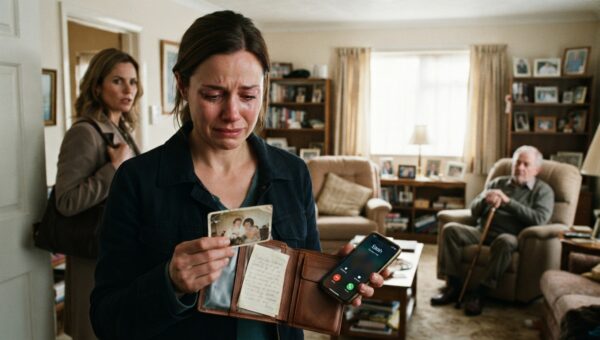
I did not wait to think it through because my fingers were already moving across the glass before my brain caught up with the numbers. I dialed my father’s cell phone number from memory, listening to the harsh, rhythmic ringing tone echoing through the empty house while Arthur was still out at the hardware store. On the fourth ring, the line clicked open, and I heard the faint rustle of newspaper pages in the background before my father cleared his throat. “Dad,” I said, and my voice sounded thinner than it should have, like paper tearing. “Dad, who is Patrice?” There was a heavy, dead silence on the line, the kind of silence that feels like someone holding their breath underwater.
I waited for him to laugh, or to ask what nonsense I was reading off the internet, or to give me some logical explanation about a distant cousin I had never met. Instead, his voice came out thin and sharp as a rusty wire. “Where did you hear that name?” he asked, and every ounce of warmth drained out of his tone. “A DNA test,” I told him, my hand tightening around the plastic phone case until my knuckles turned white. “A kit Arthur bought me for my birthday. Who is she, Dad?” The line went dead with a hard, flat click before I could even draw my next breath.
Ten minutes later, my phone buzzed again, but this time it was my mother’s number flashing across the display with the angry insistence of a fire alarm. I answered it on the second ring, expecting at least an attempt at comfort or a denial of whatever my father had just told her in a panic. My mother did not bother with hellos or pleasantries, her voice pitching up into that shrill, defensive register she always used when she was cornered. “How dare you dig into things that don’t concern you,” she screamed right into the speaker, her words clipping together with pure venom. “You just had to go poking around where you had no business, didn’t you, stirring up garbage that was buried for a reason.” I tried to speak, tried to tell her I was just looking at a birthday gift, but she cut me off without a second of hesitation. “Your father is seventy-nine years old and you are going to give him a heart attack over some computer nonsense, so you drop it right now, do you hear me?” The call disconnected with another sharp snap, leaving me standing alone in the quiet kitchen with the smell of chopped celery and a heart that felt like it was trying to pound its way out of my ribs.
I did not drop it because the anger had finally replaced the shock, settling into my chest like cold lead. I grabbed my car keys off the magnetic hook by the back door, ignoring the coat hanging right beside them, and walked out into the gray afternoon air. According to the public records search I ran on my phone while sitting in the driver’s seat, Patrice lived twenty-two miles away in a small, faded bungalow on the north side of the valley near the old rail yards. The drive took thirty-five minutes through suburban traffic that seemed unusually sluggish, every red light stretching out for an eternity while my hands gripped the steering wheel until my fingers ached. I parked my sedan two houses down from her address, cutting the engine and sitting in the sudden, vibrating stillness of the dashboard console. I watched the front door of the little house for a few minutes, noting the chipped green paint on the porch railing and the overgrown boxwood hedge that needed a serious trim. My feet felt heavy as lead when I finally pushed the car door open and walked up the concrete path, each step sounding loud and hollow in the quiet afternoon.
I raised my hand and knocked three times on the wooden door before I could lose my nerve, my knuckles hitting the grain with a dry, muffled sound. Inside, I heard footsteps shuffling across a linoleum floor, slow and cautious, followed by the metallic clatter of a chain lock sliding back. The door swung open six inches, and a woman about my age peered out through the narrow gap with wide, startled eyes that took in my jacket and my trembling hands. Before she could ask what I wanted, the breath caught in my throat because I was staring directly into my own face fifty years down the line. It was the same narrow bridge of the nose, the same thin arch of the lips, and the exact same small, pale birthmark sitting just above the left eyebrow. Patrice opened the door the rest of the way, her mouth slightly parted in disbelief as she looked at me the exact same way I was looking at her. “Who are you?” she whispered, her voice shaking as she reached up with a hand that mirrored my own nervous gesture. “I think,” I said, swallowing hard against the dryness in my throat, “we have the same father.”
Patrice did not scream and she did not slam the door in my face, but instead she stepped back and pulled it wide open, gesturing toward a small kitchen table cluttered with paperwork and a half-empty mug of tea. I followed her inside, noticing the faded floral wallpaper and the way the linoleum floor dipped slightly near the refrigerator, the kind of small, ordinary domestic details that make a place feel lived in. We sat across from each other at the small square table, the silence between us heavy with a strange, heavy recognition that defied all logic. Without a word, Patrice reached down beside her chair and picked up a heavy manila envelope that had been sitting on the bottom shelf of the side table. She slid out a small, yellowed photograph with curled edges and pushed it across the scarred wooden surface toward me. I looked down at the image, my eyes focusing on a younger version of my father standing beside a woman with dark hair and the same familiar eyes. “My mother left this to me when she passed last year,” Patrice said softly, her finger tapping against the edge of the old print. “She said he was the only man she ever really loved, but he made his choice.” I stared at the woman standing next to my father in the photograph, and the name dropped into my mind with the force of a physical blow because I had seen her smiling in old family albums tucked away in the back of my parents’ closet.
It was Aunt Claire, my mother’s younger sister, who had supposedly moved out west to Oregon back in the seventies and never came back home. The realization hit me with a sickening wave of clarity, washing away every comforting illusion I had carried about my childhood and the people who raised me. Fifty years ago, both sisters had been enmeshed with the same man during a chaotic summer when my parents’ engagement was still young and fragile, resulting in pregnancies separated by only three months. To avoid total social ruin and preserve the respectable facade of the family structure, the older generation had enforced a brutal, uncompromising silence. Aunt Claire was written out of every family gathering, packed off to live with distant relatives in another county until the baby was born and placed quietly with local adopters who later moved away. My parents absorbed Patrice’s mother back into the extended family’s periphery under strict conditions of exile, while the two children were raised on opposite sides of town as absolute strangers. They had looked us in the eyes at Thanksgiving dinner year after year, smiling across roast turkey and mashed potatoes while sitting on top of a fifty-year bomb made of lies.
I gathered up the photograph and slipped it into the front pocket of my purse, my hands moving with a cold, mechanical precision that surprised even me. Patrice walked me to the front door, and we stood on the porch for a long moment while the afternoon sun dipped low behind the neighboring rooftops, casting long, bruised shadows across the lawn. We did not make grand promises or talk about happy endings because there were no easy ways to stitch fifty years of deception back together into something clean. “I’m going to go talk to them,” I told her, my voice dropping into a flat, steady register that left no room for argument. Patrice just nodded, her hand resting against the wooden doorframe as she watched me with eyes that understood every bitter syllable of what was coming. “Let me know how it goes,” she said quietly, and for the first time all day, a tiny, sad smile touched the corners of her mouth. I walked back to my car, got behind the wheel, and drove the twenty-two miles straight to my parents’ house with the photograph burning a hole in my purse.
I did not bother to knock when I reached my parents’ house, simply turning the brass handle and walking straight into the hallway where the grandfather clock was ticking away the late afternoon hours. My mother and father were sitting side by side in the living room, frozen like actors waiting for a curtain cue as I walked through the archway into the carpeted space. My father looked smaller than he had last week, his shoulders rounded under a plaid flannel shirt, while my mother sat bolt upright with her hands clenched tightly in her lap. I pulled the yellowed photograph out of my bag and tossed it onto the coffee table right between them, watching it land with a soft, decisive slap against the polished wood. “You didn’t move to Oregon, did you, Aunt Claire?” I said, looking directly at my mother, whose face drained of every trace of color until she looked like paper. My father tried to open his mouth, tried to find some remnant of his old authority, but no sound came out except a dry, rattling breath. “Fifty years,” I said, my voice barely above a whisper, but the room felt loud with it. “You lied to every single person in this town for half a century just to save your pride.”
My mother found her voice then, shrill and desperate as she pointed a shaking finger at the photograph on the table. “You don’t understand how things were back then,” she cried out, her eyes flashing with a last, pathetic spark of defiance. “We did what we had to do to keep the peace, to keep this family from tearing itself apart in public.” I looked at her, really looked at her, seeing the fear and the selfishness that had built the foundation of my entire life, and I felt something inside me finally break and fall away. “You didn’t keep the peace,” I told her, my tone as flat and hard as a slab of granite. “You just built a cage and made everybody else live in it so you wouldn’t have to look at your own mistakes.” Neither of them spoke as I turned around on my heel and walked back toward the front door, leaving the photograph lying right where it fell on the coffee table. I pulled the door shut behind me with a solid, satisfying throb that echoed through the quiet hallway, locking them inside their little fortress of silence for good.
The evening air outside was sharp and clean as I walked down the concrete sidewalk to my car, the streetlights beginning to flicker on one by one in the gathering dusk. I pulled out my phone, tapped Patrice’s contact card, and hit dial while I unlocked the driver’s side door and climbed behind the wheel. She picked up on the second ring, her breath catching slightly as she waited for me to speak across the distance between us. “Hey,” I said, leaning my head back against the headrest while the engine purred to life beneath my feet. “There’s a diner down on 4th Street with decent coffee and red vinyl booths. Do you want to meet me there?” There was a brief pause on the other end of the line, just long enough for her to draw a breath, before she gave me a quiet, steady answer. “I’ll be there in twenty minutes,” she said. I put the car in drive, pulled away from the curb, and headed down the boulevard to find my sister.