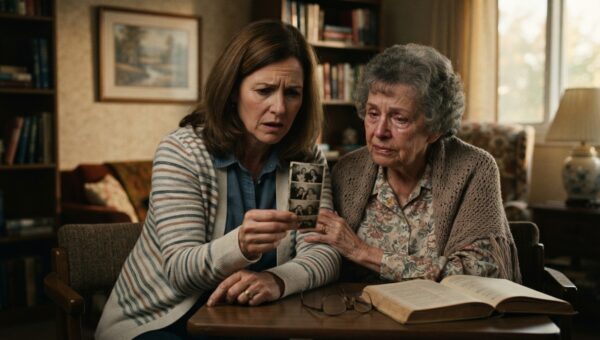
The linoleum floor of that mobile home had a slight dip right by the gas heater where the subflooring had given up years ago, a soft spot you learned to step right over if you didn’t want to turn your ankle. I stepped right into it the second I walked through the door last Christmas Eve, carrying a heavy box of groceries in my arms.
The air inside hit me first. It smelled like old tallow and cold propane, the kind of stale indoor dead air that lingers when someone hasn’t opened a window since October because they are trying to keep the heating bill under forty dollars.
Mom was sitting in her usual spot by the small electric fireplace, wrapped in a blue quilt that had lost all its batting. She looked smaller than she had back in July. Her cardigan hung off her shoulders like it belonged to someone else, the wool cuffs gray and frayed where she rubbed her thumbs against them.
“You didn’t have to drive all this way in the dark, Clara,” she said. Her voice was thin, like dry paper sliding across a desk. “The roads get tricky past the river.”
“I wanted to come, Mom,” I said, setting the cardboard box down on the formica table with a dull thud. “Besides, I missed you.”
I started unloading the bags right then. A tub of real butter, two heads of romaine lettuce, a carton of fresh eggs, a pork roast wrapped in butcher paper.
When I opened the little refrigerator to slide the milk in, the door seal let out a tired hiss. The inside shelves were nearly bare except for a pitcher of cloudy water, a half-empty jar of store-brand mayonnaise with a crust around the rim, and three small cans of creamed corn stacked neatly in the corner. Way in the back, tucked behind the mayonnaise, sat a carton of whole milk with a sell-by date stamped three weeks prior.
I stood there with the carton in my hand, staring at the gray ring of dried milk around the pour spout. I didn’t say anything for a long minute because my brain kind of stopped working for a second.
“Mom, when did you go to the store last?” I asked, keeping my voice light so she wouldn’t feel cornered.
“Oh, I don’t need much,” she said, smoothing the hem of her cotton house dress over her knees.
It was the same floral house dress she had been wearing when I visited for her birthday in April. “Your sister Brenda brings me a tin of soup now and then. And I’ve got my tea.”
“Brenda brings you soup?” I turned around, holding the sour milk. “Brenda lives an hour and a half away down in Lake Worth. How often is she driving up here?”
“Well, she has a lot on her plate with the house and the girls,” Mom murmured, looking down at her slippers. “She’s very busy.”
I didn’t answer. I walked over to the armchair and gently pulled her up so I could check the fit of her cardigan sleeves. When my hands touched her forearms, I felt bone through the knit fabric, sharp and hard like dry twigs. She had dropped eighteen pounds since the summer, maybe more. Her collarbones stuck out against her skin like two wooden pegs under a tarp.
“You’re not eating enough, Mom,” I said, and my throat felt tight and hot. “I send Brenda the money every month to handle your groceries. Plus your pension. What is happening to the grocery money?”
“Brenda takes care of all that,” Mom said, blinking her milky blue eyes in confusion. “She does the paperwork at the bank. It’s easier that way.”
That was the seed. It sat there in the cold kitchen while the little heater clicked on and blew lukewarm air against my ankles. Dad had passed away three years before, and Brenda had volunteered to take over the administrative burden of Mom’s survivor pension, saying it was too much paperwork for an eighty-four-year-old to deal with. $2,100 a month coming in from the railroad retirement board. Plus the $200 I wired into Mom’s account every single month like clockwork to make sure she had cash for her prescriptions and extra fruit.
I spent the rest of that afternoon cleaning out the refrigerator. I threw away the sour milk, wiped down the sticky shelves with a damp rag, and cooked the pork roast with some carrots and potatoes I had brought in my cooler. Mom ate two small bites of potato and pushed the rest around her plate with her fork, claiming her stomach had been acting up since the first frost.
When I left that evening, the smell of roasted garlic was still hanging in the narrow hallway, but the chill in the air felt heavier than it had when I arrived. I drove straight back to my house, but I couldn’t sleep. I kept seeing those three cans of creamed corn and the way her shoulder blades jutted through her clothes.
Three days after Christmas, I drove up to the main branch of the bank in town, the one where Dad had kept his accounts for forty years before he died. The linoleum here was polished to a bright, hard shine, and the air smelled like floor wax and printer toner.
I walked up to the counter where a young teller with a silver name tag was organizing deposit slips.
“Morning,” I said, laying my ID and Mom’s power-of-attorney papers on the marble ledge. “I need to look at the recent transaction history for my mother’s survivor pension account. I’m her secondary contact.”
The teller took the papers, scanned them into the terminal, and started typing with quick, rhythmic clicks. After about thirty seconds, her fingers stopped moving. She stared at the screen for a long beat, then looked up at me through her glasses with a curious, guarded expression.
“Is something wrong?” I asked.
“Well,” the teller said, lowering her voice slightly. “The monthly deposit from the railroad is coming in right on schedule. Twenty-one hundred dollars on the first of every month.”
“Good,” I said. “So where is the balance going?”
“It’s not staying here,” the teller said, turning her monitor slightly so she could trace a line with her fingernail. “Look. As soon as the funds clear on the second, an automated transfer moves eighteen hundred dollars out of this account and into a linked checking account at a branch down in Lake Worth.”
The lobby seemed to tilt sideways for a second. “Linked to who?”
“An account in the name of Brenda Vance,” the teller said softly. “It’s been set up that way for six years. Ever since your father passed.”
Six years. Seventy-two months.
I didn’t say goodbye to the teller. I turned around and walked out through the heavy glass doors into the bright winter sunlight, my boots crunching on the gravel in the parking lot. I got into my sedan, pulled the door shut, and sat there with my hands gripped so tight on the steering wheel my knuckles turned the color of lard.
Six years. $1,800 a month siphoned off every single thirty days while Mom wore the same three dresses and ate canned corn in the dark. I pulled out my phone, found Brenda’s number in my contacts, and hit call before I could talk myself out of it.
It rang twice before Brenda picked up, her voice bright and rushed with background noise that sounded like a television commercial. “Clara? I’m right in the middle of folding laundry. What’s going on?”
“I’m sitting in the bank parking lot in town,” I said, and my voice didn’t even sound like mine. It sounded dry and flat like a shovel hitting stone. “I just looked at Mom’s account history.”
There was a short pause on the line. The background noise didn’t stop, but the tone of Brenda’s breathing changed, becoming a little too even, a little too careful. “Oh? Did something happen with her statement?”
“She has eighteen dollars in her checking account, Brenda,” I said, my chest tightening until I could barely draw breath. “Her fridge had expired milk and three cans of corn when I was there for Christmas. She’s lost eighteen pounds. She looks like a skeleton.”
“Well, people lose weight when they get old, Clara, you know that,” Brenda said, her voice hardening up instantly, dropping the sweet sister act. “She’s eighty-four years old. Metabolism slows down.”
“Don’t you dare talk to me about metabolism,” I snapped, slamming my palm against the steering wheel. “Where is the money going? The teller showed me the transfer logs. Eighteen hundred dollars every month for six years straight. That’s one hundred and fifty-one thousand two hundred dollars, Brenda. Where is it?”
“Mom doesn’t need that money,” Brenda said, and her voice came out sharp and entirely unbothered, like she was explaining a minor grocery store receipt. “She barely goes anywhere. What is she going to do with twenty-one hundred dollars sitting in a local bank where she can’t even drive to use it?”
“She barely goes anywhere because you left her with three hundred dollars a month to live on!” I shouted, tears finally breaking hot over my eyelids. “She’s starving in that trailer while you’re paying off your mortgage!”
“It’s a roof over her head, isn’t it?” Brenda snapped back, her voice rising to meet mine. “Somebody has to pay the taxes on that Lake Worth property. Somebody has to manage the family logistics. You live an hour away and you show up twice a year with a bag of groceries acting like a saint. I earned that money taking care of her affairs.”
“Mom doesn’t even know what house you’re paying for,” I whispered, the rage burning down into a cold, hard knot. “You stole from an eighty-four-year-old woman who raised us.”
“Mom doesn’t even notice,” Brenda said, and then she let out a short, ugly laugh. “She wouldn’t know what to do with a bank account anyway. Just drop it, Clara. You can’t change how things are set up.”
“Watch me,” I said.
I hit the red end button on the screen before she could answer. My hands were shaking so hard I dropped the phone onto the passenger seat floor mat. I sat there in the quiet car for a long time, watching the exhaust pipe of a pickup truck idling near the exit lane puff white clouds into the cold air.
Then I picked the phone back up, looked up the direct number for the state Department of Health and Human Services, and filed an emergency report with Adult Protective Services right there from the front seat of my car.
The investigation moved faster than I expected once the state investigators pulled the bank records. Two days after my call, an APS caseworker named Marcus met me at Mom’s mobile home. He was a tall man with tired eyes and a thick gray mustache, carrying a heavy leather briefcase that looked like it had been through twenty years of hard winters.
We walked inside together. Mom looked up from her quilt, her eyes wide and frightened as she saw the official badge clipped to Marcus’s belt.
“Are you in trouble, honey?” she asked, looking at me.
“No, Mom, we’re not in trouble,” I said, kneeling down beside her chair and taking her cold, thin hand in mine. “We’re just going to make sure everything is set up the way it should have been all along.”
Marcus spent an hour going through the kitchen cabinets, photographing the empty pantry, the expired milk carton I had set on the counter, and the worn-out heater vents. He didn’t say much while he worked, but every time he wrote something down in his yellow legal pad, his jaw tightened a little more.
By the end of the week, the bank accounts had been frozen by court order. The automated transfers to Brenda’s Lake Worth mortgage were halted mid-stream, triggering a frantic series of voicemails on my phone that I simply deleted without listening to a single one. The state investigators subpoenaed six years of financial records, laying out every single transaction where Mom’s railroad pension had been diverted to service a suburban lifestyle three counties away.
Moving Mom out of that mobile home took two days and a rented trailer. She didn’t want to leave at first, clinging to the arms of her vinyl chair and talking about her neighbors, but once I showed her the small, sunlit apartment I had rented just down the road from my own house, an apartment with a working oven, a pantry full of soup and fresh bread, and a proper bedroom with a thick quilt, her resistance melted away into a quiet, tearful relief.
The legal fallout took months. Brenda tried to claim she had power of attorney authority to manage the funds as she saw fit, but the probate judge didn’t look kindly on an eighty-four-year-old living on canned corn while her daughter made timely payments on a $340,000 suburban home. The civil restitution proceedings were set in motion to attach liens against the Lake Worth property, and the local district office opened a formal inquiry into elder financial exploitation.
Brenda never called me again after that first phone call from the bank parking lot. There were no holidays together, no family dinners, no explanations that could bridge the gap of what she had done.
Three months after the move, I stood in Mom’s new kitchen unpacking several brown paper bags of groceries on a clean quartz countertop. The sunlight came streaming through the white blinds, cutting bright geometric shapes across the spotless linoleum floor.
Mom was sitting at the little round wooden table by the window, wearing a soft yellow cardigan I had bought her at the thrift store down the street. She was eating a bowl of warm chicken noodle soup, the steam rising in small, gentle curls toward the ceiling.
I reached into the last bag, pulled out a carton of fresh whole milk, and slid it onto the middle shelf of the sparkling new refrigerator right next to a pound of butter and a carton of farm-fresh eggs. The door closed with a firm, solid click that echoed quietly in the warm room.