The baked ziti on my paper plate was already growing cold, a greasy orange ring hardening against the cheap white rim. I wasn’t even hungry anyway. My stomach had been tied in a hard, sour knot since four o’clock that morning when Earl had woken up with that low, rattling cough that always meant his lungs were starting to fill up again.
We were sitting near the back exit of the Fellowship Hall because Earl couldn’t handle the heavy smell of the commercial floor wax they used on the linoleum. It made him dizzy. He sat beside me in his flannel shirt with the sleeves rolled up past his bony elbows, staring down at his own empty paper plate like he was trying to figure out what it was supposed to be for.
Around us, two hundred and ten people were scraping their forks against paper plates and laughing about something the youth group had done down at the lake. It was the monthly potluck Sunday, the one where everybody brings out their best casseroles and pretends for two hours that the town isn’t slowly dying around us.
Up at the front of the room, behind the scarred oak podium where the old hymn books were stacked, Pastor Williams adjusted his wire-rimmed glasses and tapped the microphone.
A sharp, high screech bounced off the cinderblock walls, and the whole room quieted down.
“Before we close our time together,” Pastor Williams said, his voice dropping into that smooth, practiced baritone he used whenever he wanted everybody to feel like they were wrapped in a warm blanket, “I just want to give a brief update on the Deacon’s Benevolence Fund. Thanks to your faithful giving, our fund was able to assist fourteen families in our immediate flock this past quarter.”
A light patter of polite applause rippled across the folding tables. People nodded at each other, feeling good about themselves, feeling like they were part of something steady in a world where everything else was slipping away.
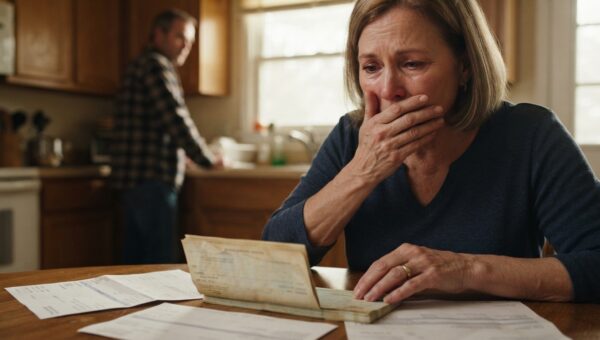
My hand didn’t go up right away. I sat there with my fingers dug hard into the cardboard rim of my plate until the paper began to tear. I thought about the letter sitting on our kitchen table back home.
It was printed on cheap cream-colored stationery with the church logo at the top, dated back in April. We had applied for three thousand dollars to help cover the out-of-pocket deposit for Earl’s transplant coordination at the medical center in Columbus. The letter had been short and clean. Regrettably, due to unprecedented demands on our benevolence resources at this time, your request could not be fulfilled.
We were told the drawer was empty. We were told there simply wasn’t anything left to give because other families were hurting just as bad.
I looked at Earl. He was staring at the floor, his breathing shallow and heavy, his skin that pale, greenish-yellow color that stayed with him around the clock now that his liver had stopped doing its job.
I stood up. My chair scraped loud against the concrete floor, but nobody turned around until I spoke.
“Why wasn’t mine one of them?” I asked.
The room didn’t go dead silent all at once. It died in layers.
The woman three tables down stopped buttering her roll. The sound of a spoon dropping into a plastic bowl echoed clear across the hall. Up at the podium, Pastor Williams froze with his hand still resting on the edge of the wooden stand, his mouth half-open.
“Helen,” he said, and his voice lost that smooth radio-preacher thickness for just a second, replaced by something thin and sharp. “Helen, this isn’t the time or the place.”
“When is?” I asked, and I didn’t care how loud my voice was getting. “Earl is on a waiting list. You told me back in April that the fund was completely empty. You told me every dollar had gone to keep folks from losing their power or their homes.”
Pastor Williams forced a thin, oily smile onto his face, the kind of smile he used when somebody asked him a hard question about the budget during the annual business meeting. He leaned into the microphone. “We all know how hard things are for you and Earl right now, Sister. But the deacons handle those distributions with prayerful discretion. We have confidentiality protocols we have to respect.”
“Confidentiality,” I said, and I reached into the oversized canvas tote bag sitting between my feet.
My fingers closed around the thick brown manila envelope I’d picked up from First National Bank on Friday afternoon. My friend Brenda, who had worked behind the commercial teller window for twenty-eight years before her knees finally gave out on her, had called me three days ago while Earl was sleeping. She didn’t say much on the phone because she knew the church board still used the local lines, but she told me to come down through the side alley after closing.
“You’ve been asking about the ledger balance for a long time, Helen,” Brenda had whispered through the frosted glass of her kitchen door. “Well, public church accounts aren’t quite as locked down as they pretend when the quarterly statements get filed for state tax exemption. Take a look at where the outgoing wire transfers actually went.”
I pulled the printed bank pages out of the envelope. They were stiff, fresh from the laser printer, every line item stark and black against the white paper.
“You told the congregation the fund was dry,” I said, taking three steps out from our table into the center aisle between the folding chairs. “You told fourteen families you didn’t have a dime to spare. But according to the First National ledger for the last six months, there were ninety-four thousand dollars in outgoing wire transfers.”
Pastor Williams stopped smiling. His face didn’t go white like you see in the movies; it just went hard, the skin tightening around his jawline until the gray stubble stood out sharp against his cheeks.
“Helen, you are causing a public disturbance,” he said, his voice rising now, losing its grip. “Sit down before I ask the deacons to escort you out.”
“Ninety-four thousand dollars,” I repeated, and I started reading the names right off the paper because I wanted everybody in those folding chairs to hear the words. “Not for utility bills. Not for groceries. Ninety-four thousand dollars sent out in four separate chunks to a business called the Serenity Aesthetic and Laser Clinic over in Shelbyville.”
A murmur went through the room like wind moving through dry corn stalks. People started turning around in their seats, looking at each other, looking up at the stage, then looking back at me.
“That’s a lie,” Pastor Williams shouted, and he actually banged his hand down on the podium. The microphone feedback gave a high, screaming whine that made several people wince and cover their ears. “That is malicious gossip and slander against the Lord’s house!”
“Is it?” I asked, and I pulled the second piece of paper from the envelope. It was a simple printout from the Ohio Secretary of State business registry, complete with the official state seal and filing dates. “Because according to the state registry, the Serenity Aesthetic and Laser Clinic is registered under the sole proprietorship of Megan Vance. And Megan Vance just happens to be your stepdaughter.”
The silence that hit the Fellowship Hall then wasn’t the polite quiet of a prayer. It was the heavy, suffocating silence of a courtroom right before the jury foreman stands up to read the verdict.
Nobody moved. Nobody breathed. Across the room, I saw Deacon Miller, who had served on the church board for thirty years and owned the hardware store down on Main Street, slowly turn his head toward the stage. His expression wasn’t angry yet. It was just profoundly, terribly confused, like someone trying to make sense of an engine that had seized up for no apparent reason.
“Pastor,” Deacon Miller said, and his voice sounded dry and old in the quiet room. “Is that true?”
Pastor Williams stood there behind the oak podium, his hands gripping the wood so hard his knuckles looked like polished bone. He looked down at the floor, then out at the two hundred and ten people who had trusted him with their tithes, their confessions, and their grief for nearly twelve years. He didn’t answer. He didn’t have an answer because the paper in my hand had the routing numbers, the dates, and the signature stamps right there in black ink.
“He told us there wasn’t enough money for my husband’s liver medicine,” I said, and my voice finally cracked, just a little bit, right at the edge of the sentence. “While his stepdaughter was getting thousands of dollars in elective cosmetic procedures paid for out of the widows’ mite.”
That was when the shouting started. It didn’t start with one person; it erupted from four different tables all at once. Sister Gable, who had given fifty dollars every single week out of her pension check since her husband passed, slammed her ceramic coffee mug down so hard the handle snapped clean off. Deacon Miller stood up from his chair, his face turning a dark, bruised red, and walked straight down the center aisle toward the stage without taking his eyes off the pastor.
“Give me those papers, Helen,” Deacon Miller said when he reached me. His hand was trembling slightly as he held it out, not from weakness, but from a cold, slow-burning fury that had been building up in the valley for a long, long time.
I handed him the First National printouts and the state registry record. He didn’t even look at them long enough to read every word; he just looked at the letterhead and the signature lines at the bottom. Then he turned around and walked up the three wooden steps to the podium, planting himself right beside Pastor Williams.
“We are going into the sanctuary right now,” Deacon Miller said into the feedback-prone microphone. His voice was steady, hard as gravel. “Every member of the board, and you, Pastor, are going to sit in the front pew while we call the bank president on speakerphone.”
By Sunday night, the church lights were still burning in the administrative offices behind the sanctuary. Earl was asleep in his armchair at home with his portable oxygen tank hissing softly in the corner, but I couldn’t sit still. I stayed by the window, watching the tail-lights of cars coming and going from the church parking lot three blocks down the street.
Deacon Miller had called me around eight o’clock. He didn’t use any fancy words or church talk.
“It’s all there, Helen,” he told me, and his voice sounded tired, like a man who had just spent four hours tearing down a rotting wall only to find the studs behind it were completely hollow. “Every single wire transfer. The bank president confirmed the routing numbers match the restricted benevolence ledger. The accounts have been frozen by emergency resolution. Pastor Williams has resigned effective immediately, and we’ve contacted our legal counsel to begin the restitution process.”
I closed my eyes for a long second, leaning my forehead against the cool glass of the living room window. “What about the transplant fund?” I asked.
“The board voted unanimously ten minutes ago,” Miller said. “We are reallocating the recovered balance immediately. The coordinator in Columbus has already been notified by fax. The deposit is covered, Helen. Earl’s name stays on the active list.”
I didn’t cry then. I had used up all my tears months ago while sitting at that kitchen table staring at rejection letters that were nothing more than lies printed on church stationery.
Monday morning, the sunlight came through the hospital room window in a pale, clean square that landed right across the foot of Earl’s bed. The linoleum here smelled of mild bleach, but it was an honest smell, not like the heavy wax they used down at the hall.
Earl was sitting up against the white pillows, looking a little better now that the sun was hitting his face. He held the official confirmation letter from the medical center in his hand, his thumb tracing the embossed seal where it certified that his financial clearance had been fully verified and approved.
I sat in the green vinyl chair beside the mattress, my canvas tote bag resting quietly on the floor by my feet. Inside it, tucked safely away at the bottom beneath my spare sweater, were the folded bank statements that had broken the silence. I wouldn’t need them anymore. The ink was dry, the accounts were frozen, and the ledger had finally been balanced the only way it ever should have been.
Outside the window, somewhere down in the hospital courtyard, a single church bell from downtown began to ring out the hour, slow and clear across the valley. Earl looked up from the paper, caught my eye, and gave me a small, quiet nod. I reached out and laid my hand gently over his knuckles, feeling the steady, familiar beat of his pulse beneath my fingertips.