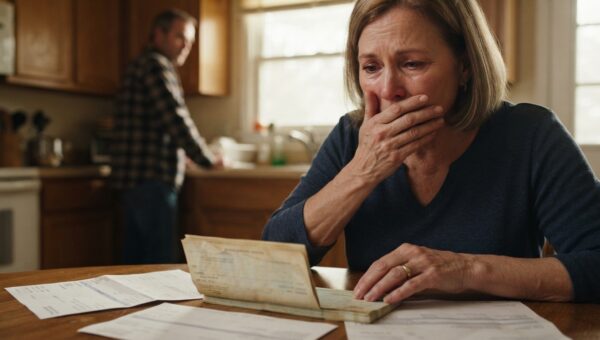
The blue spiral ledger sat squarely in the center of the oak dining table, flanked by a sharp red ballpoint pen and three stacks of canceled check receipts held together with yellowed rubber bands. I balanced our household budget on the fifteenth of every single month for thirty-six years. I knew every recurring utility charge, every quarterly insurance payment, and every seasonal repair bill down to the final cent.
It was a habit born of growing up in a house where money was always tight enough to make the floorboards creak, and I carried that caution straight into my marriage to Arthur. We built a life out of quiet predictability.
Last Tuesday, however, the math refused to settle. The column total for our joint checking account was off by exactly eighty-four dollars and twelve cents. I traced my finger back up the page, checking each entry against the receipt slips I kept filed in the brown accordion folder. Most people would have tossed the ledger aside and blamed a rounding error or an ATM surcharge, but my brain did not work that way. I needed every column to balance before I could sleep. When my finger landed on the debit line dated the fifteenth of the previous month, I noticed an automatic transfer code that did not match any of our standard utility drafts or savings allocations.
The amount listed was eight hundred dollars. Even worse, it was labeled with an alphanumeric routing string that belonged to an external financial institution across town on Elm Street. I did not panic right away because panic is a luxury for people with spare time. Instead, I stood up from the dining table, walked down the narrow carpeted hallway to the den, and pulled the top cardboard storage box down from the closet shelf. Inside were thirty-six years of monthly bank statements, packed tight like bricks.
I carried the oldest boxes back to the kitchen and dropped them onto the floor with a dull thud. For the next three hours, I sat cross-legged on the hardwood floor, pulling out envelopes from five years ago, ten years ago, and fifteen years ago. My thumb flipped through the cream-colored pages until I found the month Arthur and I celebrated our twenty-eighth anniversary.
There it was, tucked between the grocery store debits and the hardware store charges. An eight-hundred-dollar withdrawal leaving our joint account on the fifteenth.
I pulled statements from the year before that, and the year before that, tracing the same identical debit back through time like a scar hidden beneath a shirtsleeve. Eight years. Ninety-six months of eight hundred dollars vanishing into an account whose title I had never seen, registered at a branch three miles away from our quiet suburban street. My throat felt tight, and my hands started shaking slightly as I folded the statements into a neat stack. I tried to tell myself there was a logical explanation, perhaps a forgotten investment or an old loan, but the numbers did not lie. Arthur had set up an automatic wire transfer on the exact same day every month, routing funds away from our shared future into a private silo without ever mentioning a word to me.
The next morning, I drove down to the Elm Street branch of the bank in my old sedan. The linoleum floors of the lobby were scrubbed clean, and the air smelled of stale coffee and industrial floor wax. When I reached the front desk, the young teller politely informed me that account details could not be discussed over the phone or without the primary account holder present. I did not raise my voice or cause a scene. I simply reached into my canvas handbag, pulled out our state-issued marriage certificate, and laid it flat on the counter beside my driver’s license.
“My name is on the legal registry of this household, and every dollar in that originating account came from my salary and Arthur’s joint deposits,” I said, my voice dropping into that flat, level tone I used when I meant business. “I need to speak to the branch manager right now.”
The teller blinked, looked at the embossed seal on the marriage certificate, and immediately stood up to fetch her supervisor. Five minutes later, I was sitting across a grey laminate desk from a middle-aged man named Mr. Henderson who wore a silver tie clip and looked distinctly uncomfortable. I slid the printed bank statements across his desk, showing him the eight-year trail of recurring debits.
Mr. Henderson glanced down at the paper, adjusted his wire-rimmed glasses, and began tapping rapidly on his keyboard. The silence in the small glass office stretched on for an eternity, broken only by the sharp, repetitive clicking of computer keys. He stopped typing, stared at the glowing monitor for a long, agonizing moment, and let out a heavy breath that rattled the papers on his desk. Slowly, with deliberate slowness, he reached out and swiveled the flat-screen monitor around so the display faced me across the corner of the desk.
I looked at the numbers glowing against the blue screen, and my entire body went cold. The current balance sitting in that secondary account after eight years of steady monthly deposits and modest interest accumulation was ninety-six thousand, four hundred and twenty dollars. But the money was not even the worst part. Right beneath the total balance was the name of the sole account holder registered at that branch: Clara Vance.
My mind raced backward through decades of memories, searching for a name I had not heard since the first year Arthur and I were courting. Clara Vance was the daughter of Linda Vance, the young woman Arthur had been engaged to marry back in college before a patch of black ice on a mountain highway took her life twenty-eight years before I met him. Arthur had rarely spoken of Linda, only mentioning once in a quiet, shadowed moment that some griefs never truly heal. Now, staring at the bank monitor, I realized he had been funding the entire life and education of Linda’s daughter for eight years, hiding the massive drain on our finances while we scrimped and saved on grocery bills and postponed our roof repairs.
I thanked Mr. Henderson with eerie calmness, gathered my documents, and walked out of the bank into the bright midday sun. My car felt suffocatingly hot, so I rolled the windows down and drove home with my hands gripping the steering wheel so hard my knuckles turned white. The house was empty when I let myself in through the side door. The kitchen was just as I had left it earlier that morning, with the blue ledger still resting on the oak table and the red pen lying beside it.
I did not pace or cry. I sat back down at the table and waited for the grandfather clock in the hallway to strike five-thirty. At exactly five-thirty-four, the gravel in our driveway crunched beneath the tires of Arthur’s truck. I heard the engine cut off, the heavy door slam, and his familiar heavy footsteps walking up the front steps. When he unlocked the door and walked into the kitchen carrying his leather briefcase, he looked tired, the way he always looked after a long week at the supply yard.
“Hey, honey,” Arthur said, tossing his keys onto the ceramic dish by the door. “Something smells good. Are we having pork chops?”
He stopped walking when he saw me sitting at the table with the printed bank report spread out beside the checkbook ledger. I did not look up immediately. I just watched the way his shoulders stiffened beneath his flannel shirt, the sudden, telling stillness that comes over a man who knows the exact moment his carefully built wall has collapsed.
“Arthur,” I said quietly, pointing a finger at the printed statement on the table. “Sit down.”
He didn’t move toward the stove or make any excuses. He pulled out the wooden chair opposite mine, lowered himself slowly, and stared at the paper without touching it. “How did you find out?” he whispered, his voice cracking slightly on the last word.
“I balanced the books,” I told him, my voice completely devoid of warmth. “Like I have done every single month for thirty-six years. You forgot that numbers leave tracks, Arthur. You thought you could hide an entire life in the margins.”
He dropped his head into his hands, rubbing his palms against his temples. He confessed everything then, the words tumbling out in a broken, defensive rush. He explained how he had run into Clara’s aunt years ago, learned that the girl was struggling to pay for college and living expenses, and felt a crushing, lingering weight of survivor’s guilt that he had somehow survived the wreck that took Linda away. He had set up the account in secret because he knew I would be practical, because he knew we had our own retirement to think about, because he was too cowardly to have an honest conversation about the ghosts of his past.
“She didn’t even know who was paying for it,” Arthur muttered, looking up with red-rimmed eyes. “I just wanted to make sure Linda’s girl had a chance at a degree.”
“And you decided my consent didn’t matter,” I said, leaning forward across the table. “You decided that our marriage was just a bank account you could draw from to pay off your old debts to the past.”
The rest of the evening passed without shouting. There were no flying plates or dramatic tears. People who have been married for thirty-six years know that anger is often too heavy for screaming. By midnight, I had made my phone calls. I contacted our credit union, froze our joint savings, and arranged for an independent account to be opened in my name alone by morning. I packed a small overnight bag and placed it by the front door.
Arthur sat in the living room chair in the dark, watching me move through the house without saying another word. He knew better than to follow me. When I finished packing, I walked back into the study, picked up the blue ledger for the final time, and flipped it shut. The heavy cardboard cover made a sharp, definitive crack in the quiet room. I laid the red pen neatly across the spine like a period at the end of a very long sentence, turned off the hallway light, and walked out the front door into the cool night air.