My thumb was right over the glass screen, hovering above the little heart icon on Grant’s post, when the sun dipped behind the pecan trees out in the front yard and threw long, grey shadows across my kitchen table.
It was a Tuesday afternoon around four o’clock, the hour when the quiet in my house usually felt like a nice reward after a long shift at the clinic.
But that day the quiet just felt heavy, like the air right before a summer thunderstorm breaks over the county line.
I stared down at the photograph on my phone screen. There was Grant, leaning against the polished fender of a brand-new silver Mercedes that still had the temporary paper tag tucked into the back window. Behind him, the blue water of a newly installed concrete pool caught the late afternoon sun, glittering so hard it hurt my eyes to look at it. The caption beneath it said something about counting blessings and enjoying the fruits of hard work.
Hard work. That was a funny phrase coming from a man who hadn’t held a steady payroll job since the Reagan administration, a man who spent his afternoons playing golf while the rest of us traded our weekends for time-and-a-half.
I set the phone down on the oilcloth table cover and listened to the refrigerator kick on with a familiar, rattling hum.
Five years. Exactly sixty months to the day since I sat right here in this kitchen, staring at a stack of yellow legal notices from the county tax assessor, listening to Grant sob into the speakerphone like a whipped hound.
Back then, the world looked very different. My husband, Arthur, had been gone for barely two years, and I was still figuring out how to balance a checkbook that only had one signature on it.
I remember the sound of Grant’s voice that morning, thin and cracked with panic. He told me the bank was going to put a padlock on the front door of the house where our grandmother used to bake peach cobbler. He said the sheriff was already drawing up the papers for the foreclosure sale.
“I just need a bridge, Beth,” he had cried into the receiver, his voice shaking in that way that always made my chest tighten up. “Just a little runway to get the landscaping business off the ground.
I’ll pay you back every single cent. I swear on Mama’s grave, I’ll have it back to you in eighteen months tops.”
I didn’t have a million dollars. I had the life insurance payout Arthur left behind, tucked safely into a certificate of deposit meant to keep me out of the poorhouse when my knees finally gave out and I couldn’t stand for eight hours a day at the front desk anymore.
I called my financial advisor the next morning, a nice young man named Paul who had helped Arthur set up the account. Paul tried to warn me. He looked over his wire-rimmed glasses and told me family loans had a way of turning into family anchors.
“You pull that principal early, Elizabeth, you’re going to take a penalty,” Paul had said, tapping his pen against the blotter. “And once money crosses the threshold from your account to family, getting it back is like trying to un-ring a church bell.”
I waved him off because Grant was my little brother. I remembered him with scraped knees and a missing front tooth, riding his red bicycle down the gravel drive like he owned the whole county.
So I told Paul to wire the funds. One hundred and twenty thousand dollars transferred straight from my savings into the escrow account holding Grant’s mortgage together.
When the confirmation number came through on my printer, I folded the slip in half and tucked it into the back of my recipe box, right behind the card for lemon meringue pie. Grant came by the house two days later with a box of pastries from the bakery in town. He cried real tears on my shoulder, his arms wrapped tight around my back, smelling of cheap aftershave and stale cigarette smoke.
“You saved my life, Beth,” he had whispered in my ear. “You’re the only family I’ve got left that’s worth a damn.”
For the first three years, I didn’t press him. Every time holidays rolled around, Grant would show up empty-handed or with some cheap bottle of wine from the gas station, patting my shoulder and telling me the business was just about to turn a corner.
“Just waiting on the county to clear those commercial bids,” he’d say around a mouthful of turkey. “Once those clear, I’m cutting you a check for the whole balance, interest included.”
By the fourth year, the excuses started sounding a little thin around the edges. When I asked about a partial payment, even just five thousand dollars to show some good faith, Grant’s face would cloud over like I had insulted his mother.
“I thought we were family, Beth,” he’d snap, leaning back in his chair and crossing his arms. “You sitting on all that insurance money while I’m out here busting my knuckles trying to keep food on the table. You’re acting just like Daddy used to.”
That comparison always stung because Daddy had been a hard man with a quick temper and a closed fist when the liquor got the better of him. To be told I was acting like him just because I wanted my retirement security back made me bite my tongue so hard I tasted copper.
Then came last month and those photographs on Facebook.
The Mercedes, the pool, and a geotag pointing to a resort in the Bahamas where the drinks came in hollowed-out pineapples with little paper umbrellas stuck in the foam.
I didn’t yell. I didn’t cry. I just pulled out my phone and opened our text thread, scrolling back through the years until I found the exact exchange from the week of the wire transfer. There it was in black and white, glowing against the dark glass of the screen.
Grant: *Please just lend me the 120k. I will pay back every cent by next December. Put it in writing if you want.*
Me: *I know you will, Grant. Just use it to save the house. We’ll figure out the rest later.*
Grant: *Thank you. You’ll have your money back plus four percent interest. My word is my bond.*
I took a deep breath, my hands shaking just a little bit as I typed out a simple message.
Me: *Nice car on Facebook, Grant. Since business is doing so well, I need fifty thousand of that loan back by the end of the month to cover some roof repairs.*
I watched the three little typing dots bounce on the screen for nearly ten minutes. They’d appear, vanish, and then pop up again like someone was struggling to find the right words.
When the reply finally came through, it wasn’t an explanation. It was a sledgehammer.
Grant: *You never lent me a dime, Elizabeth. That money was Mama’s gift to me for taking care of her legal needs after the stroke. If you’re delusional enough to think I owe you anything after all these years, you’ve lost your mind. Lose my number.*
Before I could even type a response, a red exclamation mark popped up next to the message bubble. He had blocked me. His number, his wife’s number, even his oldest boy’s number all went dark in my contacts list within thirty seconds.
I sat there at the kitchen table as the sun went down completely, leaving only the greenish glow of the stove clock cutting through the dark.
By the next morning, the poison had already spread through the rest of the family like wildfire. My phone started ringing before six o’clock, starting with Aunt Clara, who sounded like she was reading from a script prepared by a lawyer.
“Is it true what Grant is saying?” she asked without even saying hello.
“Is what true, Clara?” I asked, rubbing the sleep out of my eyes while the coffee maker sputtered behind me.
“That you’re shaking him down for money he never took, and that you’ve been draining the family trust behind everyone’s back?”
I dropped the coffee mug. It didn’t shatter, it was one of those thick stoneware mugs Arthur brought home from the hardware store with the chipped blue rim, but it bounced hard off the linoleum, splashing dark coffee across the baseboards.
“I didn’t drain anything,” I said, my voice dropping an octave into that steady, dangerous register I usually reserved for unruly customers at the clinic. “Grant owes me one hundred and twenty thousand dollars from five years ago. I have the bank wires and the text messages to prove every penny.”
“Well, that’s not what Grant told your mother,” Clara hissed through the receiver. “He says you’ve been siphoning the old woman’s estate accounts for years, and now you’re trying to pin it on him to cover your tracks. He’s filing a civil suit to protect Mama’s assets.”
The room seemed to tilt slightly on its axis. A civil suit. My own brother, whom I had bailed out of financial ruin when his life was in tatters, was turning the tables around so fast he had the whole family convinced I was the thief.
I didn’t waste time arguing with Clara. I hung up the phone, walked out to the garage, and pulled my old Buick out of the bay before the dew had even burned off the windshield.
I drove straight to downtown Amarillo, bypassing the local general practitioners’ offices and heading straight for the brick-front building where Marcus Vance practiced civil and estate law. Marcus had known Arthur since they were boys playing little league behind the municipal water tower, and he had a reputation for being about as gentle as a barbed-wire fence when someone tried to cross him.
Marcus didn’t offer me coffee when I walked into his office. He just looked at my face, pushed his wire-rimmed glasses up his nose, and pointed to the leather armchair across from his desk.
“Sit down, Elizabeth,” he said quietly. “You look like you just saw a ghost.”
I didn’t waste breath on pleasantries. I dropped my phone, the printed text logs, the wire transfer confirmations from five years ago, and a copy of Grant’s Facebook posts onto his blotter.
“My brother is suing me,” I said, my voice shaking with a cold, dry anger that had been building up in my chest all night. “He says I stole from Mama’s estate. He says the money I gave him was a gift, and now he’s got the whole family believing I’m a criminal.”
Marcus picked up the papers one by one, his eyes scanning the lines with the practiced speed of a man who spent his life reading other people’s lies. He didn’t say a word for nearly five minutes. The only sound in the room was the heavy tick of a grandfather clock in the corner and the faint rumble of traffic out on Polk Street.
Finally, he set the papers down and looked up at me over the top of his lenses.
“Well, Elizabeth, your brother is playing hardball,” Marcus said, leaning back in his leather chair with a dry sigh. “And he’s got your mother’s power of attorney locked up tight since she moved into that assisted living cottage over on Elm Street. If he controls her accounts and has her ear every single day, he can make life very difficult for you in probate court.”
“Can he prove I stole anything?” I asked, my fingers digging into the fabric of my skirt.
Marcus gave a short, humorless bark of a laugh. “Proof doesn’t matter much when an elderly parent with early-stage memory lapses is told day in and day out that her daughter is robbing her blind. But here’s the thing about people like Grant. When they start stealing on a grand scale, they usually get sloppy with the paperwork.”
He reached over to his computer keyboard, clicked a few keys, and turned a secondary monitor toward me.
“I pulled preliminary public filings on your mother’s trust accounts this morning while waiting for you to come in,” Marcus said, tapping his finger against the screen. “Your brother didn’t just take your $120,000 and call it a gift. Over the last eighteen months, there have been twelve separate wire transfers totaling nearly two hundred thousand dollars moving out of your mother’s primary retirement trust and into an LLC registered under Grant’s landscaping business name.”
The breath went out of my lungs all at once.
“He’s been emptying Mama’s accounts,” I whispered.
“Systematically,” Marcus nodded. “And when the annual audit comes due next month, the shortfall is going to be glaringly obvious. That’s why he filed first. He needed a scapegoat. He needed the family to believe that you were the one who raided the estate, so when the bank examiners find the missing funds, he can point right at you and say you took it.”
I sat there staring at the glowing blue light of the monitor, watching the neat rows of transaction numbers and routing codes. It all clicked together with the sickening thud of a heavy gate dropping into place. The new Mercedes, the pool, the Bahamas trip, none of it came from landscaping contracts. It came from the savings our father left behind for Mama’s final years, money that was supposed to keep her safe and comfortable until the end.
“What do we do?” I asked.
Marcus pulled a fresh sheet of legal paper toward him and picked up his fountain pen.
“We don’t wait for his lawsuit to crawl through the docket,” Marcus said, his eyes narrowing. “We file an emergency injunction for financial malfeasance and elder exploitation. And then we pay a visit to your mother, together.”
The drive out to the Elm Street cottage took twenty minutes. The autumn wind was picking up now, swirling dry oak leaves across the manicured lawns of the retirement community like scattered bone chips.
When Marcus and I walked through the double glass doors of the facility, the receptionist looked up with a nervous smile, but Marcus flashed his badge and his bar association ID with the practiced ease of a man who owned half the county.
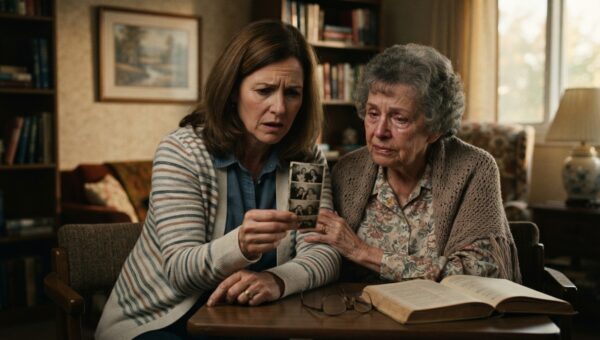
We found Mama sitting in her usual high-backed velvet armchair by the window, wearing her beige cardigan and staring out at the parking lot. Her silver hair was neatly combed, but there was a vacant, hunted look in her eyes that made my heart ache in spite of everything.
She turned her head slowly as we walked into the room. When she saw me standing there behind Marcus, her face hardened into something bitter and unfamiliar.
“Get out,” she whispered, her voice trembling as she clutched the arms of the chair. “Get out of my sight, Elizabeth. Grant told me everything. How could you steal from your own brother? How could you take the money I set aside for my twilight years?”
She was quoting him word for word. I could hear Grant’s voice coming right out of her mouth, sharp and manipulative and rehearsed.
I didn’t yell. I didn’t cry. I just walked across the carpet, pulled a folding chair over right beside her knee, and sat down so I was looking her dead in the eye.
“Mama,” I said, my voice as calm and steady as church on a Sunday morning. “Look at me. Do you really believe I would ever take a penny from you?”
“Grant showed me the bank statements,” she sobbed, a single tear cutting a path down her powdered cheek. “He said your name was on the transfer logs. He said you needed it to pay off your mortgage.”
I reached into my handbag, pulled out the certified audit printout Marcus had handed me twenty minutes earlier, and laid it right across her lap, over the folds of her floral skirt.
“I didn’t touch your accounts, Mama,” I said softly, my hand covering her trembling fingers. “Grant did. Every single month for the last year and a half. Look at the routing numbers. That’s his business name on the receiving end. Not mine.”
Mama blinked down at the paper, her bifocals sliding a fraction of an inch down the bridge of her nose. Her fingers traced the line of text where Grant’s signature had been digitally stamped onto the transfer authorization form, masquerading as her own power of attorney approval.
The room grew so quiet I could hear the faint hum of the fluorescent light fixture overhead and the muffled sound of a television playing down the hall.
For a long time, Mama didn’t say anything at all. Her breath hitched once, a dry, rattling sound, and then her mouth stayed slightly open in a silent, stunned O. The color seemed to drain right out of her face, leaving her looking fragile and terribly old, like dried corn husks left out in a winter field.
She didn’t look at the door. She didn’t call out for Grant. She just kept staring down at those numbers on the page, her hand growing cold beneath mine.
“He… he told me you were in trouble,” she whispered finally, the words barely audible over the wind rattling the windowpane. “He told me he was just helping you protect it.”
“I know he did, Mama,” I said gently.
Marcus stood quietly by the doorway, his hands folded behind his back, waiting for the dust to settle.
We stayed there in that quiet room for nearly an hour while the reality of what Grant had done settled over her like a heavy winter frost. By the time we stood up to leave, Mama hadn’t cried another tear, but her jaw was set in that old stubborn way our father used to have when he realized he’d hitched his wagon to the wrong mule.
“Do what you have to do, Elizabeth,” she said, her voice small but clear as she handed the audit papers back to me. “Don’t let him take the rest of it.”
That was three weeks ago.
The lawsuit is moving through the district court now, fast and ugly, just the way lawsuits do when the evidence is too heavy to hide under the rug. Grant’s lawyer tried to file for a dismissal last Tuesday, but Marcus shot it down before the ink was dry on the opposition brief. The bank accounts have been frozen by court order, and the Mercedes is sitting in an impound lot downtown while the bankruptcy trustees sort through the wreckage of his landscaping shell company.
I haven’t heard from Grant since the day he blocked my number, and I don’t expect I ever will. The rest of the family has gone very quiet, too. Aunt Clara hasn’t called back, and cousins I haven’t seen in a decade have suddenly found reasons to be busy when our paths cross at the grocery store.
That’s the funny thing about rescue work. People only want you to pull them out of the river until they realize you can see how they got in there in the first place.
It’s late now. The house is dark except for the amber glow of my laptop screen sitting open on the dining room table where I’ve been reviewing the final audit trail with Marcus’s paralegal.
I reach out, press the silver power button on the side of the machine, and listen to the internal fan spin down into silence.
Outside, the wind has died down entirely, leaving the pecan branches still and black against the starlight. I walk over to the front door, turn the deadbolt with a dry, metallic click, and step out onto the porch for a breath of cool night air.
I left my phone sitting face down on the kitchen island, its screen dark and quiet against the wood. Out in the lane, somewhere down toward the county road, a car’s tires hum softly over the asphalt and then fade away into the deep Texas night, leaving nothing behind at all.