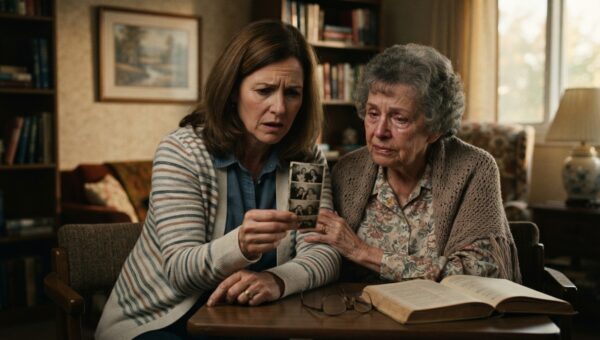
March 22, 1964.
That was the date stamped on the back of the photograph, right beneath four words that made the floorboards of my mother’s attic feel like they were dropping out from under me. I am not a writer, and since Mom passed away last month, my days have mostly been spent staring at the same spot on the kitchen wall where her favorite ceramic clock used to tick.
But that dusty afternoon up in the rafters changed the shape of every single memory I thought I owned.
I had been up there for three hours sorting through old cardboard boxes of Christmas ornaments and mothballed winter coats that smelled like cedar and damp wool. The house was quiet in the heavy way only an empty house can be after someone dies. I found the snapshot tucked deep inside a metal recipe tin that was stuffed behind a stack of my father’s old hunting magazines. It showed two infants, swaddled in identical knitted blankets with pale blue stripes, lying side by side in a wicker bassinet that was long gone. On the back, written in the sharp, sloping cursive I had stared at on every birthday card of my life, was the date and a short, ugly sentence.
March 22, 1964 – I’m sorry.
I was born on March 22, 1964. I was an only child, or at least that was the story repeated at every family dinner, every doctor’s office visit, and every tax filing for forty-some odd years.
I sat down hard on a dusty storage chest because my knees just gave out, and without even thinking about what I was doing, I pulled my cell phone from my pocket and dialed my father’s number.
It rang four times before he picked up on the other end, his voice raspy and thin the way it had been ever since his stroke two winters ago.
“Hello?” he said.
“Dad,” I said, my voice shaking so badly I barely recognized it. “Was I a twin?”
There was no intake of breath. There was no confusion in his voice. There was just a heavy, suffocating silence that stretched out across the phone line for so long I thought the call had dropped. Nobody said anything for five seconds, and honestly, that felt worse than shouting.
“Dad?” I whispered.
The line went dead with a sharp click.
He didn’t call back that evening. He didn’t call the next day, or the day after that.
Three days of absolute, maddening quiet passed while I sat downstairs in the living room with the photograph resting on the coffee table beside an untouched cup of tea. I didn’t sleep. Every time the wind rattled the siding outside, I jumped, thinking he was standing on the porch, ready to explain how an entire human being could just vanish from a family story.
When my phone finally buzzed on the kitchen counter at 4:52 in the morning on the fourth day, I answered on the first ring.
My father didn’t say hello. He didn’t ask how I was holding up after the funeral. He just spoke in a flat, exhausted monotone that sounded like a man reading off a grocery list.
“There’s a safe deposit box at the bank on Elm Street,” he said.
“Dad, wait a minute, ” I started.
“The key is taped under the third drawer of your mother’s desk,” he interrupted, his voice dropping into that stubborn register he always used when he was done arguing. “Go before you ask me anything else.”
Then he hung up again.
I didn’t wait. I drove straight to the house on Maple Avenue where my parents had lived for forty-eight years.
The place looked smaller now, the white paint peeling slightly around the porch posts where the honeysuckle vine had grown too thick. Inside, the air smelled of stale coffee and the lemon oil Mom used to polish the mahogany furniture every Friday morning.
Her desk sat in the corner of the den, a heavy piece of walnut with brass pulls that had always been off-limits when we were kids. I dropped to my knees on the hardwood floor, reaching blindly underneath the heavy frame of the bottom tier. My fingers brushed against something cool and rectangular. It was a strip of yellowed masking tape holding a small, notched brass key to the underside of the third drawer. I pulled it free, the old adhesive sticking stubbornly to my thumb, and stared at it for a long moment.
The bank on Elm Street was a brick building built back in the fifties with tall glass windows and heavy brass doors that squeaked when you pushed them open. The teller looked at my ID, looked at the key, and then looked at me with the polite, practiced indifference of someone who had seen every kind of family tragedy walk through those doors. She led me back to the small vault room with the low ceiling and the rows of numbered steel slots set into the wall.
Box 114 slid out with a heavy metallic clank.
Inside was a single manila envelope, thick and bulging with folded papers. I carried it over to the small laminate consultation table by the corner, my hands trembling as I slid the metal clasp open and tipped the contents onto the green blotter.
The first thing that slid out was a duplicate set of hospital records from St. Jude’s Memorial in the spring of 1964. There were two birth certificates, printed on yellowing onion-skin paper with faded blue ink stamps. Baby Girl Miller, born at 6:14 AM. Baby Girl Miller, born at 6:19 AM. My name was on the first one. Beneath it was a second name that I had never seen before in my life, written in a neat, hurried clerk’s handwriting. Clara.
My breath caught in my throat. I pushed my glasses up my nose and kept sorting through the pile. There were medical bills stamped with past-due notices from the summer of sixty-four, page after page of doctor’s fees and pharmacy charges that added up to numbers my parents could never have afforded on my father’s salary at the mill. And right beneath the bills was a handwritten letter folded into quarters, written on cheap lined paper in my mother’s hand.
I unfolded it, my eyes burning as I read the words she had never spoken out loud.
*We couldn’t pay for the second week in the nursery, and Dr. Vance said the county home was the only place that would take her without the balance cleared. Arthur agreed we couldn’t risk losing the house with the baby already here. I kissed her behind the ear so I would know. I left her blanket in the basket. God forgive us both.*
I sat there at that little laminate table in the bank basement for a long time, watching the fluorescent light hum above my head. The pieces didn’t fall into place like a neat puzzle; they crashed down all at once, jagged and heavy. My parents hadn’t just hidden a secret; they had traded a piece of our family history for four hundred and twelve dollars worth of hospital bills and a roof over my head. Mom spent fifty years keeping that one photograph in the attic like a candle burning in an empty room, while Dad built a wall of silence so high he couldn’t even see over it anymore.
By noon, I was standing on the front porch of my father’s house again.
I didn’t knock. I just turned the brass handle and walked right in. The television was on in the den, tuned to some low-murmuring news channel, but the room was empty. I found him sitting at the kitchen table, a mug of instant coffee cooling in front of him, staring out the window at the overgrown tomato garden in the backyard.
I didn’t say anything. I just reached into my canvas tote bag, pulled out the manila envelope, and dropped it right in the center of the oilcloth table runner. The heavy hospital forms slid across the plastic surface and stopped against his coffee mug.
My father didn’t look down at the papers. He just closed his eyes, his shoulders sinking down until he looked half his normal size in his plaid flannel shirt.
“You found it,” he whispered.
“I found it,” I said, and my voice didn’t shake anymore. It just sounded hollow. “Clara. Her name was Clara. Or is. Is she still out there?”
He nodded slowly, a single, heavy movement of his white-haired head. “Ohio. Columbus. Your mother hired a private investigator back in ninety-two when she got sick. Found out she was adopted by a couple down near the river. Good people. We didn’t have the right to show up and ruin their lives after we gave her away.”
“You didn’t have the right to keep it from me either,” I said.
That was when the silence came back, but this time it wasn’t the defensive silence of the phone call. It was the heavy, terrible quiet of a man who had run out of excuses after fifty years of carrying a load that was too big for him. He reached out a trembling, liver-spotted hand and pushed a small slip of white paper across the table toward me. On it was an address and a phone number written in my mother’s careful hand.
“She has your mother’s chin,” he said softly, staring down at his coffee cup. “I saw a picture once. In ninety-five. Your mother kept it folded behind the pantry calendar for a month before she burned it.”
I picked up the slip of paper. My thumb brushed against the edge of the ink.
The drive back to my own house took forty minutes, and I didn’t turn the radio on once. The world outside my windshield looked exactly the same as it had yesterday, but everything felt tilted, like the horizon had shifted an inch to the left while I wasn’t looking.
When I got home, I sat on the edge of my bed with the telephone in my hand for nearly an hour. The numbers on the slip of paper stared back at me from the nightstand, clear and legible and real. I didn’t think about what I was going to say, and I didn’t practice an introduction. I just pressed the buttons one by one, listening to the tone change from a steady hum to a sharp, rhythmic ring three states away.
A woman answered on the third ring, her voice crisp and slightly distracted, asking who was calling.
“My name is Martha,” I said, and for the first time in my life, I didn’t feel like an only child. “I think we share a birthday.”