I still keep the original hospital bill from the county medical center folded into four parts inside the back pocket of my ledger, dated March fourteenth, nineteen eighty-six, with the total underlined twice in red grease pencil. Two thousand nine hundred dollars was a fortune back then, especially for a pair of sharecroppers who considered a new alternator for the tractor an unnecessary luxury.
My father sat at the oilcloth-covered kitchen table and told me straight out that nobody in our county was going to hire a girl with a baby on her hip, and since I couldn’t pay the doctor, someone else would have to settle the ledger for me. I signed my name at the bottom of the release papers while the nurse stood by the door holding a plastic basin, and I never even got to look at her face before they wheeled her down the corridor. My mother took my Bible away that night and put it on the top shelf of the pantry, and for thirty-eight years I only touched it when I was dusting around the flour bins.
Last spring, the church sent a volunteer named Brenda out to my place with a box of old hymnals that had been cleared out of the basement vestry after the roof leak.
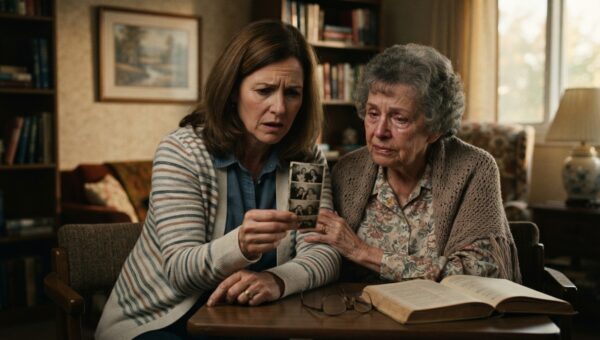
Brenda didn’t know anything about my history, but she had a habit of flipping through the pages before she boxed them up to make sure nobody had left pressed leaves or church bulletins inside. She found the photograph tucked right into the middle of Psalm twenty-three, the small black-and-white print the delivery nurse had slipped into my hand when nobody else was looking. When the padded envelope arrived in my mailbox on a rainy Tuesday morning, I didn’t even recognize my own handwriting on the return address until I saw the cedar trees down the gravel road. I pulled the flap open with a kitchen knife because my fingers were shaking too hard to get a grip on the tape. The photograph slid out onto the linoleum, face down, and when I turned it over, the blue ink on the back wasn’t mine at all.
A stranger’s hand had written three neat sentences across the faded Kodak watermark. “She has your left dimple,” it said, and the ink was slightly smeared where someone’s thumb had pressed against it before it dried.
I sat down right there on the kitchen stool and stared at that sentence for twenty minutes while the kettle boiled dry on the burner. For three days, I carried that picture from room to room like it was a piece of hot glass, setting it down on the dresser, picking it back up, and running my thumb over the corner where the emulsion was starting to curl. I kept thinking about the girl in the picture who had no voice and no money and no choice that didn’t leave her empty-handed. My mother was long gone, and the farm had been sold off to pay for her headstone, but the guilt didn’t care about time or paperwork. It just sat in the center of my chest, heavy as an anchor, waiting for the other shoe to drop.
The knock on my apartment door came at four in the afternoon on a Friday, right when the delivery trucks were starting to stack up on the narrow street outside.
I wasn’t expecting anybody except the mail carrier with the circulars, so I didn’t bother looking through the peephole before I turned the deadbolt. Clara stood on the porch with a sixteen-dollar bouquet of grocery store carnations wrapped in green paper, her coat buttoned all the way to her chin despite the mild spring air. She looked enough like my sister Brenda to make my knees go weak, but it was the slight hitch in her left cheek when she blinked that told me everything I needed to know. She didn’t wait for me to invite her across the threshold or ask who she was looking for.
“I don’t want your money,” she said, and her voice shook with thirty-eight years of carefully practiced anger. “I want to know why you…”
She didn’t finish the sentence because her breath caught in her throat, and she reached out to steady her hand against the cheap wooden doorframe. I stood there blocking the hallway, my hand still gripping the brass handle, unable to find a single word that wouldn’t sound like a lie or an excuse. The carnations smelled overwhelmingly like grocery store cooler water and stale fern leaves, a sharp, artificial scent that cut right through the smell of my coffee. I finally stepped back and pulled the door wide open, gesturing toward the small brown armchair by the window where the afternoon light was starting to fade. She walked in like a stranger entering a doctor’s office, her boots clicking hard against the linoleum before she hit the scatter rug. She didn’t sit down right away, but stood by the low coffee table looking at the empty mug I’d left there from lunch.
“You live here by yourself?” she asked, and her eyes swept over the small television set, the stack of library books, and the framed calendar hanging by the refrigerator.
“Since my husband passed over at the county hospital,” I said, my voice sounding thin and dry even to my own ears. “It’s enough room for one person.”
She set the carnations down on the edge of the table, right on top of a folded grocery receipt, and turned around to face me with her arms crossed tight across her chest. “Martha never told me anything until after the funeral,” she said, using her adoptive mother’s name like she was testing how it sounded in this room. “She kept that picture in her cedar box behind the winter sweaters. I found it when I was sorting through her papers last month. She wrote that note on the back herself before she put it in the hymnal and gave it to the church.”
“Martha was a good woman,” I whispered, because that was what you said about people who took what you couldn’t keep.
“She was cold,” Clara snapped, and the sudden sharpness in her tone made me flinch. “She was cold every day of my life. She gave me everything I needed on paper, but whenever I asked about where I came from, she told me my real mother didn’t want the bother of raising a child. She told me you traded me away for a clean slate and a fresh start.”
I walked over to the sideboard where I kept the metal tin with the old papers, my fingers stiff and clumsy as I worked the rusted latch. I pulled out the folded hospital bill from nineteen eighty-six and the adoption release form with my mother’s signature crowded right above my own shaky minor’s handwriting. I laid them out on the coffee table beside her carnations without saying a word, letting the yellowed newsprint speak for the seventeen-year-old girl who had signed them away. Clara looked down at the figures, her eyes tracing the line where the county had added interest to the room and board charge. She reached out one finger and touched the $2,900 figure just like I had touched the note on the back of the photograph three days ago.
“They wouldn’t let me leave the room until it was paid,” I told her, staring at the pattern in the rug between us. “My father told the social worker that we didn’t have a mattress to spare, let alone cash for a doctor. I thought if I signed the paper, you’d go to a family with a real house and a real stove that worked every day.”
Clara didn’t move for a long time, her hand resting flat against the old paper like she was trying to feel the pulse of a ghost. “She told me you forgot about me by the time the harvest came in,” she said, and her voice finally broke on the last word, losing all that hard edge she’d carried up the stairs. “She told me nobody who loved a child would ever let someone else sign their name on the line.”
“I prayed over that picture every Sunday of my life,” I said, and the confession came out before I could stop it, simple and ugly and entirely overdue. “Every single week while the congregation was singing the doxology, I had my hand in my pocket touching the corner of that little print. I didn’t forget you for a single day, Clara. Not one.”
She looked up at me then, really looked at me, and I saw my own mother’s chin in the way she set her jaw against the tears. The anger didn’t vanish all at once, but it softened around the edges, turning into something quieter and heavier that neither of us knew how to name yet. She reached out and picked up the photograph where I’d left it on the arm of the chair, turning it over to look at her own mother’s handwriting one more time.
“She has your left dimple,” Clara read aloud, her voice barely louder than the hum of the refrigerator in the corner. “Martha knew the whole time, didn’t she? She knew you didn’t just walk away.”
“She knew,” I said. “And she kept it to herself because she was scared I’d come back looking for what was hers.”
We sat there in the growing dusk as the streetlights outside flickered on one by one, casting long yellow bars across the floorboards between our chairs. Clara didn’t leave when the clock on the wall struck five, and she didn’t ask any more questions about the past because the paper on the table had already answered the ones that mattered. She stood up after a while, walked into the small kitchen without asking, and started running water into a clean glass jar she found in the dish rack. I watched her from the doorway as she trimmed the stems of the carnations with my paring knife, cutting them at an angle just like my grandmother used to do with the sweet peas in the back garden.
She carried the jar back into the front room and set it right on the windowsill where the last bit of the afternoon sun was catching the glass. The red petals looked bright against the gray brick of the building across the alley, standing out against the gloom like a small fire in an empty hearth. She sat back down in the armchair, pulled her coat off her shoulders, and laid it across the back of the sofa where my old wool shawl was already folded.
“I have to work tomorrow,” she said quietly, looking over at me with something that wasn’t quite a smile yet, but was close enough to keep the room warm. “But I don’t have anything planned for Sunday after church.”
“I’ll put the pot on around noon,” I told her, and my hands finally stopped shaking as I reached for the teapot on the counter.