PART 1
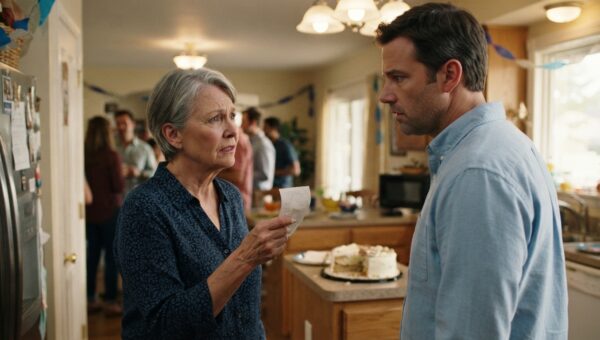
The white envelope was lying flat on the dark wood of my front porch when I got back from the grocery store. It had no stamp, no return address, and no name written on the front. Just my street address in block letters that looked rushed and shaky.
I picked it up with my thumb and finger, feeling the stiff weight of the paper inside, and walked straight into the kitchen.
I didn’t even put the bag of milk and bread on the counter first. I sat down at the small table by the window, split the top edge of the envelope with a butter knife, and pulled out a single folded piece of lined notebook paper.
The handwriting belonged to my brother Tom. I would know those cramped, backward slanting letters anywhere. He had written only one sentence.
Your mother didn’t take that loan, it said.
I stared at the ink for a long time, listening to the hum of the refrigerator. I was still holding the note in my hand when my phone rang on the counter. It was Tom calling back. I had left him two voicemails in the last hour, and now his name was flashing on the screen.
I swiped the green button and held the phone to my ear.
“Tom,” I said. “I got your note. What are you talking about?”
He didn’t sound like my brother. His voice was thin and raspy, like he had been running or crying in an empty room.
“Don’t talk to the bank again,” he said right away. “Don’t call them, don’t go back down there, and don’t answer any more of their letters.”
“Why shouldn’t I?” I asked, my fingers tightening around the piece of lined paper. “They sent me a bill for thirty-one thousand four hundred dollars. They said my name is on the bottom of a loan from seventeen years ago, and they put Mom’s signature right beside mine. Mom has been gone for three years, Tom. She’s been dead since the winter after the stroke.”
There was a long, heavy silence on the line. I could hear the faint sound of traffic in the background on his end, maybe the interstate near his house in Montgomery.
“Tom?” I said. “What do you know about this?”
He let out a shaky breath that sounded like a sob he was trying to swallow. “You need to check Mom’s old sewing box,” he whispered.
“My sewing box?” I said, frowning at the kitchen wall. “The wooden one with the folding trays? It’s sitting right in my bedroom closet. What’s inside it?”
Before he could answer, someone knocked three times on my front door. The sound was heavy and sharp, echoing through the quiet house like a gavel falling on wood.
“Tom,” I whispered into the phone. “Someone’s at the door.”
“Don’t open it,” he said, his voice turning frantic. “Clara, listen to me. Don’t open the door.”
PART 2
The phone went dead with a sharp click in my ear. I stood up from the kitchen table so fast my chair scraped loudly against the linoleum. The knocking came again, slower this time, two heavy thuds against the oak panel.
I walked down the short hallway, my heart beating hard against my ribs, and looked through the small brass peephole in the center of the door.
A man in a gray suit and a dark tie stood on my porch holding a leather portfolio.
He wasn’t a neighbor, and he didn’t look like a delivery driver. He was the same loan officer named Mr. Vance who had handed me the file folder at the bank in Mobile earlier that afternoon.
I stepped back, unlocked the deadbolt with trembling fingers, and pulled the door open six inches.
“Mrs. Davis?” he asked, tipping his chin down to look at me through wire-rimmed glasses. “I’m sorry to track you down at home, but when you left the branch so abruptly after reviewing the loan documents, we realized we needed to clarify a few things regarding the primary debtor.”
“You found my name on a thirty-one-thousand-dollar loan from seventeen years ago,” I said, keeping my hand on the edge of the door. “A loan I never applied for, with a signature that isn’t mine.”
Mr. Vance adjusted his portfolio under his arm. “The signature on file matches the state ID you provided when you opened your checking account last year, Mrs. Davis. Furthermore, the funds were disbursed directly to a joint account you held with your mother back in two thousand and nine.”
“I never saw that money,” I said, my voice rising. “My mother lived on a fixed pension. We struggled to pay for her oxygen tank the last two years of her life. If there had been thirty-one thousand dollars sitting in an account, I would have known about it.”
“The ledger shows otherwise,” Mr. Vance said politely, though his eyes were completely flat. “And since the primary borrower, Helen Davis, is deceased, the remaining balance defaults to the secondary borrower listed on the original contract. That is you.”
I looked at him, standing on my welcome mat, telling me that a debt from seventeen years ago had just landed on my shoulders like a sack of wet salt.
“Give me twenty-four hours,” I said.
He blinked, surprised by the quietness in my tone. “Mrs. Davis, the bank requires a formal response within three business days—”
“I said twenty-four hours,” I repeated, staring right into his eyes. “Then you can come back, or I’ll come to your office. But right now, you need to leave my porch.”
He hesitated for a second, then gave a stiff nod, turned around, and walked down the steps toward a dark sedan parked at the curb.
I shut the door, threw the deadbolt, and walked straight to my bedroom closet.
I reached up to the top shelf and pulled down Mom’s heavy wooden sewing box. It was made of polished cherry wood with accordion folding trays that lifted out. When I carried it back to the kitchen table and set it down, the familiar scent of old lavender and cedar rose up from the lid.
My hands were shaking as I unlatched the brass clasp and pulled the top tray open.
Inside sat her silver thimble, three spools of black thread, a small packet of dull needles, and a tangled clump of yellow measuring tape. Beneath the first tray, tucked into the bottom compartment where she used to keep her button collection, was a flat manila envelope tied shut with a piece of red yarn.
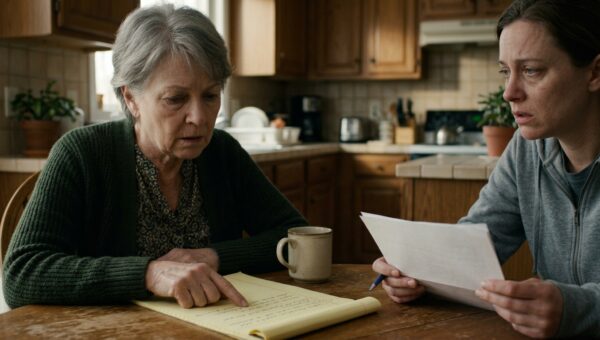
I cut the yarn with my kitchen shears, pulled out the contents, and spread three sheets of heavy yellowed paper across the table under the light.
They weren’t sewing patterns. They were carbon copies of bank loan applications, dated seventeen years ago, bearing my mother’s neat, flowing handwriting. And attached to the back of the third page was a handwritten letter addressed to me, dated just one week before she passed away.
PART 3
I pulled the letter closer to the circle of light and began to read.
My dearest Clara,
If you are reading this, the bank finally found the paper trail I tried so hard to bury. I am sorry, my girl. When Tom got mixed up with those bad loans in the spring of two thousand and nine, the men he owed money to threatened to break his legs if he didn’t pay up by the end of the month. He came to me crying, begging for help we didn’t have. The house was already mortgaged to the hilt, and my credit was shot.
You had just turned twenty-two, and your credit score was clean as a whistle because you always paid your car note on time. Tom knew your Social Security number from the tax forms we filed together. He brought the papers home, and he held the pen for me, but it was my hand that copied your signature onto the line. I let him do it, Clara.
I signed your name because he was my boy, and I was terrified he would end up in prison or worse.
We used the loan to pay off his debts. Every month for twelve years, I mailed money from my sewing machine repair earnings to cover the interest so the bank would never send a notice to your apartment. But when the stroke hit me and my mind started slipping, I couldn’t keep track of the payments anymore. I thought I had burned these copies before I went into the hospital. If Tom hasn’t confessed by now, he never will. Forgive me, Clara. I was trying to save one child, and I ended up breaking the other.
Your loving mother, Helen.
The kitchen was so quiet I could hear the faint hum of the water heater in the utility room.
Seventeen years. My mother had protected my brother by selling my name down the river, and Tom had spent a decade and a half watching her mail checks while knowing the debt was ticking away in my name like a bomb under the floorboards.
I picked up my phone and dialed Tom’s number again.
This time, he answered on the first ring, before the music even finished playing.
“Clara?” he gasped. “Did he leave? Did Vance leave?”
“I found the sewing box, Tom,” I said. My voice didn’t shake anymore. It felt cold, carved out of stone. “I read Mom’s letter. I know about the thirty-one thousand dollars. I know you used my name to pay off your loan sharks.”
“I was going to pay it back,” he stammered, his words tumbling over each other in a frantic rush. “I swear to God, Clara, I tried. But then my truck broke down, and the kids needed braces, and interest rates went through the roof—”
“Stop talking,” I said.
“Clara, please. We’re family. You can’t let them take my house. If the bank comes after me, my wife will leave me. You have savings from your job at the county. You can absorb it—”
“I worked forty hours a week at the insurance office for twenty-five years,” I interrupted, every word coming out slow and hard. “I saved every dollar so I wouldn’t have to depend on anyone. And you and Mom sat at Sunday dinner eating my pot roast while you both knew you had stolen my credit before I even had gray hair.”
“What are you going to do?” he whispered.
“I’m calling Mr. Vance back,” I said. “I’m giving him the carbon copies from Mom’s sewing box, and I’m signing an affidavit of identity theft and forgery. You can explain to the judge why you used a dead woman as an alibi for your crimes.”
“Clara, don’t do this!” he screamed through the speaker. “I’m your brother!”
“No,” I said, looking down at the yellowed papers on the table. “You stopped being my brother seventeen years ago.”
ENDING
I hung up the phone before he could say another word, walked over to the kitchen drawer, and turned his number off my call log so it would never pop up on my screen again.
The sun was dipping below the horizon, painting the sky outside my window in shades of bruised purple and gray. I didn’t cry. The shock had burned itself out, leaving behind a sharp, clean clarity that felt like walking out into a cold morning after a long fever.
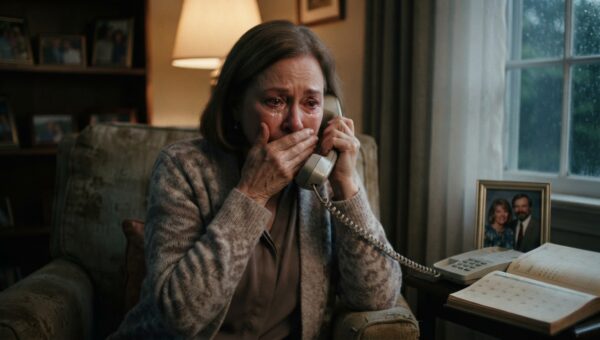
I picked up the landline phone, dialed the direct office number Mr. Vance had left on his business card, and waited for the automated greeting to finish.
When the receptionist came on the line, I didn’t ask for a payment plan, and I didn’t ask for mercy.
“This is Clara Davis,” I told her, my voice steady in the empty room. “Tell Mr. Vance I have the original documents he’s looking for. I’ll be at your downtown office first thing in the morning with a police report and a fraud affidavit.”
I set the receiver down in its cradle, walked back to the kitchen table, and carefully stacked Mom’s letters and loan papers back inside the manila envelope.
Then I closed the heavy wooden sewing box, latched the brass clasp until it clicked, and carried it out to the garage, where I set it on the bottom shelf behind a row of empty paint cans, out of sight and out of mind.