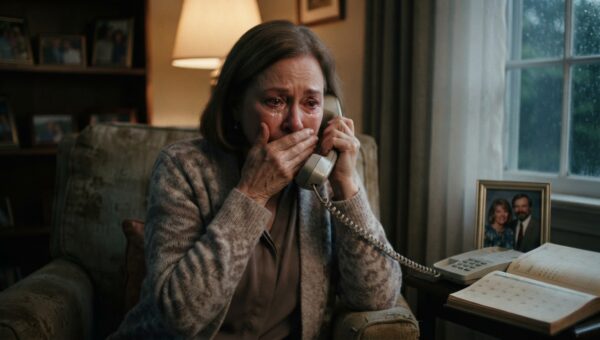
The grass was still wet with dew from the morning mist when Brenda dragged my favorite wicker laundry hamper out the front door and dumped it right into the middle of the lawn.
Twenty-four hours. Terence had not even been in the ground for a full day before they decided I was officially evicted from the premises.
I stood on the bottom step of the porch, clutching a cardigan around my shoulders because the October air had that sharp, biting edge to it.
My knees felt hollow, and the smell of fresh-cut sod mixed with the stale scent of funeral flowers was still thick in my throat. Brenda stood there with her hands planted firmly on her hips, her silver hair pulled back into a tight knot that looked as unforgiving as her expression.
“Now that Terence is gone, you get nothing,” Brenda sneered, her voice carrying across the quiet cul-de-sac like a struck match.
Behind her, Chloe stepped onto the porch with my old copper-bottomed sauté pan in one hand and her smartphone raised in the other. The little red recording light blinked steadily, capturing every humiliating second for whatever family group chat or social media audience she intended to feed. Chloe let out a sharp, practiced laugh that sounded more like a dry cough than anything joyful.
I did not scream. I did not beg or try to reason with them, because by then I already knew that words were entirely wasted on people who measured human worth strictly by bank routing numbers.
I walked down the steps, ignoring the damp grass soaking through the thin soles of my loafers, and bent down to pick up my muddy wedding album where it had landed face-down in the mud. I wiped the dark silt from the embossed leather cover with the flat of my thumb.
“You’re right,” I said quietly, looking straight up into Brenda’s hardened eyes. “I need nothing.”
Three weeks later, the silence in my small apartment over on Mill Street felt heavier than the grief itself. I had spent thirty-four years balancing checkbooks, keeping track of Terence’s chaotic schedule as an independent industrial consultant, and making sure our quiet life in the suburbs stayed peaceful. People always assumed Terence was the sole breadwinner, the one holding the keys to the kingdom, because he drove the company trucks and wore work boots that looked like they had been through a war.
They never knew about the holding accounts. They never knew about the quiet real estate transactions up north or the private tech investments Terence had cashed out four years before his heart finally gave out.
Terence knew his mother and sister better than anyone, and he had watched Howard, his uncle and the family foundation’s managing director, siphon family funds into risky ventures for decades.
“They think I’m a soft touch,” Terence had told me one evening while we sat at our old oak kitchen table, sorting through tax returns with a cup of cold decaf coffee. “They think my name belongs to the whole clan. When I’m gone, Helen, don’t give them an inch. Let them show you who they really are first.”
I had argued with him back then, thinking he was being too hard on his own blood. But standing on that lawn with my clothes scattered in the dirt proved he had read them down to the last syllable.
Two months after the eviction, the first real cracks began to appear in the family fortress. Howard had been counting on Terence’s annual six-figure personal contribution to keep the regional Heritage Foundation solvent through the winter quarter.
Without it, the foundation’s high-profile charity gala, scheduled for the six-month mark after the funeral, was facing a catastrophic liquidity gap.
I found out through Terence’s longtime attorney, Marcus Vance, who called me on a rainy Tuesday morning while I was sitting at my kitchen table reviewing grocery receipts. Marcus had a low, steady voice that always sounded like he was reading the weather report, even when he was delivering news that shook the floorboards.
“Howard’s office called my firm three times this week, Helen,” Marcus said, the rustle of paper coming softly through the receiver. “They are trying to access the primary family trust accounts to cover the catering deposits for the autumn gala. They honestly believe the funds are just tied up in probate delays.”
“And what did you tell them?” I asked, wrapping my fingers tighter around the ceramic mug.
“I told them the primary beneficiary and sole managing trustee has already executed a complete asset freeze,” Marcus replied with a dry chuckle. “Howard turned purple over the phone. He told my junior associate that a widow has no business managing endowment capital.”
Three months later, the pressure on the family reached a fever pitch. Brenda and Chloe had spent the last twenty years living entirely on the generous monthly stipends Terence had quietly deposited into a family disbursement account, assuming the well would never run dry. Now, their credit card bills were bouncing, their country club memberships were suspended for non-payment, and Howard was panicking because he had already sold three full tables at the upcoming charity gala to local city council members and bank executives who expected a massive announcement.
They needed Terence’s money, and they needed my signature to release it, but they still thought I was living out of a suitcase in some cheap motel across town.
The night of the gala arrived with a sharp November frost that turned the streetlights into blurry halos of yellow light. The grand ballroom of the St. Clair Hotel smelled of expensive floor wax, imported orchids, and roasted prime rib. High-society couples in floor-length gowns and tailored tuxedos mingled near the grand staircase, holding flutes of champagne while a string quartet played softly in the corner.
I arrived alone at 8:14 in the evening. I wore a simple midnight-blue silk dress that belonged to my mother, tailored down to my frame years ago, with no jewelry except for my plain platinum wedding band and Terence’s heavy signet ring worn on a silver chain around my neck.
I stepped through the double doors unnoticed, blending easily into the periphery of the vast, glittering room. Across the ballroom, standing near the dais under a massive crystal chandelier, Howard was working the room with a glass of scotch in one hand, laughing a little too loudly at a joke told by the city’s chief zoning commissioner. Brenda and Chloe stood nearby, dressed in matching emerald silk that practically screamed for attention, their faces flushed with the thrill of being back at the center of local philanthropy.
Howard looked radiant, right up until the moment he turned around and saw me standing ten feet away from the podium.
The color drained from Howard’s face so fast it looked like someone had turned off a light switch behind his eyes. He set his scotch glass down so hard on a cocktail table that amber liquid sloshed over the rim and stained the white linen cloth.
Brenda caught sight of me next, and her mouth dropped open in a tight, ugly circle. Chloe stopped mid-sentence while talking to a bank vice president, her phone nearly slipping from her manicured fingers.
I walked slowly across the polished hardwood floor, my heels clicking a steady, unhurried rhythm against the wood. The surrounding chatter seemed to dim slightly as people noticed the small tableau forming near the stage.
Howard hurried over, his jaw working furiously before he managed to slap a tight, oily smile across his mouth. He reached out to grab my arm, but I stepped smoothly to the left, keeping my distance.
“Helen,” Howard hissed, leaning in so close I could smell the expensive mints on his breath. “What in God’s name are you doing here? This is a private ticketed event for foundation contributors. You have no business walking into a room like this looking like a stray.”
I didn’t blink. I didn’t let my shoulders drop. I looked Howard straight in the eye, exactly the way Terence used to when closing a difficult business acquisition.
“You’re right, Howard,” I said, my voice carrying clearly across the suddenly silent circle of onlookers who had turned to watch. “I don’t belong in a room full of people who spend money they never earned.”
Brenda pushed past Chloe, her eyes blazing with suppressed fury as she pointed a trembling finger right at my chest. “You arrogant little nobody! You think you can just show up here after stealing our brother’s sympathy for thirty years? You got nothing! Terence left us everything in his heart, and you know it!”
“Actually, Brenda, that’s not what the paperwork says,” I replied, turning my gaze slowly toward her until she flinched under it.
I reached into the small leather clutch I carried and pulled out a single, folded sheet of heavy cream-colored cardstock bearing the embossed seal of Vance & Associates Legal Counsel. I didn’t hand it to her. I held it out so Howard could read the bold black header at the top of the page.
“Terence left his entire five-hundred-million-dollar estate, every commercial property downtown, and the sole directorship of this very foundation to me,” I said, my voice dropping an octave until it sounded like iron in the quiet air. “And as the sole legal trustee and owner of the primary funding source, I have already signed the dissolution papers.”
Howard stared at the seal, his lips moving silently as his brain tried to process numbers and clauses that completely wiped out his entire financial existence.
“You… you can’t do that,” Howard whispered, his voice cracking on the last word. “The board… the foundation is a family legacy.”
“The family legacy ended twenty-four hours after Terence’s funeral, Howard, when Brenda threw my laundry onto the lawn and Chloe filmed it for their amusement,” I said softly, stepping in close enough that only he could hear the final blow. “Terence knew you all were coming for the money the minute his heart stopped. He structured every single trust account so that the moment you showed your true colors, the vault doors would lock permanently from the inside.”
I turned around slowly, leaving Howard standing frozen under the crystal chandelier with his mouth half-open and his career lying in pieces around his polished shoes. Brenda let out a harsh, choking sound behind me, but I didn’t look back to check on her.
I walked back across the ballroom floor, pushing the heavy glass doors open to the cool November air outside. The city traffic hummed quietly in the distance, and the night sky was clear and bright overhead.
Back home in the quiet house on the edge of town, the restored leather-bound wedding album sat squarely in the center of the wooden mantelpiece, right where the lamplight caught the clean gold lettering on the spine. I poured myself a cup of chamomile tea, walked over to the front window, and watched the headlights sweep across the ceiling as the rest of the world finally went on without me.