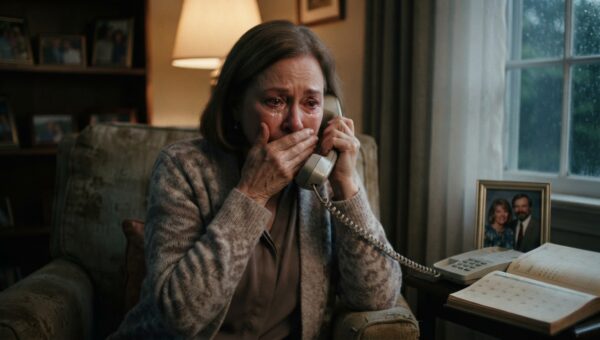
December 1987 smelled of melting slush and wet wool down in the parish basement of St. Jude’s. I remember the radiator clanking against the brick wall, a heavy, rhythmic sound that rattled every time the boiler fired up. My hands were dry from sorting through donated boxes of winter gear, cardboard flaps curling upward in the damp air.
We had forty-two coats on the folding tables that Tuesday morning, most of them frayed at the cuffs or missing buttons.
I was thirty-four back then, with dark hair I wore pinned back so it wouldn’t get in my eyes while I worked. My husband, Arthur, stayed home with our toddler, and I spent my Tuesdays volunteering because the quiet church basement felt easier than my own kitchen sometimes.
The back door creaked open, letting in a bitter gust of wind that smelled of frozen asphalt. A little boy stood in the doorway, his thin denim jacket zipped up only halfway against the sub-zero air. He wasn’t crying, which somehow made it worse. His lips had that distinct, dangerous blue tint around the edges, and his small fingers were tucked deep inside his pockets to keep them from shaking.
“Is this where the church gives away the warm stuff?” he asked. His voice was too small for the room, barely cutting through the clank of the radiator.
I dropped the wool scarf I was folding and walked right over to him.
His name was Marcus Vance, and he was nine years old, though he looked more like seven because he was so thin. He told me he lived in the old apartment complex past the grain elevator, but he didn’t want to talk about his mother or why he was out wandering alone in December without a proper jacket.
“Well, you came to the right place, Marcus,” I told him, kneeling down so I was eye-level with his shivering frame. “Let’s find you something that actually fits.”
We searched through every box until I found a sturdy navy blue parka with a faux-fur hood. It was forty-two dollars and seventy-five cents on clearance, which was more than our weekly grocery allowance at the time, but I paid for it out of my own purse before Arthur could even ask what I spent church funds on. I tucked a pair of woolen gloves into the deep front pockets and made him promise to wear them home.
I didn’t see Marcus again after that afternoon. Life at home got complicated, Arthur took a better-paying job across the county, and the parish basement eventually closed its coat drives down due to rising insurance costs. Thirty-eight years slipped through my fingers like dry sand, filled with piano lessons, high school graduations, quiet Sunday dinners, and eventually the slow, heavy ache of losing Arthur to a bad heart.
By the time I found myself shuffling down the polished linoleum hallways of Oakridge Elementary last month, my knees creaked almost as loudly as the old radiators at St. Jude’s. My granddaughter, Maya, was a fourth-grader there, and she loved to wave to me through the glass partition by the main office whenever I picked her up on early dismissal days.
“Grandma, Mr. Vance wants to see you in his classroom,” Maya told me, tugging at the sleeve of my cardigan while I was adjusting my bifocals near the trophy case. “He’s the new history teacher, and he says he knows you.”
I frowned, trying to place the name. “I don’t think I know any Mr. Vance, honey. Are you sure he didn’t mean someone else?”
“He’s sure, Grandma. He said your name before I even told him who my family was.”
The walk down the second-floor hallway felt longer than it should have, the fluorescent overhead lights buzzing with a faint, steady hum. Oakridge Elementary smelled of floor wax and dry-erase markers, a clean, institutional smell that had nothing to do with parish basements or melting snow. I knocked twice on the heavy wooden door of Room 214, which stood half-open.
A tall man with silver-streaked dark hair and tired, kind eyes stood by the teacher’s desk. The room was completely empty of students, the green chalkboard wiped clean except for a list of vocabulary words written in neat, precise cursive. He turned around slowly as I stepped across the threshold, and for one long second, time didn’t make any sense at all.
“Elijah Miller,” he said softly, using my maiden name, the name I hadn’t heard spoken out loud by a stranger in nearly four decades.
I stopped dead in my tracks, my fingers tightening around the strap of my leather purse. “How do you know that name?”
Marcus Vance walked around the desk, his footsteps echoing softly against the linoleum floor. He wasn’t nine years old anymore, and he wasn’t wearing a thin denim jacket against the wind. He wore a crisp button-down shirt with the sleeves rolled up to his elbows, revealing a small, faint scar across his left wrist.
“Thirty-eight years ago, Mrs. Miller,” he said, his voice catching slightly on the words. “You bought a forty-two-dollar coat for a freezing kid behind JCPenney because you couldn’t stand the look of him shaking.”
The breath left my lungs all at once. I reached out and caught the edge of the doorway to steady myself, my mind racing backward across decades of church bulletins, winter drives, and quiet kitchen tables. “Marcus? You’re that little boy?”
“I was,” he said, and a slow, heavy smile broke across his face. “And you kept social services from hauling me away that afternoon, too, even if you didn’t know it. My mother was inside the store trying to find someone to spot her grocery money, and the authorities were already looking at our family file. That coat… that coat proved I was being looked after. It bought us enough time to get our feet under us.”
Nobody said anything for a second, and honestly, that felt worse than crying. The quiet in that classroom was absolute, heavier than any silence I had ever known.
“I looked for you for years,” Marcus whispered, stepping closer. “After I got through college, after I started teaching right here in this district. I found out your married name through parish records a long time ago, but I wanted to wait until I could do something that actually mattered. Something that paid back what you started.”
He reached down to his desk and picked up a heavy manila folder, sliding a small stack of papers across the wood toward me. I didn’t want to look at them at first, but my eyes dropped down to the bold print at the top of the first page. It was an official school district document, stamped and signed by the superintendent just that morning.
“What is this, Marcus?” I asked, my voice barely a whisper.
“Sixty-eight students at Oakridge had their cafeteria debt cleared yesterday,” he said steadily. “Paid in full, with zero stigma and zero questions asked. And we set up a permanent discretionary fund at the office for coats, lunches, and school supplies. I called it the 1987 Coat & Lunch Legacy Fund.”
I stared at the papers, the numbers blurring behind a sudden rush of hot tears I couldn’t stop. “Marcus, you didn’t have to do all that. That was just a coat.”
“It wasn’t just a coat, Mrs. Miller,” he said, and he reached into his pocket, pulling out a small, flat object wrapped in a clean white handkerchief. He unfolded the cloth on the corner of his desk.
Sitting there under the fluorescent lights was a framed navy blue coat tag from 1987, the exact cardboard label I had snipped off the inside collar of that JCPenney parka before he walked out into the snow. The ink had faded to a pale gray, but my own handwriting was still visible in the margin where I had written his initials in black marker.
“I kept it in my desk drawer through every grade, through college, and now right here in this classroom,” he told me, his voice thick with emotion. “Every time I didn’t think I could make it through a hard semester, I looked at this little tag and remembered that someone cared enough to spend grocery money on a stranger.”
I couldn’t speak. I just reached out and placed my hand over his, feeling the warmth of his skin against mine.
Down the hallway, the heavy front doors swung open, and I saw Maya through the frosted glass of the classroom sidelight, waving her bright pink backpack in the air as she waited for her grandmother to come back down the hall.
Marcus looked out toward the corridor, then back down at me with a quiet, steady peace in his eyes. “Every child deserves a full stomach, Mrs. Miller. And every kid deserves to know someone noticed them.”
We spent the next hour talking about Arthur, about the old parish church that was now a parking lot, and about the kids in Room 214 who didn’t have to worry about lunch money anymore. The eight hundred dollars he had tucked into an envelope for the school fund sat right beside the old coat tag on his desk, a quiet monument to a Tuesday morning that changed everything.
The sun dropped low behind the maple trees outside the window, casting long shadows across the empty classroom floor. When I finally walked out to meet Maya, the cold December air didn’t feel quite so biting anymore, because I knew the warmth we started all those years ago was still burning right where it belonged.