PART 1
I am 71 years old, living on a fixed Social Security income of $1,486 a month, and every single Friday I drive 42 miles to my son’s house to watch my two grandkids for free. That is an 84-mile round trip on two-lane country roads in a twelve-year-old sedan, but I never complained once. I love my grandchildren, ages 5 and 8, and I knew how expensive childcare could be for a young family.
My 39-year-old son, Mark, works long hours in sales, and his 36-year-old wife, Ashley, runs a boutique event planning business from her home office. Last Friday, after spending eight hours keeping the kids entertained, bathed, and fed, I walked into the downstairs bathroom before making my long drive home.
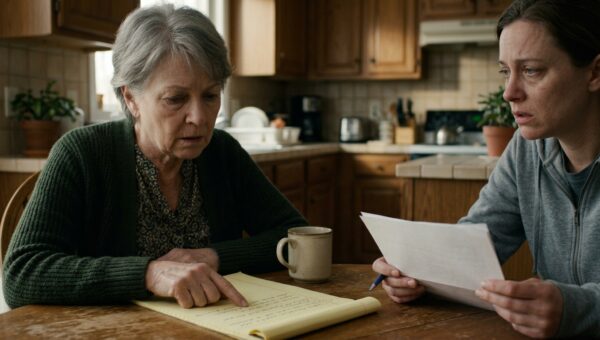
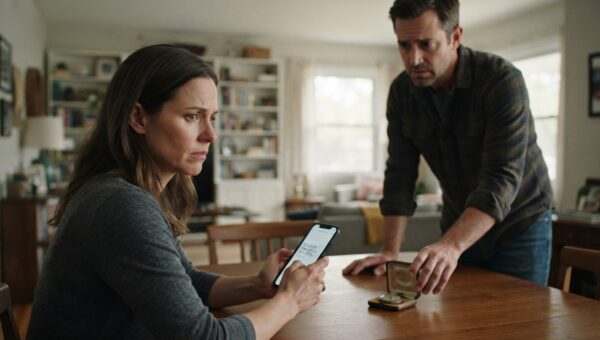
When I stepped out into the hallway, Ashley was standing by the kitchen island with a calculator and a small notepad. Mark was sitting at the dining table, staring intently down at his cell phone.
Ashley looked up at me with a flat, cold expression. She held out a small paper slip.
“What is this, Ashley?” I asked, pulling my reading glasses from my purse.
“It’s $6.84,” she said, her voice loud enough to carry across the room. “You went through two rolls of toilet paper and used half a box of tissue while you were here today. Plus the paper towels you used to wipe the kitchen counters after lunch.
We run a strict household budget, Evelyn. This isn’t a free hotel.”
I froze, holding my breath for a second. I looked over at my son. Mark did not look up. He deliberately turned his phone sideways and tapped at the screen, pretending he was absorbed in an email.
I looked back at Ashley. She held her hand out, palm up, waiting.
My monthly check barely covers my rent, my electric bill, my medication, and the gas it takes to drive out to their house every week. Gas alone costs me nearly forty dollars a week. Yet here was my daughter-in-law, standing in her quartz-countertop kitchen, demanding less than seven dollars for paper goods I used while providing eight hours of free labor for her children.
I did not raise my voice. I did not make a scene. I unzipped my coin purse, pulled out a five-dollar bill, a one-dollar bill, and three quarters. I laid the money on the granite counter beside her notepad.
“Keep the change,” I said quietly.
Ashley picked up the bills without a word of thanks and swept them into her drawer. Mark still would not look me in the eye as I picked up my handbag and walked out the front door into the dark driveway.
That night, sitting in my small apartment, my hands shook as I boiled water for tea. It was not just the seven dollars. It was the total lack of respect, the calculation, and my son’s passive silence. They had turned my love for my grandchildren into a cheap, transactional convenience. But as I drank my tea, a quiet clarity took over. If Ashley wanted our relationship to be purely business, then business was exactly what she was going to get.
The opportunity came sooner than I expected. On Tuesday afternoon, Mark called me.
His voice was lighter than usual, trying to breeze past the humiliation of Friday evening.
“Hey Mom,” he said. “Ashley and I booked a last-minute weekend trip to a resort up in the mountains. We’re leaving Friday morning and coming back Sunday night. Can you stay at the house with the kids?”
I held the phone to my ear, listening to the casual expectation in his voice. He did not apologize for Friday. He did not mention the $6.84. He simply assumed I would jump at the chance to drive 42 miles to serve as their live-in help for three days.
“What time do you need me there on Friday?” I asked, keeping my voice entirely flat.
“Around seven in the morning,” he said, sounding relieved. “The fridge is pretty light, but there’s stuff in the freezer. Thanks, Mom. You’re a lifesaver.”
When I arrived at seven o’clock on Friday morning, Mark and Ashley were already pulling their suitcases toward the garage. Ashley handed me a piece of paper with the WiFi password and the kids’ soccer schedule.
“The kids have everything they need,” Ashley said crisply, tossing her hair back. “We’ll be back Sunday around six. Lock the doors behind us.”
She did not leave a single dollar of cash on the counter. She did not leave a grocery card.
As soon as their car pulled out of the driveway, I walked over to the kitchen and opened the refrigerator.
The shelves were almost completely bare. There was half a carton of expired almond milk, a jar of pickles, a shriveled lemon, and a tub of margarine. I opened the freezer. Inside was an empty ice tray and one half-eaten box of freezer-burned waffles. I checked the pantry: two cans of green beans, a bag of white flour, and an empty box of cereal.
They had left for a three-day luxury vacation and left their 5-year-old and 8-year-old with practically no fresh food, milk, or basic staples, knowing full well that I was on a fixed income of $1,486 a month. They simply expected me to feed their children out of my own pocket.
PART 2
I stood in their kitchen looking at those empty wire shelves, and for the first time in my life, I felt a hard, cold calm settle over me. In the past, I would have quietly driven to the store, paid for everything with my own debit card, cooked their meals, cleaned their house, and swallowed the cost just to avoid conflict. I would have told myself I was doing it for the kids.
Not this time.
I took my grandchildren, Leo and Maya, by the hand and walked them out to my car. For the next three days, I took meticulous care of them. I took them to the grocery store down the street. I bought fresh milk, eggs, bread, fruit, chicken, vegetables, juice boxes, and snacks for their school lunches for the upcoming week. On Saturday night, I ordered them pizza and bought them ice cream. On Sunday afternoon, I replenished the household toilet paper, paper towels, and dish soap so there would be no excuses.
Every single time the cashier handed me a receipt, I did not throw it away or slide it into my purse. I placed it carefully into a small red folder I had brought from home.
By Sunday evening at five o’clock, the house was immaculate. The dishes were washed, the laundry was folded, the children were bathed and in their pajamas, and the refrigerator was fully stocked with fresh groceries.
I pulled out my calculator and my bank app on my phone. Over those three days, I had spent exactly $327.18 out of my checking account. That was nearly a quarter of my entire monthly Social Security check.
I sat down at their kitchen table, pulled a fresh sheet of paper from my purse, and began to write.
I laid out every receipt in a long, neat, chronological line across the polished granite island, right next to the sink where Ashley had stood two days prior. I taped the receipts together in one continuous strip so none of them could be misplaced or overlooked.
At six o’clock, I heard their garage door open.
I did not wait for them to come inside. I gathered my overnight bag, kissed Leo and Maya on their heads, walked out the front door, and got into my car. I started the engine, pulled out of the driveway, and began the 42-mile drive back to my own home.
When Mark and Ashley stepped through their mudroom door, the house was dead quiet, and the kitchen island was waiting for them.
It took less than twenty minutes for my phone to ring. Mark’s caller ID flashed across the screen.
I did not answer on the first ring. I let it ring four times before I picked up and pressed the phone to my ear.
“Mom?” Mark’s voice came through the speaker, tight, panicked, and heavily strained. “Mom, what is this on the counter?”
“It is a business statement, Mark,” I said calmly, looking out at the highway ahead of me. “Read the note.”
PART 3
There was a long pause on the line. I could hear Ashley in the background, her voice raised in a sharp, frantic tone, rustling the paper on the counter.
“Mom, this is ridiculous,” Mark stammered, his confidence completely gone. “You left a bill?”
“Read the note out loud to me, Mark,” I said. “Read every word.”
I heard him clear his throat. His voice shook slightly as he read the words I had written in dark ink on that white sheet of paper:
“Dear Mark and Ashley:
Since this isn’t a free hotel, it is no longer a free daycare.
Below is an itemized ledger for the weekend of Friday the 14th through Sunday the 16th:
1. Grocery, meal, and household supplies for Leo and Maya: $327.18 (Receipts attached).
2. Professional weekend childcare: 60 hours at $25.00 per hour = $1,500.00.
3. Mileage reimbursement: 84 miles at $0.67 per mile = $56.28.
Subtotal: $1,883.46.
Minus credit for paper products used on previous visit: -$6.84.
TOTAL DUE UPON RECEIPT: $1,876.62.
Please transfer this balance to my account by Monday at 5:00 PM. If you would like to book my services for next Friday, my weekend rate must be paid in advance. Otherwise, my free weekly visits have permanently concluded.”
When Mark finished reading, the line went dead silent.
“Mom,” Mark finally breathed out, sounding like he had been punched in the stomach. “You can’t be serious. You’re charging your own son for watching his kids? Ashley is furious. She says you’re being petty over a joke from last week.”
“It wasn’t a joke, Mark,” I said, keeping my tone perfectly level. “Ashley looked me in the eye, took six dollars and eighty-four cents from a 71-year-old woman living on fourteen hundred dollars a month, and told me your home wasn’t a free hotel. You sat at the table and stared at your phone because you were too cowardly to tell your wife she was being cruel to your mother.”
“Mom, please—”
“You left your children for three days with an empty refrigerator,” I continued, interrupting him without raising my voice. “You expected me to spend twenty-five percent of my monthly income to feed your family while you sat at a resort. You treated my love for my grandchildren like free labor you were entitled to exploit.”
In the background, I heard Ashley grab the phone from his hand. Her voice came through sharp and furious.
“Evelyn! You are acting completely ungrateful!” she yelled. “We let you into our house! We let you spend time with the kids! You think you can just hand us an invoice for eighteen hundred dollars? You won’t see a single dime of that daycare fee, and if you walk away now, don’t expect to be invited back next Friday!”
I took a slow, deep breath. The fear that used to grip me whenever Ashley threatened to withhold the grandkids simply vanished.
“Ashley,” I said quietly. “You don’t seem to understand the situation. The $327.18 for groceries is not optional. That was spent to feed your children because you left them with nothing. If that $327.18 is not back in my bank account by noon tomorrow, I will take the receipts, the photo I took of your bare refrigerator on Friday morning, and this invoice directly to small claims court. And I will make sure Mark’s family knows exactly why I had to file it.”
“You wouldn’t dare,” she gasped.
“Try me,” I said. “And as for next Friday, you are correct. I will not be there. You will need to find and pay a professional daycare service. Have a good evening.”
I hung up the phone before she could say another word, laid it on the passenger seat, and drove the rest of the way home in peaceful silence.
ENDING
At ten o’clock the next morning, my phone chimed with a bank notification.
I opened the app. A direct transfer of $327.18 had been deposited into my account, accompanied by a smaller separate transfer of $56.28 for gas. Mark had sent it from his personal account.
A few minutes later, a text message came through from Mark.
“Mom, the money for the groceries and gas is in your account. I am sorry. I should have spoken up on Friday. Ashley and I are working through some things. Please… can we talk about the kids?”
I sat at my small kitchen table, sunlight pouring through the window, warming my hands as I held my coffee cup.
I replied with a short message: “I love Leo and Maya with all my heart. They are welcome to spend weekends at my home whenever you want to bring them to me. But I will never step foot inside your house again until I am treated with respect. My commute is over.”
He replied almost immediately: “I understand. I’ll bring them to you this Saturday.”
It has been three weeks since that Sunday evening.
Ashley has not spoken to me, and that suits me just fine. But this morning, Mark drove forty-two miles to my apartment, carrying Leo and Maya’s small overnight bags up my front steps. He looked tired, but when he looked at me, he didn’t avert his eyes. He looked me straight in the face, handed me a box of pastries from the bakery downtown, and thanked me quietly for taking the kids for the afternoon.
I did not charge him a dime for today. I made lunch for my grandchildren, read them stories, and watched them play on the rug in my small living room.
My fixed income is still $1,486 a month, and my car still has over a hundred thousand miles on it. But as I sit on my sunlit porch this Friday morning, sipping my warm coffee with my car parked peacefully in the driveway, I know one thing for certain.
I paid $6.84 for a roll of toilet paper, but I bought back my dignity, and that was worth every single penny.