I got the math wrong for twenty-two years. I measured our marriage in cold silences and empty chairs, adding up every perceived slight until the total was too heavy to carry. I thought I knew exactly who Robert was. I thought he was the man who stood beside our son’s open grave in the bitter December of 1965 with dry eyes and a jaw set so hard it looked like carved stone.
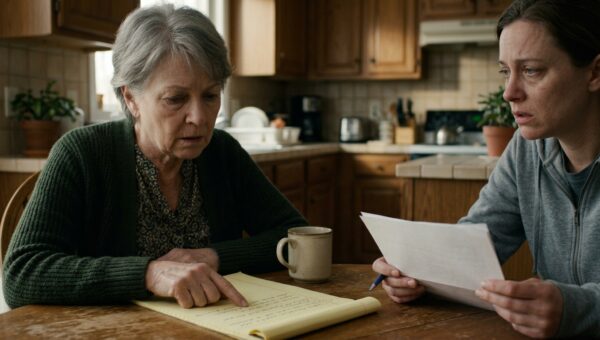
The funeral director’s office smelled of stale coffee and damp wool. Outside, the slush was turning gray against the curbs of our old town, exactly the kind of wet, miserable afternoon Robert had always hated. Arthur, the director, slid a manila folder across the polished laminate desk without looking up. He had handled my family’s sorrows for decades, starting with David, and his hands moved with a practiced, somber efficiency that always made my skin crawl.
“There was an envelope left in his desk drawer, Martha,” Arthur said, his voice dropping into that low, practiced register people use around the newly bereaved. “His lawyer brought it over this morning. He asked that it be given to you directly after the service.”
I didn’t reach for it right away. Robert had been gone three days from a sudden stroke that took him before he could even finish his coffee on the front porch, and the house still felt wrong.
It felt hollowed out. I sat there with my wool coat buttoned to the top, my fingers hooked around the strap of my old leather purse, staring at the manila tab. I expected a copy of his meager will, maybe the deed to the small house on Elm Street, or instructions about the meager pension he had drawn from the county water department.
Arthur tapped the corner of the folder. “There’s also this receipt from the medical center downtown. It came addressed to him last month.”
I finally looked down. The paper was thin, yellowed at the edges like old ledger stock, but the stamp was recent. The total printed at the bottom was nine thousand two hundred dollars. My eyes tracked up to the description line, and the room seemed to tilt slightly on its axis. It was an itemized pediatric care balance, dated back to the winter David spent his final eleven days in an oxygen tent.
“He paid this,” Arthur murmured, watching my face carefully. “Every single year. Small chunks, mostly around what would have been David’s birthday and the anniversary of the funeral. He’d come in with a cashier’s check, pay off four hundred here, three hundred there. Took him more than two decades to clear the ledger.”
My hands went entirely numb. I couldn’t feel the leather strap of my purse anymore. The silence in the small office stretched out, thick and suffocating, until I finally managed to shake my head.
“Why?” I managed to get out. The word felt dry and small in my mouth. “Why would he pay that off in secret? We divorced that winter. We split everything. We agreed to walk away clean.”
Arthur didn’t answer right away. He reached into the folder, turned a page, and slid a folded piece of lined paper toward me. It was an old grocery list, the blue ink faded and smudged.
On the back, in Robert’s blocky, uneven handwriting, were columns of dates. March fourteen. April twelve. May nineteen. Every single month, stretching back twenty-two years, marked with a tiny checkmark beside each one.
“He didn’t just pay the hospital,” Arthur said softly. “He went to the cemetery every month, Martha. Rain or shine. He’d park down by the maintenance shed and walk up through the pines so nobody would see him.”
The kitchen on Elm Street used to smell of burnt toast and wet boots during those final years before the divorce. After David died at sixteen, our house became a tomb where nobody spoke above a whisper. We walked around each other like strangers sharing a boarding house, careful not to bump into the furniture, careful not to mention the empty room at the end of the hall where David’s guitar still leaned against the radiator.
I remembered the morning of the funeral more clearly than I wanted to. The ground was frozen solid, and the wind off the river was sharp enough to cut through wool. Robert had stood at the foot of the bronze casket, his hands shoved deep into his overcoat pockets, his face pale and completely blank. Not a tear. Not a sigh. When the pastor placed a comforting hand on his shoulder, Robert had simply shrugged him off with a sharp, violent jerk and stared straight ahead at the fresh dirt.
I had looked at him through my black veil and felt something inside me snap clean in half. My own heart was tearing apart in my chest, every breath feeling like swallowing broken glass, and there he stood, as cold and unmoving as a granite headstone. I told myself right then, standing in that freezing wind, that he had never really loved our boy. I told myself he was made of iron and indifference. By January, I had packed my bags and moved across town to my sister’s spare room, filing for divorce before the spring thaw could even begin. He didn’t contest it. He just signed the papers without a word, handed them back to his lawyer, and disappeared into that quiet little house by the water department.
Now, sitting in Arthur’s office, the weight of those twenty-two years began to shift, pressing down on me with a terrifying, suffocating clarity.
“Look at the last page,” Arthur whispered, pointing a manicured finger at the bottom of a stapled document from Robert’s pre-arrangement file. “His personal statement. He wrote it down for the records just last month, right after his doctor gave him that bad news about his heart.”
I pulled the paper closer. My fingers were shaking so badly I could barely trace the lines. Robert’s handwriting was messier than I remembered, scrawled in blue ballpoint ink near the signature block.
*He never knew I was the one who stayed when the nurses told everyone else to go home.*
I stopped breathing. The office around me seemed to fade away until there was only that one sentence staring up from the page.
“What does this mean, Arthur?” I whispered, my voice cracking entirely. “What is he talking about?”
Arthur sighed, leaning back in his squeaky leather chair and rubbing the bridge of his nose. “Robert talked to me a few weeks ago when he came in to set up his own marker. He knew his ticker was giving out. He wasn’t a well man, Martha. He hadn’t been for a long time. He told me things that day he’d kept bottled up since the hospital.”
He leaned forward again, resting his elbows on the desk. “You remember the night before David passed, don’t you? The nurses made you go down to the family lounge to get some sleep because you hadn’t closed your eyes in three days.”
“I remember,” I said, a cold dread washing over me. “I fought them on it, but I collapsed in the chair.”
“You did,” Arthur nodded gently. “And when you woke up at four in the morning and rushed back to the room, Robert was sitting in the vinyl chair by the bed, and David was gone. You looked at Robert’s face, and you thought he just didn’t care because he wasn’t crying.”
“He looked dead himself,” I choked out. “He just stared at the wall.”
“He wasn’t indifferent, Martha. That was shock. Catatonic shock,” Arthur said, his voice steady and heavy. “And worse than that, Robert carried a terrible, crushing guilt that he never shared with a living soul. He was the one who insisted on waiting three hours before calling the specialist when David first complained about the pain in his side during dinner that week. He thought, in his own tortured mind, that those three hours were the reason the infection took hold. He believed, right up until the day he died, that he had killed his own son.”
The room spun. I reached out and caught the edge of the desk to steady myself, my breath catching in my throat. “That’s… that’s insane. The doctors told us it was an aggressive strain, that nothing could have stopped it once it settled in. I told him that. We all heard the chief physician say it.”
“You told him, yes,” Arthur said softly. “But a man doesn’t listen to reason when his boy is lying in a white bed with tubes in his arms. Robert blamed himself every single second of every single day. He thought if he showed grief, if he broke down and cried like you did, it would mean he was admitting his guilt out loud. So he locked it all inside. He built a wall out of silence because he thought he didn’t have the right to share your sorrow.”
I sat there in the quiet office, the ghosts of two decades rising up around me like dust in a shaft of sunlight. All those years I spent cursing his name, hating him for his coldness, writing him off as a monster who felt nothing when our only child was lowered into the ground. All those years, while I was nursing my resentment like a precious heirloom, Robert was working down at the water department, saving every spare dollar to pay off the hospital that had failed to save our boy, visiting a lonely patch of grass once a month with an old grocery list in his pocket.
“He left something else in the lockbox at his house,” Arthur added, sliding a small brass key across the desk. “He wanted you to have it, too. He said if you ever came to understand, you’d know where to look.”
The drive back to Elm Street took twice as long as it should have. The snow had started again, wet flakes sticking to the windshield and melting into gray streaks under the wipers. When I let myself into Robert’s house, the air was cold and smelled faintly of pipe tobacco and peppermint tea. It was entirely unlike my own home; there were no framed photographs on the walls, no rugs on the bare hardwood floors, just a narrow cot in the corner of the small bedroom, a reading lamp, and a tall stack of books about local history.
I found the lockbox in the bottom of his small metal desk, right where Arthur said it would be. It didn’t take much effort to turn the brass key. Inside sat a thick ledger, bound in black oilcloth, and a single handwritten letter addressed to my maiden name in that familiar, blocky script.
I didn’t open the letter right away. I sat on the edge of his narrow cot and opened the black ledger instead. Page after page was filled with small, neat columns of numbers, household expenses, grocery budgets, and beside each one, a precise calculation of what he had sent down to the hospital billing office that month. Tucked between the pages were old Polaroids of David taken when he was eight years old, riding his red Schwinn bicycle down by the creek, laughing into the camera with a gap-toothed smile. Robert had kept them hidden away in the dark, away from the bitter arguments, away from the divorce court, away from the life we had torn apart.
The final entry in the ledger was dated just three days before he died. It was a note to himself, written in a hand that had grown shaky and weak near the end.
*Paid the final balance today. David would have been thirty-eight this year. I wonder if she still hates me. I hope she knows I never stopped walking with him.*
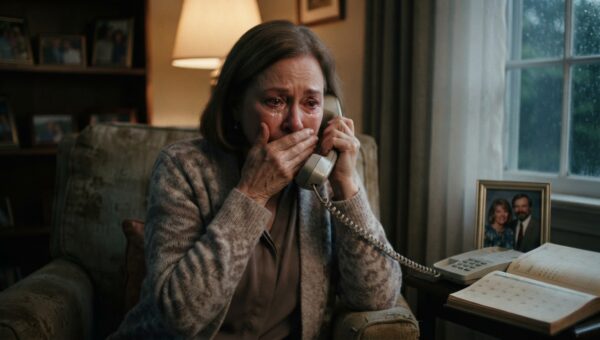
The tears finally came, not as a sudden flood, but as a slow, heavy ache that seemed to rise up from the marrow of my bones. I wept for the boy we lost in the winter of 1965. I wept for the man who lived twenty-two years in total isolation because he thought his grief was a crime. And most of all, I wept for myself, for the twenty-two years I spent building a monument out of a misunderstanding, locking my heart away behind walls just as high and cold as the ones Robert built.
The next morning, the snow had stopped, leaving the town wrapped in a thick, blinding white silence. I didn’t call anyone. I walked down to the small neighborhood florist near the square and bought a single bunch of white carnations, wrapping them in brown paper just the way Robert used to do.
The cemetery was deserted when I got there. The wind was still cold, biting at my cheeks and rattling the bare branches of the maples overhead. I walked past the row of old slate markers until I reached David’s headstone, the gray granite standing firm against the drifts.
Beside it, in the damp earth where the snow had been carefully brushed away, was a small, neat depression in the grass, the exact spot where another pair of boots had stood month after month, year after year, in rain and sleet and freezing cold, while I sat across town nursing my anger.
I knelt down in the wet slush, ignoring the cold soaking through the knees of my slacks, and laid the white carnations across both markers. I reached into my coat pocket and pulled out the old grocery list with the faded dates, holding it tight against my chest as the winter wind swept across the open hill.
“I know,” I whispered into the empty air, the words catching in my throat and dissolving into the quiet morning. “I know now, Robert. You can rest.”