PART 1
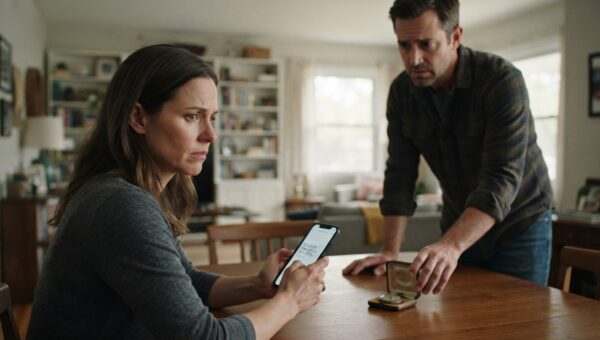
The envelope from the Internal Revenue Service sat on the kitchen counter between a half-empty mug of coffee and a stack of overdue utility bills, looking far too thin to carry that kind of weight. When I slit the top open with a butter knife, my thumb left a gray smudge across the corner of the paper. I figured it was an audit notice for our household deductions, or perhaps a minor penalty for a late quarterly filing on my freelance design work.
Instead, the bold print near the top cited corporate withholding deficiencies for Sterling Commercial Holdings, totaling $74,850.
My name was listed as the sole managing partner responsible for the balance.
I stared at the figures until the numbers began to blur together under the fluorescent overhead light. Sterling Commercial Holdings was the family-owned accounting firm where my wife Elena and her sister Chloe ran daily operations. I had never held an executive title in the firm. I was a minority equity holder on paper, a formality set up years ago when Elena and I pooled our early savings to help Chloe lease office space in downtown Columbus. My actual job was two towns over, managing inventory logistics for a regional supply warehouse during the day and taking freelance drafting contracts at night to keep our mortgage current.
I picked up my phone and dialed Elena while pacing across the linoleum floor.
She answered on the fourth ring, her voice tight with the background hum of the firm’s main copier.
“Marcus, I’m right in the middle of month-end reconciliations with Chloe,” she said before I could speak. “Can this wait until I get home tonight?”
“An IRS notice just arrived at the house,” I said, keeping my voice level despite the tightness in my chest. “It’s addressed to me personally for seventy-four thousand eight hundred fifty dollars in unpaid corporate withholdings for Sterling Holdings.”
There was a sharp intake of breath on the other end, followed by the muffled sound of a door clicking shut as Elena moved into a private office.
“That has to be a mistake,” she whispered. “Our corporate returns are filed through Chloe’s department. You aren’t even on the active payroll account.”
“Tell that to the federal government,” I said. “The notice says I signed the liability waiver making myself primary guarantor. When did I sign a liability waiver for the firm, Elena?”
Silence stretched across the line, heavy and unresolved.
“I don’t know,” Elena finally murmured. “Chloe handles all the structural filings with the state. Let me look into it.”
She hung up without offering any reassurance. I walked over to the window and looked out at our gravel driveway where my ten-year-old sedan sat with a slow leak in the front tire. For two years, while Elena and Chloe poured every spare dollar into expanding the firm’s commercial portfolio, I had worked sixty hours a week, covering groceries, braces for our oldest daughter, and health insurance. I had trusted them to handle the paperwork because numbers were their world, not mine.
That trust had just cost me seventy-four thousand dollars.
Two hours later, Elena walked through the front door, looking pale and exhausted. She dropped her leather tote bag onto the entryway bench and avoided my eyes.
“I talked to Chloe,” she said, her voice strained. “She told me not to panic. She said there was an administrative restructuring six months ago when you were hospitalized with pneumonia. She said the state required an active signature from a partner to keep our small business tax status, and since I was tied up with the audit committee, Chloe had you sign the paperwork at the kitchen table before you left the hospital.”
I stopped walking across the room. My throat went dry.
“I was in Mercy Hospital on intravenous antibiotics for five days with bilateral pneumonia,” I said slowly. “I couldn’t even walk to the bathroom without a nurse holding my arm. I never signed any corporate restructuring papers.”
“Chloe swears she brought the portfolio to your bedside table,” Elena insisted, though her defense lacked conviction. “She said you were groggy from the medication, but you agreed to it so the firm wouldn’t lose its operating license.”
“She forged my name,” I said.
“Marcus, don’t say that,” Elena snapped, her defensive instinct flaring up to protect her sister. “Chloe is a certified public accountant. She has two kids to put through private school. She wouldn’t risk her license over a routine filing.”
“Then explain why the federal government is demanding seventy-four thousand dollars from a man who hasn’t stepped foot inside the accounting office in two years,” I said.
I turned away from her, realizing then that the real battle wasn’t just going to be with the IRS. It was going to be convincing my own wife that her sister was capable of selling us out to keep her business afloat.
PART 2
The following morning, I bypassed the office and drove straight to downtown Columbus to see a corporate attorney recommended by an old college friend who worked in commercial real estate. Attorney Arthur Vance no relation, despite the shared last name pushed his wire-rimmed glasses down his nose as he scanned the IRS notice and a copy of the amended LLC operating agreement I had pulled from the Ohio Secretary of State online portal the night before.
“This signature is remarkably clean for someone who was supposedly heavily medicated with pneumonia,” Arthur said, tapping his pen against the digital signature block on page four of the amendment. “In fact, it is too clean. It matches your standard corporate signature down to the loop on the capital M, but the electronic timestamp indicates it was uploaded from an IP address originating inside the Sterling Commercial Holdings office subnet at 2:14 PM on a Tuesday. Were you at the office that Tuesday?”
“I was in bed at home with a fever of one hundred and three, waiting for home health nurse visits,” I said. “My medical chart from Mercy Hospital lists my discharge date as three days after that timestamp.”
Arthur leaned back in his leather chair and folded his hands across his stomach.
“If what you are saying is accurate, your sister-in-law didn’t just make an administrative shortcut,” he said. “She committed digital forgery and securities fraud under federal withholding guidelines. By shifting primary liability to you, she insulated her personal assets and the firm’s primary accounts from any tax deficiencies resulting from their recent expansion.”
“How do we prove it?” I asked.
“We need the server access logs from Sterling Holdings for that specific week,” Arthur said. “And we need a forensic accountant to trace where the firm’s actual cash reserves went during the quarter those taxes were supposed to be paid. Seventy-four thousand dollars doesn’t just vanish. It gets shifted somewhere.”
I left his office with a formal request for production of records and a heavy sense of dread settling into my ribs.
When I got home, Elena was sitting at the kitchen island with her laptop open, staring blankly at an Excel spreadsheet. She looked up as I walked in, her eyes red-rimmed.
“I went through the firm’s general ledger today after hours,” she said quietly. “Chloe wasn’t at her desk. I found… I found some transfers.”
I set my keys on the counter. “What kind of transfers?”
“Three separate wire transfers totaling seventy-five thousand dollars out of the corporate tax withholding account,” she whispered. “They went into a private holding account registered under Chloe’s name and her husband’s construction LLC. She used our tax money to bridge a gap on their new commercial building loan.”
The anger that had been simmering in my chest suddenly turned cold and sharp. I didn’t yell. I didn’t slam my fist against the counter. I just looked at my wife, seeing the complete collapse of her denial in real time.
“And she let the IRS come after me,” I said.
“She told me she intended to pay it back once their commercial loan cleared next month,” Elena cried, her voice cracking. “She swore it was just a temporary bridge loan. She didn’t think the IRS would audit the withholding account so quickly.”
“Temporary or not, she put my name on a federal liability document without my consent while I was sick in bed,” I said. “She used me as an invisible financial safety net so she wouldn’t have to face her own bad investments.”
“What are you going to do?” Elena asked, her voice trembling as she reached for my hand.
“I’m filing the formal fraud affidavit with Arthur tomorrow morning,” I said, pulling my hand away gently. “And Chloe is going to have to explain to the state board of accountancy how her office IP address generated a forged signature.”
Elena didn’t try to defend her sister anymore. She buried her face in her hands and started to weep, the realization finally catching up to her that her family loyalty had just destroyed her marriage and her sister’s professional life.
PART 3
Two weeks later, the conference room at Arthur Vance’s law firm smelled faintly of old paper and carpet cleaner. Chloe sat across the cherrywood table, flanked by a defensive attorney she had retained from a downtown corporate defense firm. Chloe looked smaller than she usually did, her expensive silk blouse slightly wrinkled, her eyes avoiding mine entirely.
Arthur slid a thick compilation of documents across the polished table.
“These are the certified server access logs from Sterling Commercial Holdings, matching the timestamp of the LLC restructuring amendment,” Arthur said smoothly. “They confirm that the document was authenticated using administrator credentials assigned exclusively to Chloe Sterling, uploaded from her workstation while Mr. Vance was documented by his physician as being confined to bed with acute pneumonia.”
Chloe’s attorney flipped through the pages, his expression shifting from professional confidence to guarded skepticism as he examined the IP routing data. He glanced sideways at his client.
“Is this correct?” the attorney asked quietly.
Chloe swallowed hard, her jaw tight. “We needed liquidity for the firm,” she muttered defensively, her voice lacking its usual sharp authority. “If we didn’t restructure the liability tiers, the commercial bank would have called our operating loan. I protected the business.”
“You didn’t protect the business, Chloe,” I said, leaning forward across the table. “You protected your own investment by committing felony fraud and dropping a seventy-four-thousand-dollar tax bomb on a man who has worked sixty hours a week to keep his own family afloat.”
“You were a silent partner,” Chloe snapped, her temper finally flaring through her panic. “You didn’t contribute a single hour to managing the firm’s accounts. You just sat back and collected equity while Elena and I built this place from scratch.”
“I contributed our life savings twelve years ago to help you lease this office,” I said, my voice steady and cold. “And when you ran out of money, you chose to forge my signature rather than admit your commercial loan was failing.”
Arthur raised a hand to cut off the argument.
“Here are the terms for resolution,” Arthur said, sliding a final agreement toward Chloe’s counsel. “First, an immediate amended corporate filing restoring full equity ownership to Mr. Vance and removing him from all secondary tax liabilities. Second, a formal confession of judgment transferring the full seventy-four-thousand-dollar IRS liability back to Sterling Commercial Holdings and Chloe Sterling individually. Third, a stipulated report to the state board of accountancy regarding the falsification of corporate governance records.”
Chloe’s attorney stared at the document for a long moment, then looked at Chloe.
“If we don’t sign this,” the attorney said plainly, “the state’s attorney general will have this in front of a grand jury by Friday morning on federal fraud charges.”
Chloe looked across the table at me, her eyes pleading for some kind of family mercy. But there was nothing left to say. She looked down at the pen on the table, her hand shaking slightly as she pulled it toward her and signed her name to the papers that stripped her of her executive standing at the firm.
ENDING
“`text
The sun was setting behind the treeline when I pulled into our driveway that evening. The front tire on my sedan still had a slow leak, but the heavy pressure in my chest was finally gone.
Inside the kitchen, the IRS notice had been replaced by a certified compliance letter from Arthur’s office confirming that the tax liability had been legally reassigned to Chloe’s commercial holding account. Elena was sitting at the kitchen island, quietly packing a small box of family photo albums that had once belonged to her and Chloe’s shared childhood. She didn’t look up as I walked in, but she didn’t need to. We had months of rebuilding ahead of us, and the family dynamic would never be the same again, but the foundation was ours once more.
I picked up the empty coffee mug from the counter, washed it in the sink, and placed it upside down on the drying rack. For the first time in months, the house was completely quiet.