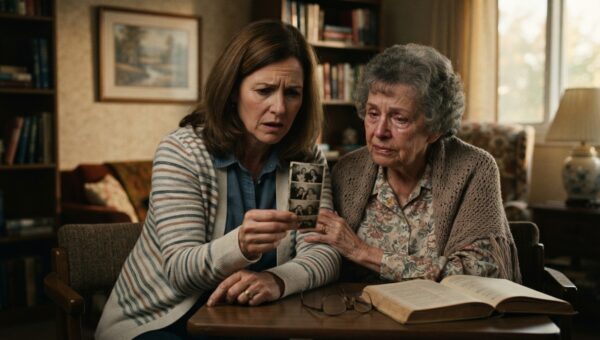
Seven hundred and twenty dollars was the electric bill we got in January of ninety-two, right after Arthur had to quit his shift down at the plant because his chest wouldn’t stop rattling when the wind turned east. I remember sitting at the amber formica table with a yellow legal pad, licking the lead of my pencil the way my mother used to do when she was figuring up the feed store ledger, trying to decide if we could squeeze twenty dollars out of the grocery envelope to pay the meter man before he slapped the red tag on the side of our box.
Arthur didn’t say a word. He just sat there with his wool sweater pulled tight across his ribs, watching the steam rise off his black coffee like he was trying to read shapes in it, his hands scarred pink around the knuckles where the hot grease from the turbine housing had bit him three summers back.
That was the life we built. Brick by brick, payment by payment, stretching a single maintenance paycheck over thirty-two years in a house on Elm Street that always smelled slightly of damp pine needles and the old kerosene heater Arthur insisted on tinkering with every October. When he went in ninety-eight, the doctors told me it was the scarring in his lungs, sixty percent of his capacity gone from what they called industrial exposure, though Arthur never called it that. He called it Tuesday. He called it the normal wear and tear of keeping thirty-four boilers from blowing the roof off Route Nine.
I kept the ledger going after he died. Every month on the fifteenth, I’d write out the check for the mortgage principal and interest, sixteen years of it left when the bank took over the second note after the funeral expenses cleared out our savings. By last Tuesday, I was down to the last ninety-six months. Eight years. I figured if my knees held out and I didn’t need any new teeth, I’d be square with the world by the time I hit eighty-one.
Chloe had driven me down to the branch on Fourth Street because my left eye has been acting up since the first frost, making the yellow traffic lights smear out like lanterns in a fog. She’s sixteen now, all long legs and sharp questions that she asks while she’s winding her hair around her thumb. We were standing by the little standing counter where they keep the deposit slips and the Bic pens with the chewed-off caps when young Mr. Henderson called my name from behind the glass.
“Mrs. Collins,” he said, and his voice sounded like he’d swallowed a mouthful of gravel. “Can you come back here for just a second?”
I didn’t think anything of it. You don’t think much when you’ve banked at the same brick box since the Carter administration. I walked behind the little half-door, my rubber-soled shoes squeaking on the linoleum, and Chloe trailed right behind me like a shadow with a backpack. The computer monitor on the desk was still lit up with my account number at the top in green numbers, and beside it was a name I hadn’t heard in years, though I didn’t know it yet.
Mr. Henderson looked like he’d seen a ghost in the vault. His hands were shaking slightly as he laid a white handkerchief on his blotter.
“Who was that man who was just sitting in the third chair?” Chloe asked, pointing toward the lobby where the leather seats were still indented. “He looked like he was crying, Grandma.
He stood up so fast he knocked his pen on the floor.”
I looked at Mr. Henderson. Mr. Henderson looked at the green screen.
“That was Mr. Vance,” the manager whispered, and he cleared his throat twice like he was trying to dislodge a button. “Julian Vance. He was looking at the ledger history for the routing numbers on your escrow account, Mrs. Collins. He saw your signature populate on the terminal when I pulled up the monthly draft.”
“Well, Julian Vance is a stranger to me,” I said, smoothing down the front of my cardigan. “Unless he’s the fellow who bought the hardware store from the Millers, but he looked too old for that.”
Mr. Henderson didn’t answer right away. He turned his computer screen toward us just enough so we could see the bottom line, where the red figures usually sat like a small anchor at the base of my month. The red was gone. The numbers were all zeros, right down to the last cent of the principal, followed by a little stamped note that looked like it had been tapped out on an old manual typewriter before being scanned in.
“Your mortgage has been paid in full,” Mr. Henderson said, and he didn’t look at the screen anymore; he looked straight at my chin. “Anonymous cashier’s check delivered by courier thirty minutes before you walked through the door. One hundred and fifteen thousand dollars. And there was a letter attached, Mrs. Collins. The teller read it before she put it in the drawer.”
I didn’t feel my heart stop. I just felt my knees get very heavy, like I was standing knee-deep in wet creek sand. I looked at Chloe, and Chloe was staring at the monitor with her mouth slightly open, her fingers hooked into the straps of her canvas bag.
“What do you mean, paid?” I asked. “I’ve got ninety-six checks left in the box at home.”
“You don’t have any checks left,” Mr. Henderson said softly. He reached into his drawer and pulled out a heavy cream-colored envelope with my name written across the front in block letters that looked like they’d been drawn with a ruler. “He left this for you. He wouldn’t wait. He saw your name on the terminal, and he just walked out the side door toward the alley.”
The next twenty-four hours were quiet. Too quiet. The kind of quiet where you can hear the ice maker in the refrigerator dropping cubes from three rooms away. I didn’t sleep on Tuesday night. I sat in the green armchair by the radiator with the cream envelope on my lap, turning it over between my fingers until the paper was soft at the corners. I didn’t want to open it until I knew what was inside, and then I was terrified of what was inside.
Chloe came over before school on Wednesday with a thermos of coffee she’d made herself, burnt around the edges the way Arthur used to like it. She sat on the floor by my feet, her shoulder leaning against my knee.
“Grandma, read it,” she said. “You’ve been staring at the crest on the back since yesterday.”
I took the small silver butter knife from the side table and slid it under the flap. Inside was a single sheet of heavy linen paper, the kind they sell in stationery shops downtown where the boxes cost twenty dollars apiece. The handwriting was large and a little shaky, the way men write when their hands have been broken once or twice by heavy machinery.
Dear Mrs. Collins, your late husband saved my life in 1987. Factory fire on Route 9. I was 22. He carried me out. I’ve been looking for family for 36 years. I’m sorry I couldn’t say it in person. Please tell his grandchildren he was…
The note stopped right there. No signature at the bottom, just a blank space where the ink had feathered slightly into the grain of the paper.
“Eighty-seven,” I said out loud, though I was talking more to the wallpaper than to Chloe. “That was the year of the flare-up in number four turbine. Arthur came home smelling like burned rubber and hair for three days straight. He wouldn’t let me wash his jacket in the machine; he made me take it out to the garden hose because he said the grease would ruin the agitator.”
“Grandma,” Chloe whispered, her hand coming up to touch my wrist. “The fire on Route 9. That was the one where the roof came down on the west wing, wasn’t it? Dad told me once that Grandpa got a medal from the union, but he threw it in the bottom of the toolbox.”
“He didn’t throw it,” I said, my voice sounding thin even to me. “He put it in the biscuit tin with the spare spark plugs. He said medals don’t keep the rain off your cabbages.”
We went up to the attic after breakfast. I hadn’t been up the pull-down stairs since we cleared out Arthur’s winter boots three years back, and the air up there tasted like cedar shavings and old newspapers that had baked under the tin roof through forty summers. The light came through the small circular gable window in gray beams, catching the dust motes that floated around like tiny pieces of cotton.
It took us twenty minutes to find the biscuit tin. It was pushed behind a stack of old National Geographics from the seventies and a cardboard box of canning jars that still had the green porcelain lids. I pulled the lid off with a small *pop*, and there it was, sitting right on top of a bundle of union receipts and Arthur’s old driver’s licenses with the corners chewed by mice: a clipping from the *Route Nine Gazette* dated November fourteenth, nineteen-eighty-seven.
The paper was yellowed until it looked like corn husk, the edges crumbling into tiny brown flakes the moment I touched them. *PLANT WORKER HAULS THREE FROM BLAZE,* the headline said in thick black type that had begun to bleed into the pulp. The photograph underneath was dark and grainy, showing two men in heavy canvas jackets standing near the back of a fire truck with their faces blackened by soot so they looked like coal miners coming up from the deep shaft.
Arthur was on the left, his cap pulled down low over his forehead, his mouth set in that flat, stubborn line he always had when something needed lifting. Beside him was a boy, he couldn’t have been more than twenty-two, with a bandage taped across his left cheek and his hair singed right down to the skin on one side. The caption listed their names in small print at the bottom: *Arthur Collins, maintenance lead, and Julian Vance, seasonal laborer.*
“That’s him,” Chloe said, her finger touching the glass of the attic window as if she could trace the years backward through the dust. “That’s the man from the bank.”
“He was twenty-two,” I said, and the years between nineteen-eighty-seven and today felt as thin as the paper in my hand. “Arthur was forty. He came home that night and sat on the back step for an hour with a garden hose spraying his boots because he said the heat had melted the rubber right into his socks. He didn’t say a word about the boys. He just ate three cold pork chops and went to bed with his clothes on.”
By Thursday afternoon, Mr. Henderson had called me back. He didn’t want to give me the man’s number over the phone, bank people are funny about privacy once the money starts moving, so I told him if he didn’t write down Julian Vance’s address on a piece of yellow ledger paper right then and there, I’d pull my checking account out and put it in the credit union by the feed store where people still had some common sense.
Mr. Henderson sighed over the line, and ten minutes later I was sitting in the passenger seat of Chloe’s little blue Honda while she drove us three miles out past the old county line toward the industrial park where the new warehouses sit like clean white boxes among the corn stubble.
Vance Logistics was written in blue letters across the side of a metal building that looked big enough to hold four freight trains. The parking lot was paved with black asphalt that didn’t have a single crack in it, and there were six shiny semi-trucks lined up by the loading docks like horses at a trough, all of them painted the same dark forest green.
We didn’t go inside the office. We found him standing by the side door with a clipboard under his arm, an older man with white hair cut short like a brush and a heavy wool jacket that looked too warm for an October afternoon. He wasn’t twenty-two anymore. He had a slight hitch in his left leg when he turned around, and the skin around his left ear had that shiny, pulled look that fire leaves behind when it’s done with you.
He saw me coming across the gravel. I could tell the exact second he recognized the tilt of my chin or the way I carry my shoulders, because the clipboard slipped three inches down his coat before he caught it against his ribs.
“Mrs. Collins,” he said. His voice was rough, like two bricks rubbing together in the bottom of a sack.
“You’ve got a lot of nerve, Julian Vance,” I said, stopping three feet from him so the wind wouldn’t blow my coat into his face. “Coming into my bank and making Mr. Henderson lose three years off his life over a bunch of zeros.”
Julian looked down at the gravel between his boots for a long, slow second. He didn’t look like a rich man who owned six green trucks. He looked like a boy who had been standing in the dark waiting for someone to open a door that had been locked for thirty-six years.
“I tried to find him,” he said, and his voice cracked right on the middle of the sentence. “After the hospital let me out, I went down to the union hall three times. They told me he’d transferred to the night shift up in Ravenna, and then the plant closed down and everyone just scattered like quail. I went to the courthouse four years ago to look up the tax rolls, but the name on the deed was just Collins. I didn’t know your first name until Monday morning when the girl at the window turned the screen around.”
“Arthur never talked about it,” I said, and my own voice sounded smaller than I meant it to. “He told me he pulled a couple of fellows out of the smoke, but he said anybody with two legs would have done the same thing if they didn’t want to smell like pork fat for the rest of their natural born days.”
Julian reached out his hand, but then he stopped himself, like he wasn’t sure if his hands were clean enough to touch anything belonging to Arthur Collins. His fingers were thick, the nails squared off and stained with grease around the quicks, the hands of a man who still went out on the loading dock when the boys were shorthanded.
“He carried me thirty yards through the steam after the second tank went,” Julian said, and he wasn’t looking at me anymore; he was looking past my shoulder at the horizon where the sun was starting to drop behind the grain elevators on the edge of town. “The floor was gone by the time we hit the loading bay. I wouldn’t have made it ten feet. My boots were melted to the grating. He threw me over his shoulder like a sack of seed corn and walked right through a wall of fire that looked like the gates of hell.”
He reached into his pocket and pulled out a small, folded piece of paper, the rest of the note, the part that hadn’t fit on the bank manager’s desk. He didn’t hand it to me; he laid it down on the hood of Chloe’s Honda like he was leaving an offering on a flat stone.
“I told myself every day for thirty-six years that if I ever found out where he was, I’d make sure he never had to worry about a single mortgage payment as long as he drew breath,” Julian said. He looked at me then, and his eyes were the same watery blue as Arthur’s used to be when he looked out over the corn in August and wondered if the frost would hold off until the ears filled out. “I was too late for him. I know that. But I wasn’t too late for you.”
I looked at Chloe. Chloe was looking at the note on the car hood. She didn’t say anything, just reached out and picked it up with two fingers, her thumb hovering over the last line where the sentence finally finished itself in those same block letters: *…he was a hero who gave me a second life I tried every day to honor.*
We stood there in the gravel parking lot for maybe ten minutes while the big green trucks backed up to the loading bays with a loud *beep-beep-beep* that echoed off the metal siding. Nobody talked. There wasn’t anything left to talk about that hadn’t already been said by a fire in nineteen-eighty-seven.
Julian walked us back to the car. He opened the passenger door for me the way Arthur used to do before the trucks took over the driveway, his hand steady on the chrome handle.
“You come by on Sunday,” I told him as I pulled my skirt down over my knees. “I’ve got a pot roast in the freezer that’s been waiting for an excuse, and Chloe can show you where your picture is in that old gas-company calendar Arthur kept in the tool shed.”
Julian nodded, and for the first time since we walked into the bank on Tuesday, the hard lines around his mouth loosened up into something that looked almost like a smile. “I’ll bring the pie,” he said. “Apple. From the stand down on Route Nine.”
The sun was all the way down by the time Chloe turned the car into our driveway, the headlights catching the white paint on the porch railing where Arthur had slapped two coats of lead-based primer back in ninety-five just before his shoulders started giving out. The house looked different tonight. It didn’t look like a place where you had to sit at the formica table and count out twenty-dollar bills until your fingers were gray with lead. It just looked like home.
I walked up the steps with the mortgage discharge letter folded square in my pocket, the ink still crisp and smelling faintly of the printer down at the county courthouse. Chloe stayed by the car for a minute, her hands in her pockets, looking out toward the maple tree by the fence where the leaves were turning that deep, rusty red that only comes when the frost has bitten the tips.
“Grandma?” she called out softly, her breath making a little white cloud in the cold air.
“I’m right here,” I said, turning round on the top step with the key already in the lock.
“He really did it, didn’t he?”
“Of course he did,” I said, and the iron key turned twice in the deadbolt with a clean, heavy click that went right through the floorboards. “Arthur never was one to leave a job half-finished.”