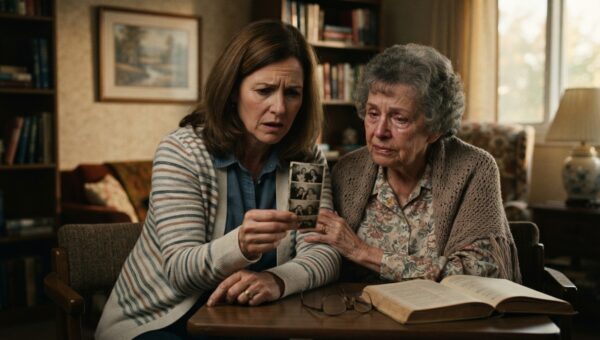
The brass bell above the door of the Vine Street coffee shop chimed with a sharp, high-pitched ring that made my left shoulder twitch. I had been sitting at that corner booth for twenty minutes, staring down at the amber ring of spilled coffee I had left on the laminate tabletop. My hands were shaking just enough to make the ceramic spoon clatter against my saucer every time I tried to stir sugar I did not want.
I kept smoothing the front of my blue cotton cardigan, pulling the knit fabric down over my hips as if a smoother hem could somehow flatten the knot in my stomach. Seven years is a long time to let a silence fester. Seven years of holidays spent wondering if I would ever see her name pop up on my phone, or if the silence I chose back then had finally made me a stranger she never cared to remember.
Back in 2017, our lives were built entirely around keeping the floorboards from creaking. Rick had moved into my daughter’s house two years prior, bringing with him a heavy, suffocating sort of atmosphere that filled every room he walked into. He had this way of clearing his throat that made the silverware rattle on the sideboard, a dry, deliberate sound that meant everyone at the table needed to check their posture and watch their tongue.
My daughter, Brenda, had spent so long trying to keep him happy that she had hollowed herself out, turning into someone who nodded at everything he said and jumped whenever his heavy boots hit the linoleum. I watched it happen from my small house three miles away, telling myself every single week that it was not my place to interfere, that Brenda was a grown woman who had made her bed, and that poking my nose in would only get me locked out of the house entirely.
The Easter dinner in 2017 was supposed to be a nice afternoon with ham, scalloped potatoes, and homemade rolls. Mia was seventeen then, just coming into her own, with bright eyes and a quick laugh that she usually kept tucked away when Rick was in the room. I remember walking through the front door that afternoon and smelling the cloves and brown sugar drifting from the kitchen.
Brenda looked tired, her hair pulled back into a messy clip with a few gray strands coming loose around her ears. Rick sat at the head of the table already, carving the ham with strokes that were just a little too hard, the blade screeching against the ceramic platter. Mia came out of the hallway carrying a pitcher of sweet tea, and when she reached for the extra glasses, her sleeve slipped back just an inch.
The bruises were there at Easter. I saw them. I said nothing. That was 2017. They were dark, overlapping patches of purple and greenish-yellow, shaped roughly like thick fingers wrapped around the upper part of her left arm. I remember stopping right there by the dining room entrance, the cold glass pitcher condensation wetting my palm, my breath catching in my throat for half a second. My eyes met Mia’s across the table, and she gave me this wide, terrified look that begged me to ask, begged me to scream, begged me to do anything that would break the terrible spell of that house.
But I looked away. I looked right past her shoulder at the framed print of sunflowers on the wall, blinked hard, and walked over to set the pitcher down on the sideboard without uttering a single word about what was staring me right in the face.
That cowardice felt practical at the time. I told myself that if I made a fuss, if I pointed at the purple marks and demanded answers from Rick, Brenda would take his side out of sheer self-preservation and I would never see my granddaughter again. I convinced myself that playing nice, keeping the peace, and passing the ham around the table was the only way to keep a small foot in the door so I could be there if things ever got truly desperate. I traded a teenager’s safety for my own comfortable access to Sunday dinners and holiday photos. When Rick bowed his head to say grace that afternoon and squeezed Mia’s arm under the table so hard she let out a sharp little gasp, I sat right next to her, gripped my napkin, and kept my eyes fixed firmly on my own empty plate until the prayer was over.
The memory of that specific afternoon had replayed in my mind a thousand times over the last seven years, always ending with the same terrible sound of my own voice asking the room a question designed to cover up the groaning floorboards. Brenda had passed the platter, the room had gone dead silent save for the hum of the refrigerator, and I had opened my mouth to fill the horrible void with nonsense. Who wants more ham? I asked it into the quiet, smiling a thin, trembling smile while Mia sat beside me staring at her lap like she had just been sentenced. That sentence became the soundtrack of my failure, a little phrase I could hear playing in the back of my head while I did my laundry, while I watched television in the dark, while I sat alone in my kitchen on Thanksgiving Day wondering why my granddaughter had blocked my number.
Now my granddaughter Mia is 24 years old. She walked into the coffee shop on Vine Street right at two o’clock, wearing a tailored navy blazer and carrying a worn leather folio tucked under her arm. She didn’t look like the seventeen-year-old girl who used to hide behind my pantry door when Rick was yelling about the bills. She looked steady, sharp-eyed, and entirely unyielding, carrying herself with the quiet, heavy authority of someone who had seen the bottom of human nature and learned how to stand up straight in the middle of it. She walked straight to my corner booth, didn’t bother offering a hug or a polite greeting, and sat down across from me with a brisk, efficient movement that told me she had rehearsed this conversation every day for years.
“Grandma,” she said, her voice entirely flat and devoid of any warmth. “Thanks for coming.”
“Of course, honey,” I started to say, my voice cracking a little around the edges. “I’m just so glad, “
“Don’t,” she interrupted, holding up one hand just an inch to stop me. “Let’s skip the small talk. There’s something I should have told you seven years ago, and I need to get it out before I lose my nerve.”
She reached into her folio, pulled out a small black leather case, and flipped it open on the scarred wooden tabletop. It was her badge. Child Protective Services investigator. The gold lettering caught the dull afternoon light coming through the dirty shop window, gleaming with a terrible, ironic sort of dignity. Below it, I knew from what Brenda had mentioned through the grapevine before we stopped speaking entirely, she was making about thirty-eight thousand dollars a year working long hours in county offices where people yelled and slammed doors all day long. She looked down at the gold shield for a second, tracing the edge with her thumb before looking straight across the table into my eyes.
“You saw the bruises,” she said. It wasn’t a question.
I felt the blood drain right out of my face, leaving my skin cold and prickling. I swallowed hard, trying to find some moisture in my mouth, but my tongue felt like dry cardboard. “Mia, I, “
“You saw them,” she repeated, her voice dropping an octave, steady and merciless. “Easter dinner. Your arms. The purple marks above your elbows.”
I couldn’t look away from her. The eyes were the same ones that had looked up at me over the sweet tea pitcher all those years ago, but the terror in them had hardened into something like ice. I nodded once, a slow, miserable jerk of my chin that felt heavier than my whole head.
“I know you saw, Grandma,” she said, and her voice finally broke just a tiny bit, showing the jagged edge underneath. “I watched you look at them. Then you looked at Mama. Then you poured more sweet tea.”
I gripped my coffee cup with both hands, my knuckles turning white as porcelain under the harsh fluorescent lights overhead. I wanted the floor to open up and swallow me whole. I wanted to tell her about my fear, about Brenda, about how complicated things were back then, but the words stuck in my throat like gravel. I had rehearsed excuses for years, but sitting across from her in that noisy little shop with her badge sitting right there between our cups, every excuse sounded small and rotten.
“During grace, Rick squeezed my arm under the table,” Mia whispered, leaning forward just an inch so I wouldn’t miss a single word. “I flinched. You were sitting right next to me. You could feel the table shaking.”
“I was afraid,” I finally choked out, the tears finally spilling over my lower lashes and running down my cheeks without me even trying to stop them. “I was so afraid. If I said something, if I made a scene, your mother would have cut me off completely. I thought… I thought if I stayed on the inside, if I didn’t push too hard, I could still keep an eye on you.”
Mia looked down at her badge, letting out a short, bitter breath that wasn’t quite a laugh. “That’s what you told yourself to sleep at night, wasn’t it? I protect children now for a living. You know why? Because the people who were supposed to protect me when I was seventeen chose to be comfortable instead. You traded my safety for your Sunday afternoon peace of mind.”
“I’m sorry,” I sobbed, my shoulders shaking as the full weight of what I had done crashed down on my chest. “I am so, so sorry, Mia.”
“I know,” she said quietly, her expression softening just enough to make it hurt worse. “I know you’re sorry now that I’m grown and sitting here telling you about it. But sorry doesn’t undo three years of living with a man who counted my bruises like trophies. The day I decided no adult would ever protect me was Easter 2017. You were wearing that blue cardigan. You had sweet tea in your hand. And when I looked at you for help, you looked down at your plate and said, ‘Who wants more ham?’ That’s the sentence I hear every single time I knock on a door where a child is living in fear.”
The silence in the coffee shop seemed to drop ten tons heavier around us. The espresso machine hissed behind the counter, and someone laughed loudly by the register, but across that little table, it was just the two of us trapped inside the memory of a dining room that had died seven years ago. I sat there with my hands empty, my defenses completely stripped away, realizing that there was nothing left to salvage of the grandmother I thought I was. I had been a coward who measured her own safety in polite holiday greetings, and my granddaughter had spent seven years paying the interest on my cowardice.
“I don’t expect you to forgive me,” I whispered, wiping my nose with a paper napkin that tore instantly against my wet skin. “I don’t deserve it. But I need you to know… I haven’t spoken to your mother since the year Rick finally left, and I live with this every single day.”
Mia didn’t offer me comfort. She didn’t reach across the table to pat my hand or tell me it wasn’t my fault. She sat back, zipped her leather folio, and looked at me with a steady, clear-eyed evaluation that felt like being weighed on a scale and found wanting.
“I’m not here for an apology tour, Grandma,” she said, her voice back to that professional, steady register. “I’m here because I’m tired of carrying the ghost of that afternoon around like a heavy coat. If you want to be in my life now, there are no more excuses. No more pretending everything was fine. No more hiding behind Brenda’s bad choices. I work thirty-eight thousand dollars a year protecting kids who don’t have anybody in their corner, and I don’t have room for people who look the other way when things get uncomfortable.”
I nodded, my chest aching with a strange, clean sort of pain that felt almost like healing. For the first time in seven years, I wasn’t trying to fix it or smooth it over or find a clever way to make myself look better.
“I understand,” I said. “Whatever terms you want, Mia. I’ll take them.”
She stood up, buttoned her navy blazer, and tucked her folio under her arm. She didn’t hug me, and she didn’t say goodbye with any family warmth, but she didn’t walk out the door forever either. She just gave me a single, level nod, turned on her heel, and walked out into the afternoon light, leaving a simple white paper coffee cup left unblemished on the scarred wooden table between us, while I folded my hands over my lap, refusing to reach for comfort I had not earned.