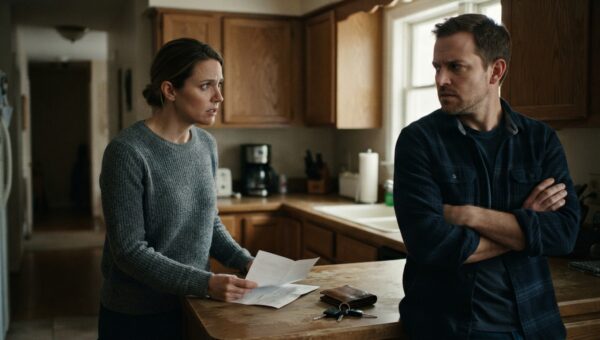
The laminate table in my kitchen still had a faint ring where Daniel’s coffee mug used to sit every Sunday morning. Four months after his funeral, the house was too quiet, and the silence felt heavy like wet wool. I was folding a load of his old flannel shirts when Claire stood in the doorway with her car keys in her hand.
She didn’t take off her coat. She told me she had the moving truck booked for Tuesday and that she and seven-year-old Leo were heading six hundred miles north to start over near her sister. Then she asked about the $115,000 from Daniel’s life insurance payout that I was holding in trust. She wanted the check cut by morning.
“You’re taking him all the way up there?” I asked, dropping a shirt back into the basket. My hands felt cold. “Claire, Leo just lost his father. He needs his family here.”
“My sister has a yard, and the schools are better,” she said, her voice flat and rehearsed like she had practiced it in the car. “And I need the check, June. That money was supposed to secure Leo’s future. It’s legally mine.”
I looked at her across that little kitchen where I had fed my son for thirty-four years.
I thought about how hard Daniel had worked, traveling down to the warehouse in Springfield three nights a week, taking double shifts just to keep their heads above water. “That money stays in the account for Leo’s schooling,” I said, my voice hardening. “I’m not handing over six figures so you can pack up and ghost me. You won’t get a single dollar from me.”
She didn’t blink. She didn’t raise her voice or throw her hands up like she usually did when we disagreed. She just gave me a small, terrible smile that didn’t reach her eyes. “Keep the money if you want… but then you’ll have to live with what really happened to your son.”
I stood there because my brain kind of stopped working for a second. The phrase hung in the air between us like smoke. I wanted to yell at her, to ask what nonsense she was spewing, but the look on her face told me she wasn’t bluffing.
She turned around and walked out the front door, leaving it half-closed against the autumn wind.
Three days later, the house felt even more hollow. I couldn’t sleep. Every time I closed my eyes, I saw Daniel sitting on the back porch steps, rubbing his forehead the way he used to when the bills got too high. The official report said accidental heart failure brought on by severe stress and exhaustion at thirty-four years old. But Claire’s words kept scratching at the back of my skull like a mouse behind the baseboards. I needed to know what she meant. I waited until Thursday afternoon, tied a yellow scarf around my neck, and walked down the creaking hallway to Daniel’s old home office.
The room still smelled like his spearmint gum and old paper. I sat at his walnut desk and started pulling open the drawers one by one. Most of them held old tax forms, spare pens, and receipts for hardware store parts.
But the bottom drawer on the left side was locked tight. I remembered Daniel keeping his spare car title in there, but when I took a small flathead screwdriver from the utility closet and jimmied the brass latch, the wood gave way with a sharp crack.
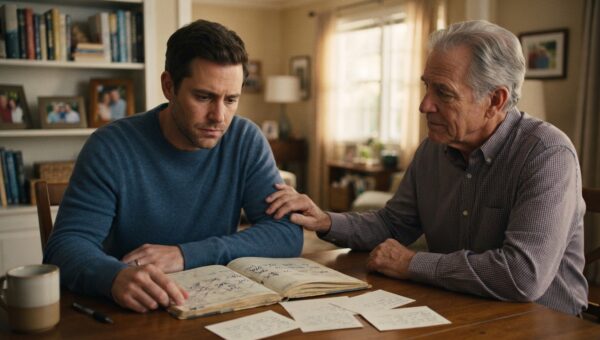
Inside wasn’t a car title. It was a thick manila folder stuffed with bank statements from six years ago and a stack of printed emails. I pulled the top paper out. It was a notice from a commercial bank in Kansas City showing a defaulted credit line of $84,000 tied to a failed landscaping supply venture Daniel had tried to launch behind Claire’s back. Further down the stack was a handwritten draft of a letter from Daniel to his wife, dated right around the time baby Leo was just learning to walk.
“I am so sorry,” the messy ink scrawled across the lined paper. “I didn’t mean to lose the savings. Please don’t take him away from me.”
I sat back in the creaking leather chair and stared at the wall. Daniel had blown their entire nest egg six years ago on a bad business gamble. Claire had bailed him out using money her own father had left her, but she had never let him forget it. Not once. She had kept it locked away like a loaded gun in a drawer, using it to keep him quiet, compliant, and terrified of losing his family.
I needed to talk to someone who had seen him at the end. On Friday morning, I drove down to the warehouse and found Arthur, the shift supervisor who had worked beside Daniel for a decade. He was wiping grease off his hands with a dirty shop rag when I pulled up a folding chair near his desk.
“He looked like a ghost those last three months, June,” Arthur told me, not looking me in the eye. “Man was working eighty hours a week and barely eating a sandwich. I told him he was going to kill himself. You know what he told me one night when we were unloading pallets at two in the morning?”
I shook my head, my throat tight. “What did he say?”
“He said, ‘If I don’t pay every last cent back, she’s taking Leo and I won’t even get to say goodbye,'” Arthur muttered, throwing the rag into a metal bin. “I thought he was just being dramatic about a normal marital fight. But Daniel was scared of her. Really scared.”
The pieces didn’t fit together into a nice clean picture; they jagged into each other like broken glass. Daniel hadn’t just died of overwork. He had been crushed under the weight of an unpayable debt and a wife who had locked him in an emotional prison for six years, doling out forgiveness like rations in a siege.
On Sunday night, I called Claire. My voice didn’t shake when I told her to come back over. “I found the folder from six years ago,” I said into the receiver. “The bank statements. The letters. I know about the debt, Claire.”
There was a long, dead silence on the other end of the line. When she finally spoke, all the sharp edges were gone. “Be here in twenty minutes.”
When she walked through the front door this time, she looked smaller. She sat on the floral couch, her hands folded tightly in her lap, staring down at the carpet. I didn’t yell. I didn’t offer her coffee. I just laid the manila folder on the coffee table between us.
“You knew,” I whispered. “For six years, you held it over his head.”
“You don’t know what it was like, June,” Claire said, her voice cracking for the first time. “I gave up my inheritance to save our credit. I changed diapers while he was out chasing bad investments. Every time I looked at him, I saw our future burning up in a parking lot. He promised me he was done lying, but the secrets just kept piling up.”
“Is that why he died, Claire?” I asked, leaning forward. “Did you push him over the edge that last night?”
She covered her face with both hands, her shoulders shaking. “He came home at midnight the night before his heart gave out,” she whispered through her fingers. “He was crying. He got down on his knees right there by the television and begged me to just look at him as a husband again, not a criminal. He said he couldn’t breathe in this house anymore. And I told him… God help me, I told him I felt nothing left for him. I told him he was a stranger.”
She dropped her hands and looked at me, her eyes red and swollen. “I didn’t know his heart was bad. I just wanted him to hurt the way I hurt for six years. And then the next morning he didn’t come down for breakfast.”
The anger I had carried all week drained out of me, leaving behind something hollow and exhausted. I looked at the woman sitting on my couch, not a monster, just a deeply broken person who had weaponized her own unforgiveness until it killed the father of her child.
“The money,” I said softly. “You still want the $115,000?”
“I need to leave,” she sobbed. “I can’t walk down this hallway without seeing him lying there. The money is for the moving truck and the deposit on the apartment.”
I reached across the table, picked up the checkbook I had left ready, and signed my name on the line. I slid it across the wood toward her. “Take it. Go up north. Start over.”
She looked down at the paper, stunned. “June… I thought you were going to fight me.”
“I am fighting,” I said, my voice steady. “Just not for paper. You’re taking Leo six hundred miles away, but you are going to bring him back down for Thanksgiving, and you are going to FaceTime me every Sunday afternoon without fail. If you try to cut me out of his life, I will take you to court until we are both broke. Do we understand each other?”
Claire wiped her eyes with the sleeve of her sweater and nodded slowly. “We understand each other.”
The moving truck came on Tuesday morning. I stood on the front porch with my arms crossed against the crisp air, watching the burly movers carry plastic bins out to the curb. Seven-year-old Leo ran over to me, wrapping his little arms around my waist and looking up with Daniel’s wide brown eyes.
“Are you coming to visit us soon, Grandma?” he asked, holding my hand tightly.
“Every single month, buddy,” I told him, kneeling down to fix the collar of his jacket. “I promise you that.”
Claire stood by the passenger side door of her sedan, watching us with a quiet, fragile sort of truce between us. She didn’t say goodbye, just gave a small, respectful nod before sliding behind the wheel.
I stayed on the porch long after the taillights disappeared down the block, listening to the wind rustle through the dry oak leaves in the yard. Inside, the house was quiet again, but the heavy wool blanket was gone. A small, worn photograph of Leo sliding into a cardboard moving box sat on the kitchen counter next to a packing slip, marking both a painful departure and an unbroken promise of what came next.