Chloe had yellow crayon smeared across the heel of her left hand, right where she always rested it when she pressed too hard.
The kitchen table was covered in little bits of shaved blue and pink wax because she refused to use the electric sharpener that hummed like a dentist’s drill. I was trying to fold a basket of wash while the news droned on about some bridge repair down on the interstate, but my eyes kept drifting back to the square piece of manila construction paper she had brought home in the side pouch of her pink backpack.
We were a family of three. David and me and our little girl. That was the math of our house for five years, ever since the nurses handed her to me wrapped in a blanket that smelled of harsh laundry soap and newborn skin.
So when I picked up the paper and saw six stick figures lined up in a neat row across the bottom, I figured she just had a very busy imagination. Kids draw extra hands and three-eyed dogs all the time. But she had labeled them with looping, unsteady block letters she must have copied off the whiteboard at preschool.
I pointed my thumb at the little cluster of figures standing off to the right of David’s tall stick figure.
“Who are these people, honey?” I asked, keeping my voice light because you never want to make them feel silly for inventing things.
Chloe didn’t even look up from her pink crayon. She was busy coloring a very aggressive purple hat onto the head of the fourth figure.
“That’s Daddy’s other mommy,” she said, her voice dropping into that casual, sing-song tone kids use when they are telling you the sky is blue. “And Emma. And baby Lucas.”
My thumb stopped rubbing the edge of the paper.
“Other mommy,” I repeated. It came out flat.
“Yeah. And we went to their house on Saturday to get the red shovel.” She finally looked up, her gray eyes wide and entirely innocent. “Emma has a big dog that barks loud, Mommy. You know that.”
I didn’t know that. On Saturdays, David usually went out around nine in the morning to pick up supplies from the hardware store or check on the rental property his uncle left him down in the valley. He always came back smelling of cedar dust and black coffee, sometimes bringing a bag of powdered donuts that Chloe loved.
When David came through the back door twenty minutes later, his jacket was unzipped and he was carrying a small sack of groceries.
He kissed the top of my head the way he always did, his lips dry and cool from the autumn wind, and asked how my day had gone.
I held up the piece of manila paper.
“Chloe drew a family portrait,” I said. “She says we have some extra people.”
David glanced at the paper while he set the milk on the counter. He gave that easy, chest-deep laugh of his, the one that used to make me feel like everything in the world was nailed down solid. He didn’t even blink.
“Kids imagine things,” he said, already turning to pull the lettuce out of the bag. “You know how she is with those storybooks. Last week she thought the mailman was a pirate because of his blue jacket.”
He was so smooth about it. He reached out and ruffled Chloe’s curls, calling her his little artist, and she giggled and ducked away from his hand.
He made it sound like I was the one being silly, reading too much into a five-year-old’s crayon scribbles. I wanted to believe him. God, I wanted to believe him because the alternative meant the floor was about to drop out from under our entire life.
I spent three hours staring at the ceiling after the house went dark.
David was breathing softly beside me, his arm draped across my waist in that familiar, heavy way that used to mean safety. Every time I tried to shift away, his fingers would twitch and tighten just a fraction, pulling me back into the warmth of his side. I lay there listening to the hum of the refrigerator downstairs and the low whistle of the wind through the eaves until the numbers on the digital clock glowed 5:14.
The moment the light started turning that pale, bruised gray behind the blinds, I got up quietly, pulled on my heavy cardigan, and walked down the hall with my phone in my hand.
I didn’t want to wait until school started. I dialed the number for Mrs. Gable straight from the hallway, my thumb trembling against the glass screen.
She answered on the third ring, sounding a little breathless like she was already sorting papers in the empty classroom.
“Mrs. Miller? Is everything all right with Chloe?”
“She’s fine,” I said, my voice sounding tight and small even to my own ears. “I’m looking at her family tree project from yesterday. She drew… well, she mentioned some people I don’t know. Emma and Lucas.”
There was a long, heavy silence on the line. Not a normal pause, but the kind of silence where someone is suddenly trying to figure out how to put their foot back in their mouth.
“Oh,” Mrs. Gable said softly. “Oh, honey. I just assumed you knew.”
My stomach didn’t drop. It felt like it dissolved completely.
“Knew what?”
“Well, during Career Day last month,” she went on, her words tumbling out now like she wanted to get the bad part over with. “Your husband came in with the two little ones. A girl around seven and a toddler. He introduced them as his kids, Mrs. Miller. He was so proud. He even gave us a five-hundred-dollar check for the library fund using your last name and everything.”
I couldn’t breathe. The hallway wallpaper seemed to drift about two inches away from the wall.
“He brought them to the school?”
“Yes. He stayed for an hour. He said you were home with the baby, well, with Chloe, and that he was juggling his schedule between both households.” She hesitated. “I just… I thought it was common knowledge. He was so natural about it.”
I hung up the phone without saying goodbye.
The drive home from the grocery store parking lot where I had pulled over was a blur of gray asphalt and red brake lights. My knuckles were white against the steering wheel, locked so tight my fingers ached all the way up to my wrists. Every time I hit a bump in the road, my mind kept replaying every Saturday morning he left for the hardware store, every two-day business trip to the regional office in Cincinnati that always seemed to fall on the weekends when my mother was visiting her sister.
He had been splitting his life down to the hour. Four years of a second house, a second set of kids, a second woman who probably thought she was the only one waiting for him to come home on a Tuesday night.
When I pulled into the driveway, his gray sedan was parked right where it always sat.
I walked through the back door with my boots clicking loud on the linoleum. The smell of browning butter and onions hit me first. David was standing by the stove in his shirtsleeves, the cuffs rolled up twice to reveal those thick, steady forearms I used to trace when we first met. He was whistling some old tune that didn’t have any words, gently moving a wooden spatula across the bottom of a cast-iron skillet.
He didn’t hear me come in over the sound of the onions spitting in the grease.
I stood there for three seconds just watching him. The way his shoulders dropped. The way he tilted his head to check the clock on the microwave like he had a schedule to keep even when he was off the clock.
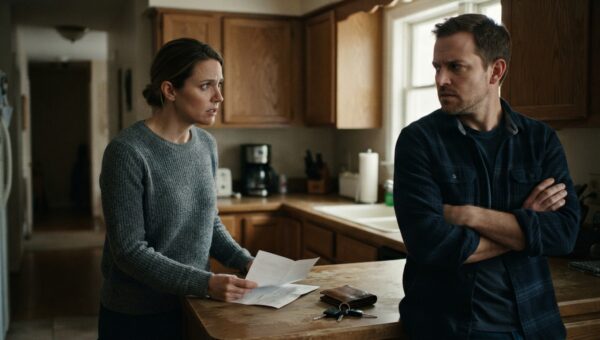
“Who is Emma?” I asked.
His hand froze right in the middle of a stroke. The spatula stayed pressed against the side of the skillet, his knuckles going suddenly rigid under the skin.
He didn’t turn around right away. He took a long, slow breath, his shoulders rising and staying up like he was bracing for a blow he had seen coming down the pike for a long time.
Slowly, very carefully, he laid the wooden spatula across the edge of the stove. He didn’t look at me. He glanced over toward the dining room table where Chloe was sitting with her box of crayons, her tongue tucked out the corner of her mouth as she colored in a brown bear.
He leaned down a little, his voice dropping into a harsh, ragged whisper that didn’t sound like him at all.
“Emma is your…” he started, and then his voice caught, dry and tight in his throat.
He turned around then, his face gray and drawn in the kitchen light, his eyes darting toward the hallway like he was looking for an exit that wasn’t there.
“She’s your sister,” he whispered.
The words sat in the air between us, small and ugly and impossible to push back down.
“Four years, David,” I said. My voice didn’t even shake. It felt like it belonged to a stranger standing somewhere near the ceiling. “You had a whole other house. A whole other life while I was sitting right here making dinner.”
He took a step toward me, his hands half-raised in that familiar, defensive gesture he used when he wanted to explain away a late invoice or a missed appointment.
“Just let me sit down and explain how it happened,” he said, his voice rising just enough that Chloe stopped coloring for a second and looked up toward the kitchen archway. “Sarah didn’t know about you either at first. It just… it got away from me, Elena. I couldn’t just walk away from the kids.”
“Don’t you dare,” I said, holding my hand up like a stop sign. “Don’t you dare use those children to make yourself sound noble.”
I walked past him toward the mudroom, my boots heavy on the floor, and picked up his leather duffel bag from the floor where he always dropped it on Friday nights after his so-called regional meetings. I threw it hard against the kitchen island, right into the middle of his half-chopped onions.
“Get your things,” I said. “And don’t you ever try to talk to Chloe again without a judge telling you when.”
He stared at me for a long moment, his mouth opening to say something else, some other excuse he had probably been polishing for years just in case the floor gave way. But he must have seen something in my face because the words didn’t come out. He just reached down slowly for his bag.
By nine o’clock that night, the house was dead quiet except for the hum of the refrigerator.
I sat on the front porch with the cold air coming off the lawn, watching the yellow porch light catch the frost on the grass. Chloe was asleep upstairs in her own bed, her breathing light and even beneath the quilt her grandmother had sewn for her.
On the refrigerator inside, held up by a single red plastic magnet shaped like an apple, was a new piece of white paper.
She had drawn two people this time. Just two tall stick figures standing very close together under a square house with a yellow chimney, both of them holding hands with a much smaller one in the middle.
I reached out and locked the front door twice, listening to the heavy brass bolt slide home into the frame, and let the quiet settle in around me like a heavy wool coat.