The cold kitchen floor always hit the soles of my feet first thing in the morning, long before the coffee pot finished its wet, sputtering cough. I lived in that quiet house on Elm Street with Maya, just the two of us, keeping our routines tight and our circle small. I liked the predictability of it. I liked knowing where every spoon went and that the back deadbolt stayed thrown every single night.
After everything I had survived to get us to that town, predictability was the only currency I cared about.
That all stopped the morning Brenda Gable hammered on my screen door at 7 AM.
Brenda lived three houses down, right on the corner, and she was the kind of woman who noticed when a blue jay changed trees. She didn’t wait for me to untie my robe or invite her in. She just pushed past the threshold, smelling faintly of the menthol cigarettes she smoked behind her garage. Her gray curls were slightly flattened on one side, telling me she had rolled right out of bed and come straight to my porch.
“I didn’t want to say anything,” Brenda said, her voice dropping to a harsh stage whisper that made my spine go rigid. “I really didn’t. But a man has been leaving your house every morning at 6:15 for three months.”
The kitchen seemed to tilt on its axis. The hum of the refrigerator suddenly sounded like a low-flying engine. I stood there with my coffee mug halfway to my mouth, my fingers tightening on the ceramic until my knuckles turned yellow.
“You must be confused, Brenda,” I said, and my voice sounded thin even to my own ears. “It’s just Maya and me here. Nobody else has a key.”
“I’m not confused about time, Clara,” she snapped back, leaning in close enough that I could smell the stale tobacco. “Every single weekday, right when I’m putting the kettle on. Tall fellow. Wearing a gray canvas jacket. Comes out your back door, cuts across the grass toward the alley like he owns the place. Today I finally decided you needed to know.”
She left as abruptly as she arrived, letting the screen door slam hard enough to rattle the old glass panes.
I didn’t chase after her to argue. I couldn’t. Because the moment Brenda mentioned the gray jacket, something cold and heavy dropped right into my stomach.
I didn’t call the police. I didn’t wake Maya, who was still dead to the world in her bedroom down the hall, buried under three heavy quilts. Instead, I walked over to the junk drawer by the pantry, pushing aside old takeout menus, rubber bands, and dead batteries until my fingers brushed against the small cardboard box I had shoved in there a year ago.
It was a cheap $49 Amazon Ring camera I had bought on a whim during a Prime sale after a string of package thefts downtown. I remembered charging it, setting it up on the kitchen counter, and then shoving it into the drawer because the Wi-Fi in our old house was spotty and I never got around to mounting it outside.
Except I had left it plugged into the outlet on the side of the fridge, facing the back door, and I had completely forgotten about it.
My hands were shaking so badly I dropped the phone twice while trying to log into the app. When the interface finally loaded, the little battery icon in the corner showed it had been recording motion events for months, triggered by the slight draft or the sensor picking up movement near the back entry.
I scrolled back. Eighty-seven days of footage.
I clicked on a clip marked 11:24 PM from three nights prior. The kitchen was dark, lit only by the amber glow of the microwave clock. A shadow moved near the back door. Then came the distinct, muffled click of a brass key turning smoothly in the deadbolt. A tall young man stepped inside, moving with a practiced, quiet ease that suggested he had done it a hundred times before. He locked the door behind him, dropped a worn gray canvas jacket over the back of the kitchen chair, and walked down the hall toward Maya’s room.
Then I clicked on a clip marked 6:12 AM. The same man. He pulled on the gray jacket, unlocked the door, stepped out into the damp morning grass, and pulled it shut behind him.
Eighty-seven times. Eighty-seven nights of a stranger letting himself into my home while my daughter slept down the hall.
The blood rushed in my ears, drowning out every rational thought. I walked down the hallway, my bare feet hitting the hardwood with heavy, uneven thuds, and shoved Maya’s bedroom door open without knocking. The room smelled of lavender laundry detergent and teenage sleep. Maya was curled on her side, her dark hair tangled across the pillow, looking smaller than sixteen.
“Maya,” I said, and the tone in my own voice terrified me. “Get up. Right now.”
She stirred, blinking against the sharp morning light I let in from the hall. “Mom? What’s wrong? What time is it?”
I didn’t answer with words. I walked over to the bed, turned the screen of my phone around, and dropped it right onto her duvet cover, playing the clip from the night before on an endless, looping repeat. The little green light on the camera feed blinked steadily in the dim room.
Maya sat up instantly. All the color drained out of her face, leaving her skin the gray-white of skim milk. She stared at the small glass screen, her lips parting, but no sound came out. Her whole body started to shudder, a fine, violent tremor that shook the bedsheets.
“Who is he?” I asked. My voice wasn’t loud. It was low and flat, stripped of everything maternal. “Who is this man in our house?”
She looked down at her lap, her fingernails digging deep into the fabric of her pajama bottoms. Tears spilled over her lower lashes, hot and fast, tracking down her pale cheeks.
“Mom, please don’t be mad,” she whispered, her voice cracking right down the middle.
“Mad?” I let out a harsh, dry breath that felt like glass. “A strange man has been using a key to walk into our house in the middle of the night for three months, Maya. Somebody could have hurt you. Somebody could have killed us. You tell me right now who he is, or I am calling the police from this exact room.”
She flinched like I had struck her. She reached out and grabbed the hem of my shirt, her fingers clutching the cotton so hard her knuckles turned white.
“He told me not to tell you,” she sobbed, the words tumbling over each other in a frantic rush. “He said if you found out, you’d throw him out again. He said he’s my…”
She stopped. She couldn’t finish it. But she didn’t need to, because in that exact second, the floorboards in the front hallway creaked under the weight of someone stepping through the front door.
The front door that I had forgotten to lock when Brenda left.
I didn’t wait for Maya to explain. I spun around, leaving my phone on her bed, and marched down the hallway with my heart hammering against my ribs like a trapped bird. The kitchen was empty, but the back door was standing open an inch, letting in the damp smell of the morning lawn. Footsteps scraped softly against the linoleum near the pantry.
“Who is there?” I shouted, rounding the corner with my hands balled into tight fists.
A young man was standing by the kitchen island, pulling off a wet gray canvas jacket. He froze when he saw me. He was tall, maybe twenty-one or twenty-two, with dark, unruly hair that fell across his forehead and eyes the exact shade of green I had tried to scrub out of my memory for more than a decade. He looked like a ghost stepped straight out of a courthouse photo from a life I had burned to the ground.
He was my son.
Jonah.
The air left my lungs in a sharp rush. I staggered back a half step, my hand catching the edge of the refrigerator to keep from falling. I hadn’t seen him since he was nine years old, left behind in the wreckage of a marriage I fled in the middle of a freezing November night, running from shouting matches and broken glass and a man who swore he would take everything from me if I tried to leave with both children. The courts had failed me, my family had turned their backs, and in a desperate, cowardly act of self-preservation, I had packed what could fit in the trunk of a rusted sedan, taken my toddler daughter, and disappeared across state lines, legally erasing the past so we could breathe clean air.
“Mom,” Jonah said, and his voice was deeper now, rough around the edges, but it still carried the cadence of a little boy who used to ask me to read him stories by the radiator.
“You,” I whispered. The word tasted like copper and old ash. “How did you… how did you find us?”
Before he could answer, Maya appeared in the hallway behind me, wrapping her arms around her own waist, crying silently.
“I found her, Mom,” Maya said, her voice shaking as she stepped up beside me. “About six months ago. On ancestry sites and social media. I was just curious. I saw her name and yours, and I reached out. It wasn’t his fault. I brought him here. I gave him the spare key from under the flowerpot.”
Jonah looked down at the linoleum, his jaw tight, his hands clutching the gray jacket like a shield. “I didn’t want to scare you,” he said quietly, looking up to meet my eyes for the first time. “I just… I wanted to know who my sister was. I wanted to see what life you built after you left us behind like trash.”
Those words hit me harder than any punch could have. They sat heavy in the quiet kitchen, echoing off the counters, carrying the weight of twelve years of resentment, unanswered letters, and lonely birthdays I had tried to pretend never happened.
I looked from my son, who had grown into a stranger with my old ghosts written across his face, to my daughter, who was trembling because she had carried the burden of a secret family history she was never supposed to know. The anger I had felt five minutes ago didn’t vanish, but it shifted, turning into something heavier, something suffocatingly sad.
“You can’t just sneak into a house at midnight, Jonah,” I said, my voice breaking on the last word. “Do you have any idea what could have happened? If a neighbor hadn’t seen you, if I had woken up with a bat…”
“I know,” he said softly, stepping closer, though he kept his distance out of respect for the line I had drawn. “Maya told me you’re paranoid about security. That’s why we waited until you were asleep. But I’m not him, Mom. I’m not the man you ran from.”
I looked at him, really looked at him, seeing the way his shoulders slouched just like his father’s used to, but seeing also the kindness in the corners of his eyes that belonged entirely to himself. The past I had buried in a deep, dark grave had finally clawed its way back up to the surface, demanding to be let into the light.
I didn’t call the police. I couldn’t. But I didn’t let him stay either.
We spent the next two hours sitting around the kitchen table in the cold morning light, drinking instant coffee that tasted like cardboard while Maya explained every message, every late-night chat, and every secret visit they had shared over the last eighty-seven days. I listened without interrupting, forcing myself to swallow the bitter pill of my own history. I had protected Maya from the wrong things for so long that I had accidentally kept her from the very family she had a right to know, even if it arrived in the most terrifying way possible.
When Jonah finally stood up to leave, promising to come back through the front door at a reasonable hour the following afternoon, the house felt entirely different.
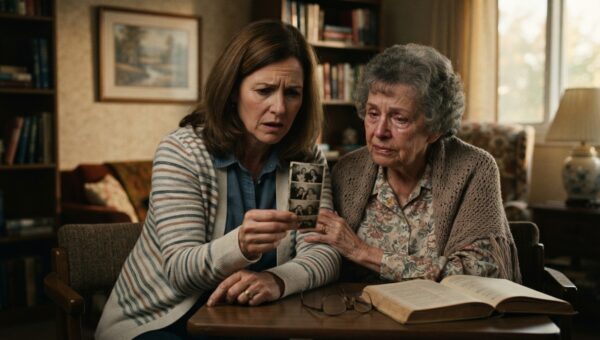
The heavy deadbolt clicked twice as I turned it from the inside, securing the door against the morning wind. Then I walked over to the kitchen drawer, pulled out the shiny new brass deadbolt I had bought at the hardware store a month ago and never installed, and set it right on the table next to an old, cracked photograph of Jonah as a little boy that Maya had printed out from her laptop.
Maya sat across from me in the afternoon sun, our fingers touching lightly on the worn wooden surface as we looked down at the picture together, finally letting the past into the room where it belonged.