Four hundred and eighty-two days. That is how long the brass deadbolt on Maya’s bedroom door has stayed oiled and shiny, clicking into its iron plate with a sharp, heavy sound that you can hear right down the hall. I check it every single night before I go to sleep. I run my thumb over the cold metal and I think about the smell of pot roast and scorched carrots sitting on Charlene’s dining table, and I know that some doors are never meant to be unlocked again.
Back in 2023, outside Dayton, my twelve-year-old came to me in tears because Grandma told everyone her secrets. Maya wouldn’t come out of her room. She had jammed a yellow plastic wedge under her door handle and pulled her floral comforter all the way up over her head, shaking so hard that her bedframe was tapping against the drywall. I remember I was standing by the kitchen sink, rinsing out a glass, when the silence from upstairs got too heavy to ignore.
“She read it, Mom,” Maya had whispered through the crack in the door, her voice raw and ruined from crying. “She read the whole thing out loud while everyone was passing the butter.”
Charlene had been in my daughter’s room putting away laundry. That was the cover story anyway. She always volunteered to take the clean clothes up because it gave her a free pass to slide her fingers under mattress corners, check the backs of closet shelves, and rifle through nightstand drawers like she was a customs inspector hunting for contraband.
This time, she hit paydirt. She found the spiral notebook with the faded purple cat on the cover where Maya poured out every awkward, messy, beautiful thought a twelve-year-old girl tries to make sense of. Crushes on boys in seventh-grade math, worries about her skin, angry poems about me telling her to clean her room. Private things. Holy things, if you ask me, that belong to a child’s growing soul.
Charlene didn’t just tuck the diary back where she found it. She brought it downstairs like a trophy. Right in the middle of Sunday pot roast, with my brother-in-law and his wife and three cousins sitting right there at the table, Charlene cleared her throat, opened the book, and started reading excerpts in that loud, mocking schoolmarm voice she used whenever she wanted everyone to stop talking and listen to her supreme wisdom.
I still remember the exact line she cackled over. “Look here,” Charlene had announced, waving a page in the air. “Listen to this bit about Robbie Henderson. ‘I hope he looks at me during choir practice.’ Oh, Lord, the drama of it all.”
The table had gone dead quiet. My cousin Mark looked down at his plate like it held the secrets of the universe.
My husband, Gene, froze with his fork halfway to his mouth, his face draining of color so fast it looked like someone had pulled a bedsheet over him.
When I slammed my water glass down so hard the base cracked, Charlene just waved her hand at me like I was a gnat buzzing around her ear. “Oh, stop looking like a martyr,” she had snapped, leaning back in her chair. “Kids need to learn nothing’s private. I’m saving her. I’m teaching her.”
That was her favorite phrase whenever she trampled a boundary. *I’m teaching her.* As if humiliation was some kind of vitamin every kid needed to grow straight and strong.
I didn’t yell in front of the relatives. I didn’t give her the satisfaction of a screaming match in her own dining room. I grabbed Maya’s coat, hauled my daughter out to the car while she was still wiping her red eyes with her sleeves, and got into the passenger seat of our old Buick.
Gene climbed in behind the wheel. The engine turned over with a familiar, tired cough, and we pulled out of the gravel driveway without a single person coming out to wave goodbye.
For the first three miles, the car was so quiet you could hear the tires humming against the hot asphalt. Gene kept his hands glued to ten and two on the steering wheel, his knuckles white enough to look like bone through his skin.
Then he looked straight ahead through the windshield and said, “I think it’s time somebody set her straight in front of everyone.”
That sentence hung in the air between us, heavy as an anchor dropped in shallow water. Gene had spent forty years dodging his mother’s thumb, making excuses every time she showed up uninvited with her spare key or criticized how I kept the pantry stocked. But reading a child’s diary to a table of gossiping relatives had broken something loose in him. It wasn’t just anger anymore. It was cold, clean clarity.
The next afternoon, we didn’t call first. We didn’t ask if it was a good time. Gene drove us straight back down Route 74 to Charlene’s house, the tires crunching over the same white gravel driveway we had fled twenty-four hours earlier.
Gene had made three phone calls that morning while I was sitting on the edge of Maya’s bed trying to convince her to eat a piece of dry toast. He called his sister Brenda, he called our uncle Ray, and he called cousin Mark. He didn’t tell them why they needed to come over at two o’clock on a Monday afternoon. He just used that flat, steady tone of voice that meant nobody in our family dared say no.
When we walked up Charlene’s front steps, we could see her through the screen door sitting at her kitchen island, sorting through a stack of coupons with her reading glasses perched low on her nose. She looked up, expecting her dutiful son to come in and apologize for my bad attitude the day before.
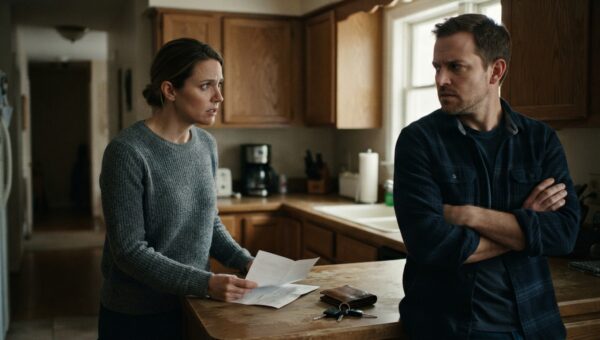
Gene pulled the screen door open without knocking. He didn’t even say hello. He just walked right past her kitchen island and dropped a thick manila envelope onto the Formica top right next to her scissors.
Charlene blinked at us, her mouth tightening into that thin, pinched line she used when she didn’t get her way immediately. “Well,” she said, her voice dropping into that chilly register. “I suppose you’re here to explain why you stormed out like a couple of children yesterday. Especially after I tried to help that girl of yours understand the real world.”
“You didn’t help anybody, Mother,” Gene said. He didn’t raise his voice. He spoke just loud enough to fill the small kitchen. “You humiliated a child because you can’t stand the thought of anyone having a corner of their life you don’t control.”
Before Charlene could draw breath to launch into one of her standard speeches about respect and filial duty, headlights crunched outside. Brenda and Mark walked through the front door, looking confused and slightly uneasy. Uncle Ray followed them right behind, leaning on his wooden cane, his cap tipped back on his gray head. They filed into the kitchen, looking at the two of us standing by the counter and Charlene sitting frozen behind her coupons.
“Sit down,” Gene told them, pointing a thumb at the kitchen chairs.
Nobody argued. Uncle Ray lowered himself into the chair by the calendar with a groan of his old knees, and Brenda sat next to him, her purse clutched tight in her lap like a shield.
“What is the meaning of this little meeting?” Charlene demanded, standing up from her stool, her chin coming up in that stubborn, aristocratic tilt she had practiced her whole life. “Marching people into my house like you’re holding a tribunal. Have you both lost your minds?”
“No, Mom,” Gene said, his voice terrifyingly quiet. “We found them.”
He reached down, opened the manila envelope, and slid a stack of old yellowed papers across the shiny Formica. They weren’t Maya’s diary pages. They were letters. Dozens of them, written on thin blue stationery with the edges curling from age.
Charlene’s eyes dropped to the top page, and for the first time since I had known her, the color drained clean out of her face. Not a dramatic movie pale, but that awful, chalky gray of someone who just realized they stepped off the edge of a cliff.
“Where did you get those?” she whispered.
“I found them in the back of your cedar chest when I was looking for the spare snow shovel last winter,” Gene said, looking right into her eyes. “Letters you wrote to Aunt Clara back in seventy-eight. Every mean, vicious thing you ever said about Brenda behind her back. Every secret Uncle Ray told you in confidence about his business troubles that you spread around the bridge club before the week was out.”
Uncle Ray shifted in his chair, leaning forward to squint at the papers. “What’s that about my business?”
“She told the whole sewing circle about your second mortgage back when you were nearly under, Uncle Ray,” Gene said, never taking his eyes off his mother. “She wrote it down in black and white. Just like she read Maya’s diary yesterday. She’s been collecting other people’s private lives her whole life to make herself feel like the queen bee of this family.”
The kitchen went so quiet you could hear the refrigerator humming through its cycle. Brenda picked up one of the blue sheets, her thumb tracing her mother’s looping handwriting from forty years ago. She read two lines silently, her lips parting in slow, sickening realization.
“You told Mrs. Gable I was having trouble with my nerves,” Brenda said, her voice barely a breath. “You told her I was cracking up after the baby.”
Charlene tried to puff herself up, but her shoulders were shaking. “It was the truth! Somebody had to keep an eye on you, “
“Shut up, Charlene,” Uncle Ray said. It wasn’t loud, but it carried the weight of seventy years of being the older brother. He laid his cane across his knees and looked at her with a disgust so complete it made me look away. “Just shut your mouth.”
That was the moment her whole kingdom fell apart. Not because of a dramatic shouting match, but because the people she had manipulated and managed for decades simply looked at her and saw her for what she was: a lonely, small-minded woman who used other people’s pain as currency.
She looked around the room, her eyes darting from Brenda to Mark, looking for a single ally, a single person to nod and agree that she was just practicing tough love. But nobody moved. Nobody met her gaze. Brenda was staring down at the blue letter in her hand like it was a snake she had just pulled out of a basket.
“You’re not coming into our house again,” Gene said, his voice flat and final as a slammed door. “Not uninvited. Not while I’m alive. If you want to see your granddaughter, you’ll call first, and you’ll wait on the front porch until we open the door. And if you ever mention a single word of what happens under our roof to anyone outside these walls again, you won’t see us at all.”
Charlene opened her mouth to say something sharp, something about respect or blood or who owned the family name, but no sound came out. She just dropped back down onto her kitchen stool, her hands trembling as they hovered over her neatly stacked coupons.
We didn’t stay for coffee. We didn’t wait for her to recover her dignity. We turned around, walked out the front door, and got back into the Buick.
When we got home, Maya was still upstairs behind her locked door. I walked up the stairs, my boots creaking on the pine boards, and knocked twice the way we agreed we would.
“It’s just me, sweet girl,” I said softly.
The yellow plastic wedge scraped across the floorboards, and the door opened an inch. Maya’s eyes were still pink, but she looked up at me with something resembling safety returning to her face. I didn’t give her a long speech about how everything happens for a reason or how Grandma didn’t mean it. I just handed her a brand-new notebook with a plain black cover and told her she could write whatever she wanted in it, and nobody would ever touch it again.
The next day, Gene spent two hours with a drill, a wood chisel, and a heavy brass deadbolt. He installed it three feet up from the floor on Maya’s bedroom door, right where she could reach it herself.
Now, every single night, I hear that sharp, clean click echo down the hallway. It’s the sound of a sanctuary holding firm. Charlene still calls on Sundays sometimes, letting her phone ring five times before it clicks over to voicemail, but we don’t pick up. Let her talk to the machine. Some chapters are better left unread, and some doors are meant to stay locked against the cold.