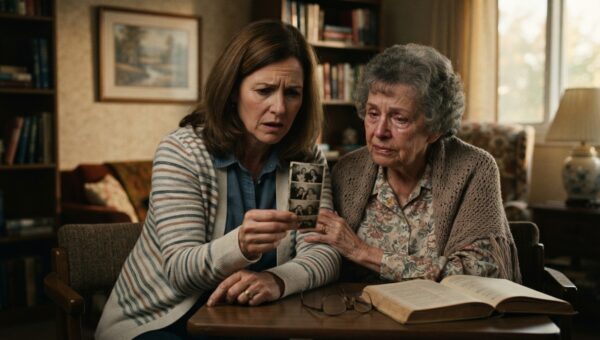
There are two wills sitting in Mr. Harrison’s mahogany office across town, and both of them bear my legal signature. The first was stamped and witnessed in the autumn of 2022, leaving this white-trimmed house and the quarter acre it sits on to my granddaughter Amara. She moved into the spare bedroom two days after my hip replacement surgery, and in all the months since, she has not missed a single doctor’s appointment, a single grocery run, or a single evening checking if my tea is hot enough.
The second will was found by my son Devon just last Tuesday, tucked far back in the walnut kneehole of his late father’s old roll-top desk. That one was dated 2019, drawn up during the heavy, suffocating months after Arthur passed away, and it leaves the entire property squarely to Devon. Both documents are fully notarized. Both have my name written in ink that has long since dried. And now Mr. Harrison tells me the court has to decide which piece of paper tells the truth about what I wanted.
The house smells faintly of celery and boiling broth today. Amara is standing by the stove right now, her shoulder pressed against the white tile as she stirs a pot of potato soup with a wooden spoon that has a split handle I keep meaning to glue. She doesn’t know I am sitting here at the dining room table looking at the carbon copy of Devon’s legal notice.
She is just moving quietly through the kitchen, humming some tune she probably picked up at the community college where she takes her night classes in accounting. She has lived under this roof for two years, bringing in groceries, wiping down the counters, and helping me up the three front steps when the damp gets into my knees. She hasn’t asked about the lawyers. She hasn’t asked about the deed. She just sets a glass of water beside my chair every afternoon at three o’clock and goes back to her books.
Devon came by yesterday afternoon, and his boots left gray mud right on the braided rug by the screen door. He didn’t wipe his feet because he was too worked up to notice. He laid a heavy manila envelope right on top of my crossword puzzle, and his face was flushed the way it always gets when he feels like the world is tipping over and nobody is listening to him.
He pointed a thick finger right at the paper he had printed out from the county courthouse website.
“It is right here in black and white, Mother,” he said, his voice bouncing off the high ceiling of the parlor. “Dad wanted me to have this place. He built that porch with his own hands in seventy-eight. I was out there handing him nails before I was ten years old.”
“I know you were, Devon,” I told him, keeping my hands flat on the table so he wouldn’t see them shaking. “I remember the sawdust in your hair.”
“Then why did you sign the other one?” he asked, and that was when his voice cracked just a little bit, dropping from anger into something much smaller and harder to listen to. “Why did Amara get the keys when I am the one who spent three weekends fixing that roof after the November windstorm?”
He had a point. Or at least, he had a memory that matched mine.
In October of 2019, just six months after Arthur died of his heart attack, the rain came down sideways for three days straight and found a weak spot right above the master bedroom chimney. The ceiling plaster started to sag like a wet belly. I sat on the edge of the bed with a galvanized bucket between my feet, watching brown water drip into the tin, feeling fifty years of marriage turn into damp drywall and empty silence. Devon drove out from town in his rusted Ford truck before the storm had even let up. He climbed that ladder in the freezing sleet with a tarp and a staple gun, his jacket soaked clear through to his undershirt, refusing to come down until the leak was stopped. When he finally walked back through the back door, steaming like a workhorse, I looked at his red hands and felt this fierce, desperate need to make sure he was anchored here.
I called Mr. Harrison the next morning. I told him to draw up the papers leaving everything to Devon. I wanted my son to know that the house would stay in his hands, that his labor mattered, that he was the man of the property now that his father was gone. It felt true then. It felt like the only right thing in a world that had suddenly gone cold.
Three years later, my left hip gave out completely while I was reaching for a can of peaches in the pantry. I remember lying on that linoleum floor for twenty minutes, staring at the bottom of the refrigerator where a stray onion skin had gathered dust, unable to push myself up. Devon was three towns over working a commercial job and couldn’t leave the site. Amara was the one who answered my cell phone call, dropped her backpack in the middle of her dorm hallway, and drove sixty miles straight to my front door. She didn’t complain. She didn’t sigh. She moved into the narrow twin bed in the guest room, helped me out of hospital gowns that felt like sandpaper, and drove me to physical therapy three mornings a week at seven o’clock sharp. When I finally learned how to walk again without a aluminum walker, I looked at her sitting on the porch steps reading her textbooks while I watered the ferns, and I realized something else.
I realized that keeping a house going isn’t just about who nailed the shingles down twenty years ago. It is about who stays in the room when you cannot stand up by yourself. So I called Mr. Harrison again. I signed the second will. I didn’t cancel the first one in my own mind because I didn’t think about it that way. To me, a house is big enough to hold two different kinds of gratitude.
The law doesn’t see it that way, of course. Mr. Harrison explained it to me over the telephone in that careful, dry voice he has used for forty years. He told me that in the eyes of the probate court, a later will automatically revokes an earlier one if the language is clear. But Devon’s contest isn’t just about the dates on the paper. It is about what is hiding underneath those dates.
“She doesn’t even have a full-time job,” Devon had said yesterday, standing by the kitchen sink and looking through the window at Amara’s old sedan parked in the gravel drive. “She’s twenty-four years old, Mother. She’s just floating. If anything happens to you, she’ll sell the place to the first developer who offers her cash for the lot, and then where is our family history?”
“Amara loves this place just as much as you do,” I told him, but I kept my voice low because I knew what he was really talking about.
It wasn’t just about the development. It was about the pressure he was under. His contracting business has been struggling since the lumber prices went up two years ago, and I know he’s been taking out loans against his truck just to keep his crew paid. He looks at this house not as a home, but as a bulkhead against a rising tide he is losing control of. He needs to feel like he won something from his father, like his years of showing up were worth more than just a handshake and a cup of cold coffee.
Amara walked into the dining room just then, carrying two blue ceramic bowls on a wooden tray. She set mine down in front of me without a word, the steam carrying the smell of butter and black pepper. She has her mother’s quiet eyes, the kind that don’t need to ask questions because they already assume you are doing the best you can.
“Grandma, Mr. Harrison’s office called while you were resting,” she said softly, her thumb brushing against the rim of her bowl. “They want to know if we’re coming in on Thursday morning for the pre-trial conference.”
“We’re going,” I said.
She nodded once, not pressing me for details, and sat down across the table. She didn’t look angry. She just looked tired in that deep, steady way that young people get when they realize the adults around them are making a mess of things they ought to have settled years ago.
That was when the spiral started in my own head. I sat there watching the steam rise off my soup, and for a long hour, the whole world seemed to narrow down to those two pieces of paper locked in a downtown filing cabinet. I thought about every winter we spent in this kitchen, every birthday cake baked in that old oven, every notched pencil mark on the pantry door frame where Devon and his sister measured their height until they grew right off the wood. I thought about Arthur sitting at this very table with his reading glasses slipped down his nose, figuring out property taxes on the back of an envelope. And then I thought about Amara wiping down the bathroom tiles last Tuesday after I dropped a bottle of lotion, kneeling on the hard floor without a word of complaint. I had tried to be fair to both of them, but fairness isn’t something you can measure with a notary stamp.
You can’t slice a roof in half. You can’t divide the memory of a rainy afternoon into fifty-percent shares without killing what made it matter in the first place. Devon thinks he owns the past because he hammered the boards, and Amara thinks she owns the future because she held my hand when my knees gave out, and both of them are right, and both of them are terrified that I loved the other one more.
The hearing is set for ten o’clock next Thursday. Mr. Harrison told me I would have to take the stand, put my hand on a book, and testify about my state of mind on two different Tuesday mornings separated by three years of aging. He said the judge would want a clean answer. He said the law doesn’t have room for a mother who changed her mind because her body broke down and her heart shifted with the wind.
I haven’t told either of them what I am going to do yet. But I am not going to let a judge in a gray robe decide which child earned my front porch.
Yesterday evening, after Devon left and the sun had gone down behind the ridge, leaving the valley in that cold, blue shadow that comes before night, I walked out to the garage and found Arthur’s old toolbox on the top shelf behind the lawnmower. It still had his initials burned into the pine lid with a soldering iron back in sixty-five. Inside, underneath a tangle of rusted hose clamps and spare spark plugs, was the old plat map of the property from back when his father bought the acreage from the county.
I brought it inside and laid it out right on the oilcloth kitchen table.
Amara looked up from her books, and I told her to call her uncle and tell him to be here at eight o’clock tomorrow morning before he goes down to his job sites. I told her we are going to fix this ourselves, before Mr. Harrison’s paperwork turns our family into strangers arguing over property lines.
The kitchen is quiet now except for the refrigerator humming in the corner and the sound of the wind moving through the tall pine trees out by the well house. Amara is finishing up her notes at the counter, her pen scratching against the paper in a steady, rhythmic pattern. Devon will be here in the morning, carrying his grievances and his ledger books, ready to fight for a house he thinks he lost. But I still have my voice, and I still have the table where we all sat through the bad years and the good ones. We are going to sit down together, the three of us, and I am going to tell them that a will is just ink on dead trees, but a family is the thing that keeps you from falling when the floor gives way beneath your feet.