My mother’s grave has had four years of summer crabgrass and winter snow settle over the stone, but somebody down in Indianapolis was still treating her signature like it was fresh ink on a paycheck.
The envelope came on a Tuesday morning when the mail carrier dropped three circulars and a heavy white envelope against the inside of the screen door.
It didn’t look like much. Just window glass and the return address of the Social Security Administration printed in that dull grey ink that government offices love. I was standing in the kitchen wiping down the grease splatter behind the stove when I opened it. I figured it was some kind of post-death audit, a routine form about a final adjustment or a returned check from the month she passed.
Instead, I read that her $1,907 monthly deposit had never stopped.
Forty-eight months of steady, uninterrupted wire transfers. Ninety-one thousand, five hundred and thirty-six dollars total. Sitting in an active regional bank account that hadn’t seen my mother’s hand since she went into the nursing home down on 4th Street. The account was registered in my brother Duane’s name. Not as an executor, and not as a beneficiary of an estate that had been settled and closed back when the headstone was set, but as the primary holder of a durable power of attorney that expired the exact minute my mother took her last breath.
I didn’t call him right away. I sat at the kitchen table for a long time watching the blue flame of the pilot light flicker under the teakettle until the water boiled away completely and the pot started to smell like scorched metal.
The truth was that Duane had always lived right on the edge of things where money was concerned. When Mama was alive and sliding into that quiet, grey fog of dementia where she forgot my name first and then forgot how to work the latch on the back door, Duane was the one who moved into her spare room. He told everyone he was being a good son. He said he was saving her nursing home fees so there would be something left for the grandchildren. I believed him because I wanted to believe him. We all want to believe the person doing the heavy lifting is doing it with clean hands.
By the time Thanksgiving rolled around last month, the numbers from that Social Security letter were still turning over in my head like stones in a dry creek bed.
We gathered at Duane’s house out past the old mill. The air smelled of woodsmoke and damp leaves that had rotted into the roadside ditches. Duane stood at the head of the cherry-wood table with the carving knife in his hand, slicing the breast of the turkey with long, smooth strokes that made the blade scrape against the ceramic platter. The fork hit the tray with a sharp, ugly crack that made the water glasses shiver. Everyone was talking about the weather and how high heating oil had climbed this autumn, passing bowls of yellow corn and buttered rolls down the line like nothing was wrong in the world.
I waited until the kids went out to the porch to slam the screen door behind them.
I pulled the printed statement out of my pocket and laid it right beside the gravy boat, smoothing the crease with my thumb.
“You want to tell me about the nineteen hundred and seven dollars a month, Duane?” I asked. My voice sounded thin, like dry paper tearing in the wind.
Duane didn’t even drop his eyes to the paper. He just set the carving knife down beside the turkey, the metal gleaming under the warm overhead light. He gave me that slow, tired look he always used when he wanted me to feel like I was making a fuss over nothing.
“You didn’t visit her the last two years,” Duane said, and his voice didn’t even shake. “You stayed away because it was too hard to look at her when she couldn’t remember your kids’ names. I changed the sheets. I cleaned up the floor when she couldn’t make it to the bathroom. I took care of her every single day while you were off living your nice quiet life. I deserve to have it.”
He said it like he was reading an itemized bill from a hardware store. He had forged a doctor’s renewal note, swearing under penalty of federal law that Mama was still living at home and incapacitated, sliding the paperwork through the local office every twelve months like clockwork. He looked at me across that turkey dinner with the absolute certainty of a man who believed his own excuses.
I didn’t yell. I didn’t throw a glass or start a fight in front of the cousins. I just picked up my coat from the back of the chair, pulled my keys out of my pocket, and walked out to the car.
The next morning, I drove straight to the federal building downtown and filed the report.
Two weeks went by in a blur of gray rain and silence. Then the investigator came out to the house. His name was Special Agent Vance, and he wore a dark gray suit that looked too heavy for the mild November afternoon. He sat across from me in my living room with a thick manila folder spread open across his knees, turning the pages with fingers that smelled faintly of pipe tobacco and peppermint.
“Your brother wasn’t the only name on the forged medical activation documents,” Agent Vance said, looking up from a paper with a raised notary seal. “Federal benefits fraud on this scale requires a dual-verification signature for institutional wire routing when the primary beneficiary is flagged as deceased in the vital statistics registry. Someone had to verify identity at the bank level.”
I nodded slowly, thinking of Duane’s old college buddy who worked at the credit union, or maybe some crooked notary down on Main Street.
“Who was it?” I asked. “Some lawyer he paid off?”
Agent Vance closed the folder with a soft, dull slap that seemed to echo off the walls. He didn’t blink. He just looked straight at me with eyes the color of muddy river water.
“Your brother didn’t work alone, ma’am. Someone co-signed the bank indemnity bond. Someone who attended your mother’s funeral four years ago, walked down the aisle behind the casket, and signed the secondary witness affidavit the very next morning.”
My hands started shaking so hard I had to lock my fingers together in my lap to keep them from jumping.
The co-signer was my husband.
Richard had stood right beside me at the gravesite four years ago, holding my elbow when the wind came off the river and made the tent canvas snap overhead. He had driven Duane to the bank three days after the burial. He had kept the books while I cried over photo albums. Every month when the deposit hit, he was the one who balanced our household budget, smiling across the kitchen island while we talked about saving for a new roof.
The pieces didn’t fall into place like a movie. They crashed down like a rotten ceiling beam giving way all at once.
Agent Vance laid a single sheet of paper on the coffee table between us. It was a copy of the bank signature card from four years ago, dated three days after we buried Mama. At the bottom, in neat, familiar cursive, was Richard’s name right beside Duane’s. The ink was dark and steady.
“He’s at the hardware store downtown,” I whispered, my mouth feeling dry as dust. “He said he was picking up new weatherstripping for the back door.”
Agent Vance stood up and adjusted his coat, his face entirely neutral. “I have federal marshals waiting down the block, Mrs. Miller. We can handle this quietly, or we can go meet him together.”
I stood up, my knees feeling like water, and walked to the front closet to get my coat. The house was dead quiet except for the hum of the refrigerator in the corner.
“Let’s go,” I said. “Let’s go talk to him.”
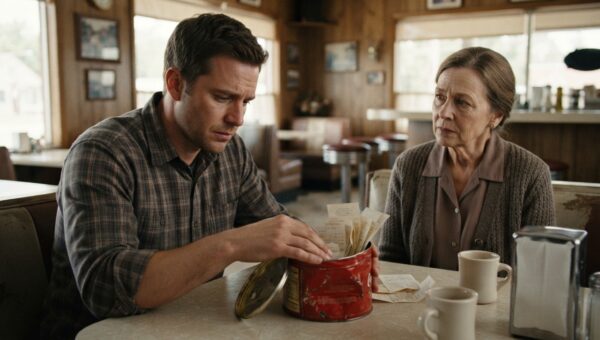
We didn’t have to go all the way to the hardware store. Halfway down 4th Street, I saw his truck parked outside the diner where we always stopped after church on Sundays. Richard was sitting in the corner booth by the window, a cup of black coffee steaming in front of him, looking out at the gray river with that calm, easy expression he wore every day of our married life.
Agent Vance pulled the sedan up behind his truck, blocking him in against the curb.
I opened the passenger door and stepped out onto the damp pavement, the wind biting through my sweater. When I pulled open the diner door, the little brass bell above it gave that same cheerful chime it always did, marking the exact second the rest of my life split in two.
Richard looked up as I walked across the linoleum floor, his hand pausing halfway to his coffee cup. He didn’t look scared. He just looked annoyed, like I was interrupting him during a quiet moment of his morning.
“What are you doing here?” Richard asked, setting the mug down. “I told you I’d be home by noon.”
I didn’t sit down in the vinyl booth. I dropped the federal investigator’s manila folder right on top of his saucer, scattering a few brown sugar packets across the table.
“You didn’t just go to the funeral, Richard,” I said, and my voice didn’t shake anymore. It came out hard and flat, like stones hitting the bottom of an empty bucket. “You signed the papers three days later. You helped him steal ninety-one thousand dollars from a dead woman.”
Richard stared down at the visible signature through the clear plastic sleeve of the evidence bag. For a second, his jaw tightened, and then that mild, reasonable mask he wore for twenty years slipped just enough to show the stranger underneath.
“Your brother was drowning,” Richard said, his voice dropping to a low, reasonable murmur, trying to manage me the way he always did when I got upset. “Someone had to help him keep the roof over his head. It was just government money sitting in an account that wasn’t hurting anybody. It was keeping the family afloat.”
“We are done,” I said. The words came out before I even knew I was going to say them, small and final as a slammed door.
Agent Vance stepped up behind me, his hand resting lightly on the back of the empty booth seat. Richard looked past my shoulder at the federal badge glinting under the diner’s fluorescent lights, and for the first time, the color drained completely out of his face. He reached out a hand like he wanted to touch my sleeve, the way he had every Sunday for twenty years.
“Now wait a minute,” Richard said, his voice finally cracking at the edges. “Let’s not do something we can’t take back over a misunderstanding.”
I didn’t step toward him. I took two steps backward toward the door, letting the chill of the street air hit my face.
“You can explain it to the judge,” I said.
I walked back out to the car and waited in the passenger seat while the marshals went inside. The diner window was fogged over from the heat inside, and I couldn’t see Richard’s face anymore through the glass.
When I got back home, the house was empty. The kitchen was just the kitchen again, quiet and smelling of old coffee grounds and cold linoleum. I didn’t cry. I walked down the hall to our bedroom, pulled Richard’s heavy leather suitcase out from the back of the closet, and set it open on the bed. I didn’t throw his things or tear his shirts. I just started piling his clothes into the canvas bag one by one, folding them neatly the way I always had, stacking them until the zipper could barely close.
Outside, the first dry flakes of winter snow were starting to stick to the grass, turning the brown lawn gray.