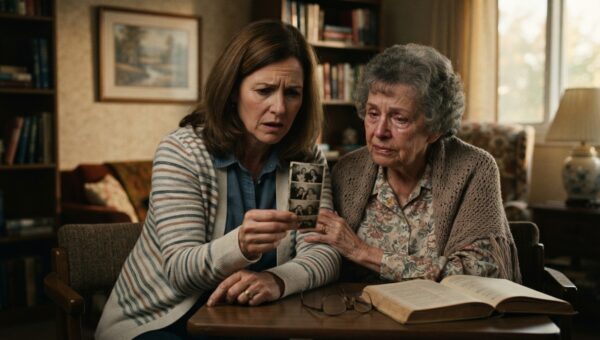
The hallway light always hums a little bit when the weather turns damp in upstate New York. It is a low, cheap sound from the ballast inside the plastic cover that my first wife, Clara, put up back when we bought the place on Maple Street. I stood right under that hum at 11:14 at night, holding a glass of lukewarm water I did not want, staring down at my seven-year-old daughter Maggie.
She was standing in the doorway of her bedroom in her little flannel nightgown with the faded pink horses, her small fingers twisted deep into the soft, gray-matted fur of her stuffed rabbit, Barnaby. Her brown eyes were wide and fixed on the floorboards between us, that particular look she gets when she is carrying something too heavy for her small ribs.
I had been married to Elena for fourteen months. We had spent the first year building a quiet, predictable rhythm after the dark, hollow years that followed Clara passing away from the cancer that took her in six months flat. Elena was a high school art teacher with ink permanently stained into the cuticles of her thumbs, a woman who brought order to our kitchen and taught Maggie how to braid friendship bracelets out of embroidery floss. I thought we were safe. I thought we had traded our old grief for a clean slate.
Then Maggie looked up from the floor, her little chin trembling just enough to catch the yellow hallway light, and dropped the sentence that stopped my blood cold.
“Daddy, new Mom asked me to keep a secret from you. Is that okay?”
I set the glass down on the small oak side table so hard a little water sloshed over the rim and onto the wood. My hand stayed on the glass for a second longer than it should have because my fingers had gone stiff. I tried to keep my voice flat, the way I do when I am talking a customer down off a bad estimate at the body shop, but it came out too sharp, too tight in the quiet house.
“No, sweetheart. You can tell me anything. You know that.”
Maggie swallowed hard, her throat bobbing. She shifted her weight from one bare foot to the other on the cold carpet. “Yesterday, I woke up early because I heard a thump by the back door.
I thought it was just the delivery man or the raccoon that gets into the garbage, so I went to look. But it wasn’t. I saw new Mom coming out of the basement with a man.”
The humming of the hallway light seemed to get louder, a high, vibrating drill in the back of my skull. I had not been down in the basement since Tuesday, when I hauled down a stack of winter tires and a box of old tax files. The fruit cellar down there had a heavy wooden latch that stuck if you did not pull it just right, and the rest of the lower level was mostly concrete blocks, exposed copper pipes, and the old workbench my grandfather left me. Nobody went down there unless something broke.
“What did he look like, Maggie?” I asked, and my voice sounded like it belonged to someone else standing across the room.
“He was really handsome, Daddy,” she whispered, her voice dropping lower as if she thought someone else might be listening from the dark corners of the hall. “He had nice blond hair, like a prince in one of my picture books, and a bright red jacket.
He smelled nice, too. Like mint and expensive soap, not like sawdust or motor oil.”
My stomach gave a hard, sick twist. Elena did not have a brother she talked about often, and her parents lived down in Florida in a retirement community where the biggest excitement was a shuffleboard tournament. She had told me once she had a younger sibling who was always bouncing from one place to another, a kid who never quite settled down, but she said it with that heavy, dismissive sigh people use when they are tired of bailing water out of a sinking boat. She never mentioned him visiting. She certainly never mentioned him sleeping under our roof without telling me, let alone hiding in the dark, unfinished belly of our house while my daughter was asleep upstairs.
“Did she see you, honey?” I asked, crouching down so I was eye-level with her small, worried face.
“She saw me right when she was locking the cellar door,” Maggie said, her voice dropping to a guilty whisper. “She came over and crouched down by me. She told me it was a special game. She said if I didn’t tell you, we would go get ice cream at Dairy Queen after school on Friday. But I didn’t want to keep secrets from you, Daddy. It felt bad in my tummy.”
I reached out and pulled her into me, burying my face in her hair, which smelled like the strawberry shampoo Clara always used to buy for her. “You did the exact right thing, Mags. You go back in your room and get back under the covers. Everything is fine. I’m just going to go check on the furnace, okay?”
She nodded against my shoulder, her little arms squeezing my neck tight before she let go and scurried back into her room, clicking the white door shut behind her. I stood up in the hallway, my chest burning as if I had swallowed a hot coal. The house was dead quiet again, save for the refrigerator humming in the kitchen down the hall and the distant hiss of traffic out on Route 9. I walked past our bedroom. The door was cracked open an inch, and I could see the pale shape of Elena’s shoulder rising and falling under the duvet, deep in the heavy sleep of someone who believed her secrets were safe in the dark.
I did not turn on the kitchen light. I walked straight to the basement door by the pantry, my hand reaching out by habit for the heavy mag-lite we kept hanging on a brass hook by the frame. My thumb found the rubber switch and shoved it forward. A bright, circular white beam cut through the dark drop of the stairwell, illuminating the steep, unpainted wooden steps that Clara and I had patched together ourselves during our first summer here.
The air on the stairs changed immediately. It dropped ten degrees, smelling faintly of damp limestone, old cardboard, and, cutting sharply through the rot of the cellar, the crisp, sweet scent of mint and peppermint tobacco. That was the detail that made my jaw lock. Not the damp, not the dust, but the smell of a man who did not belong in my house, lingering in the draft coming up from the floor.
I took the steps one by one, my boots hitting the wood with a dull, heavy thud that I did not try to muffle. If someone was down there, I wanted them to hear me coming. The beam of the flashlight swept across the concrete floor, catching the stack of winter tires, the spare bags of potting soil, and the old cedar chest where we kept our out-of-season blankets. Everything looked undisturbed, just the ordinary clutter of a family trying to live a normal life in a house that was getting too small for them.
Then I reached the back corner, past the old coal chute that we had sealed shut with plywood and fiberglass insulation years ago. That was where the fruit cellar sat, a small room with a thick wooden door that Elena insisted on keeping locked because she said the damp air made her canning jars rust. I had the key on my key ring in the kitchen, but I didn’t need it tonight. The heavy wooden latch was pushed down, but the door was not fully clicked shut. A thin sliver of yellow light leaked out from the bottom crack onto the gray concrete floor.
My heart was hammering against my ribs now, hard and fast like a trapped bird. I reached out with my left hand, wrapped my fingers around the rough edge of the wood, and pulled the door open in one hard, violent motion.
The flashlight beam cut inside, hitting a makeshift camp set up against the canned-peach shelves. There was a rolled-up blue camping sleeping bag spread out over a thick layer of moving blankets. A half-eaten turkey sub from the deli down on 4th Street sat on a paper plate next to an empty can of soda and a scatter of loose change. But the thing that made my breath catch in my throat was the bright red puffer jacket tossed carelessly over a plastic storage bin, the very jacket Maggie had described, bearing a small designer logo on the chest that cost more than two weeks of my grocery budget.
Before I could step inside to look closer, a board creaked behind me in the main basement area.
“Who’s down here?” a young, sharp voice called out from the shadows near the laundry sink. “Elena? Did you bring the coffee?”
I spun around, the flashlight beam slashing through the dark and catching a young man standing by the washer and dryer. He was blinking hard against the sudden glare, his hand coming up to shield his eyes. He had messy blond hair that fell across his forehead in soft waves, a thin, handsome face that looked entirely too young to carry the hard, sunken look around his eyes, and he was wearing a gray hoodie with the sleeves pushed up to his elbows. He was shivering slightly despite the heavy wool sweater he had thrown on over his shirt.
“You’re not Elena,” he muttered, taking a slow step back toward the dark corner by the water heater.
“No,” I said, and my voice was so quiet it barely sounded like my own. “I’m the guy whose house you’re hiding in. And you must be the prince.”
The kid, he couldn’t have been more than twenty-four, with a nervous, twitchy energy in his shoulders, let out a dry, humorless laugh that sounded more like a cough. He shoved his hands deep into the pockets of his jeans, rocking back on his heels the way people do when they are trying to look casual while standing on the edge of a cliff.
“Look, man, I didn’t mean to cause any trouble,” he said, his voice carrying that fast, slippery cadence of someone who had talked his way out of a dozen small-time jams before. “Elena said it was cool for a couple of days. Just until I get my car sorted out. I’m Julian.”
“Julian,” I repeated, tasting the name like something sour on the back of my tongue. “Elena’s brother.”
“Yeah. Exactly. Her little brother.” He gave a tight, nervous smile that didn’t reach his eyes. “Look, I can clear out right now. I don’t want to mess up whatever you two have going on up there. She was just trying to help out family, you know how it is. Blood and all that.”
“Blood,” I said, stepping closer to him, the flashlight beam steady on his chest. The smell of expensive mint cologne was thick around him now, masking the stale sweat of someone who hadn’t showered in three days. “She didn’t mention anything about blood when she was lying in bed upstairs. She didn’t mention you sleeping on my floor or bribing my seven-year-old daughter to keep your secret.”
Julian’s jaw tightened, the easy charm slipping away to reveal the raw, desperate panic underneath. “Look, mister, you don’t understand. If I go back out to my car tonight, I’m not going to a motel. There are people looking for me. People who want money I don’t have. If they find me in this town, I’m done for. Elena was just trying to keep me from getting my legs broken, alright? Is that what you want to hear?”
The words hung in the damp air between us, heavy and ugly. The image of Maggie sleeping just two floors above us, her little pink horse nightgown and her stuffed rabbit, flashed through my mind. I thought of her wide, honest eyes telling me about the man in the red jacket, and the smooth, practiced way my wife had looked me in the eye at dinner yesterday and asked me how my day at the shop went while her brother was eating deli sandwiches in our cellar.
“Get your jacket,” I said.
Julian stared at me, his eyes widening. “What? Man, it’s twenty degrees outside. You can’t just throw me out into, “
“Get your red jacket,” I repeated, my voice dropping into that low, flat register that left no room for argument. “And grab your sleeping bag. You’re leaving right now.”
“Elena!” Julian suddenly shouted toward the stairs, his voice cracking with panic. “Elena, get down here! Your husband’s losing his mind!”
The heavy wooden basement door at the top of the stairs creaked open, throwing a long shaft of warm hall light down onto the steps. Footsteps hurried down, light and frantic, and then Elena appeared in the opening, wearing her old flannel robe, her dark hair loose around her shoulders and her face pale with terror.
“Stop it! Both of you, stop it right now!” she cried, rushing down the steps until she stood between us, her hands up as if she were trying to block a physical blow. She looked from me to Julian, her chest heaving as she tried to catch her breath. “Tom, please. Just listen to me for one second.”
“I’m listening, Elena,” I said, keeping the flashlight pointed at the concrete floor between us so the harsh glare didn’t blind her. “Starting with why my daughter had to lie to me so you could run a shelter for a fugitive down in our fruit cellar.”
Elena let out a ragged sob, her hands dropping to her sides as the last of her defenses crumbled away. “He made a massive mistake down in Syracuse, Tom. Some people he owed money to, bad people, they came to his apartment. They trashed the place. He called me from a gas station three days ago, crying, terrified. I couldn’t just let them hurt him. I knew if I told you the truth right away, you’d panic, you’d tell him to leave because of Maggie, and I couldn’t bear the thought of something happening to my only brother. I was going to figure something out by the weekend. I swear to God I was.”
“You lied to me,” I said, and the words felt like lead dropping into a well. “Every single day for three days, you sat across from me at that kitchen table, and you lied. You used my daughter as a pawn to cover for your family’s wreckage.”
“I was scared,” she whispered, tears finally spilling over her lashes and cutting tracks through the pale skin of her cheeks. “I was so scared of losing this family. I thought if I just kept it hidden until I could get him onto a bus to our cousin in Chicago, everything would go back to normal. I didn’t mean to hurt Maggie. I just panicked.”
Julian stood behind her, his head down, clutching his red jacket in his fist like a shield. The silence in the basement stretched out, heavy and suffocating, broken only by the hum of the old furnace kicking on in the corner.
I looked at Elena, really looked at her, seeing past the art teacher, past the woman who braided friendship bracelets with my daughter, past the comforting routine we had built over the last fourteen months. I saw someone who believed that love meant protecting people from the consequences of their own destruction, no matter who else got caught in the crossfire. And I knew right then that if I let this go, if I let him stay one more night, the foundation of our house was cracked all the way through to the dirt.
“He’s not staying here,” I said quietly, the words final and absolute. “And we are not covering for him anymore. We are going to call your cousin in Chicago right now, we are going to buy him a one-way bus ticket leaving out of the terminal at six a.m., and you are going to sit right there and watch him pack his things.”
Elena looked up at me, her eyes wide with a mixture of grief and realization, and slowly nodded. She didn’t argue. She knew there was nothing left to bargain with.
It took two hours of cold, quiet logistics in the kitchen while the rest of the neighborhood slept. We did not yell anymore. The anger had burned itself out into something gray and hollow, leaving only the hard work of cleaning up the mess. Julian sat at the kitchen table with a cup of black coffee I didn’t want to give him, staring at his phone while Elena worked out the details with her family up north, her voice shaking as she explained that the hiding place was over.
By 4:45 in the morning, the back door clicked shut behind Julian as he walked down the driveway toward the cab I had called for him, his red jacket zipped up to his chin and his duffel bag slung over one shoulder. We watched him from the kitchen window until the tail lights of the sedan turned the corner onto Maple Street and disappeared into the gray pre-dawn mist.
Elena stood beside me at the sink, her hands wrapped tightly around a cold mug of coffee she hadn’t touched, her eyes fixed on the empty driveway. Neither of us said a word. The house felt impossibly large and quiet around us, the kind of quiet that comes after a storm has passed and left the roof caved in.
I walked down the basement stairs one last time before the sun came up. The air was already warming up, losing that sharp, sweet scent of mint and panic. I stepped into the little fruit cellar, picked up the empty paper plate and the soda can, and tossed them into the trash bag I had brought with me. Then I walked out, pulled the heavy wooden door shut until the latch clicked solidly into place, and threw the iron bolt.
I climbed back up the stairs, walked into the kitchen, unhooked the brass key from the board by the pantry, and slipped it into my pocket where it belonged. Upstairs, down the hall, Maggie’s door was still shut tight, her little pink horse nightgown safe in the dark, resting easy in a house where the secrets were finally locked away where they couldn’t hurt her anymore.