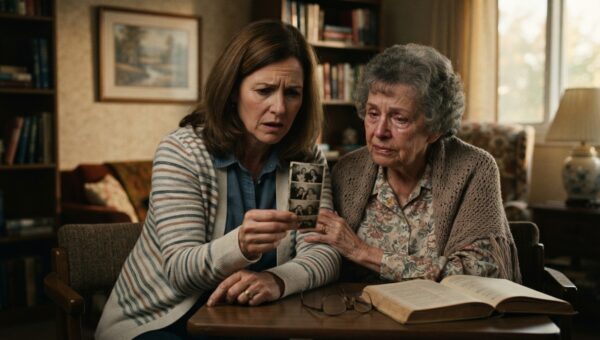
The metal latch of the basement storage bin always stuck if you didn’t yank it just right. I gave it a sharp tug, letting out that familiar screech of rusted iron against the concrete floor, and dragged the cardboard box out into the pale light of the utility room. It was Wednesday afternoon, and the house felt too large since my knees started acting up and I retired from the machine shop down on Fourth Street.
I had promised myself I would clear out the junk stacked against the north wall before the winter frost set in.
Inside the box sat three decades of forgotten paperwork, old tax returns from years I barely remembered, and a stack of school mementos that should have gone into the trash ten years ago. Right at the bottom, beneath a bundle of old utility bills and a rusted set of socket wrenches, was Chloe’s 2012 high school yearbook. The dark blue cover was faded around the edges, the gold foil lettering worn down until her name looked like a smudge in the dim overhead light.
I didn’t plan on opening it. I actually intended to drop the whole box straight into the grey garbage bin outside by the curb. But my thumb caught the edge of the hard cover, and the book fell open right across the middle pages, landing face down with a dry slap against the linoleum.
When I picked it up to straighten the pages, a small piece of faded pink cardstock slipped out from the gutter of the binding and fluttered down onto my old leather slippers.
It was a ticket stub from the municipal auditorium dated May fourteenth, 2012, admitting one person to the senior class graduation ceremony. The printed price on the corner read forty-seven dollars, which had felt like real money back when I was working sixty hours a week on the second shift to keep up with the mortgage. I turned the small slip over between my thumb and forefinger, noticing a grease smudge near the barcode, and then I saw the handwriting scrawled across the back in blue ballpoint ink.
Dad, I saved you a seat.
The kitchen went dead quiet except for the low hum of the refrigerator motor in the corner. I stood there holding that little piece of cardboard, my thumb pressed against the blue ink, and the year 2012 came rushing back into the room with the force of a slammed door.
Back then, my life was measured in shift changes and time clocks. I had told Chloe three days before the ceremony that I could not get the evening line supervisor to cover my station without losing my overtime bonus.
“It’s just a ceremony, Chloe,” I had told her while I stood at the sink scrubbing engine grease off my knuckles with a pumice stone. “They hand out a thousand pieces of paper to kids who didn’t even work for them. You know how things are at the plant right now.”
She didn’t yell or slam anything down. She just stood by the kitchen table with her graduation gown draped over the back of the chair, looking at me with those quiet grey eyes she got from her mother. “I know, Dad,” she had said, and her voice didn’t even sound mad, which somehow felt worse than if she had screamed. “I just thought maybe this once.”
That was the first crack. The second one came two months later when the wedding invitation arrived in a cream-colored envelope that sat on the counter for four days before I opened it. She wanted her stepfather, the man her mother married three years after the divorce, to walk her down the center aisle of the small Baptist church downtown. I called that disrespectful, pure and simple, and told her over the phone that if I wasn’t good enough to take her down the aisle, I wouldn’t bother showing up in the pews at all.
“If you want to be a guest, you can buy a program,” I remember telling her, my voice rising over the sound of the television news in the background.
There was a long pause on the other end of the line, just the sound of heavy breathing and traffic outside her apartment window. “Okay, Dad,” she had whispered, and then the line went dead with a sharp click. She stopped answering my calls after that afternoon. When I tried to drop by her apartment two weeks after the wedding, the landlord told me she had already moved out and left no forwarding address. My pride was a thick, heavy thing back then, and I convinced myself that she was the one who had walked away from family.
I sat down hard on the wooden kitchen chair, my knees trembling slightly under the weight of the memory, and brought the ticket stub up against my lips. The paper tasted like old cardboard and dust, but for a second I could smell the faint scent of the lilac perfume she used to wear when she was eighteen. Fourteen years of complete silence compressed into a single square inch of pink paper.
I didn’t put the yearbook back in the box. I carried it into the living room and placed it on the coffee table right beside the landline phone, as if leaving it there would change what had happened. My sister Clara was the only person in the family who still kept track of any of us, living out her quiet retirement in a small brick duplex over in Racine. I picked up the receiver around four in the afternoon, my fingers fumbling with the buttons because I hadn’t dialed her number in at least six months.
“Hello?” Clara’s voice came through scratchy and high-pitched over the landline.
“Clara, it’s Arthur,” I said, clearing my throat because my mouth felt like sandpaper. “Listen. I found something of Chloe’s today. In an old box.”
There was a long silence on the other end, the kind of silence that tells you someone is weighing whether it’s even worth their time to speak. “Did you now,” Clara said finally, and her tone didn’t have any warmth in it. “And what brought that on after all this time, Artie?”
“I found a ticket stub from her graduation. With a note on it.” I didn’t want to tell her I was crying, but my voice gave out on the last word anyway. “Clara, I need to know where she is. Just an address. I’m not looking to cause trouble. I just need to see if she’s alright.”
Clara sighed, a long, tired sound that seemed to come from deep inside her chest. “She’s alright, Artie. She turned out fine in spite of us all. Got her nursing degree down at the technical college three years after that wedding, worked double shifts at St. Mary’s until she saved up enough for a down payment.”
“Where does she live?” I asked, leaning forward until my forehead nearly touched the edge of the coffee table.
“She’s got a little place over on Elm Street,” Clara said, her voice dropping lower. “Number 412. It’s a small brick bungalow with a white porch railing. She bought it four years ago with her husband, Mark. They’ve got two boys now. Ten and seven. But Artie, I’m telling you right now, she built a good life for herself because she stopped waiting for you to show up. Don’t go over there thinking you can just walk in like nothing happened.”
“I just want to see her,” I said, and the line went quiet again before Clara gave me the street name and the zip code.
I didn’t sleep that night. I sat in the armchair by the front window watching the headlights of delivery trucks sweep across the living room ceiling, turning the ticket stub over and over in my fingers until the corners were soft and frayed. By ten o’clock the next morning, I had put on my good wool jacket, the one I only wore to funerals and church on Christmas Eve, and climbed into the cab of my old Ford pickup truck.
The drive across the county took forty-two minutes through flat farm country where the cornstalks had already been cut down to stubble for the winter. My hands felt stiff on the steering wheel, and every time I stopped at a red light, I thought about turning the truck around and heading back to the quiet safety of my kitchen. But the ticket stub was sitting right there on the passenger seat, held down by my wallet so it wouldn’t blow out the window.
Elm Street was a quiet neighborhood with large maple trees lining both sides of the road and small brick houses with neat hedges out front. Number 412 sat back from the street behind a patch of green lawn that looked like someone spent their Saturdays tending to it with a pair of shears. A silver sedan was parked in the driveway, and a plastic red scooter lay on its side near the bottom of the concrete steps.
I killed the engine and sat there in the cab for five minutes, watching the front screen door of the bungalow. A blue jay landed on the porch railing, pecked at an empty seed bell hanging from the eaves, and then flew off toward the neighbor’s roof. My chest felt tight, the way it used to feel back when the foreman at the plant would walk down the assembly line with a clipboard to hand out layoff notices.
I pushed the truck door open, the heavy hinge groaning in the cold air, and walked up the three concrete steps to the front porch. The wood of the doorframe was painted a clean, bright white that looked like it had been brushed on within the last year. I raised my hand, my knuckles hovering an inch away from the wooden panel, and let out a breath that came out white in the morning air.
Before my fist could touch the wood, the inner door swung inward with a soft click.
A woman stood behind the mesh of the screen door, wearing a simple grey sweater with her brown hair pulled back into a loose clip at the base of her neck. Her face had the same high cheekbones I remembered from her mother’s side of the family, but the lines around her eyes were deeper now, carved by years of long shifts and real life. She was holding a blue kitchen sponge in one hand, and she stopped dead the second she looked through the screen at my face.
The world seemed to narrow down to the space between us, just a few feet of painted wood and rusted wire mesh.
“Chloe,” I said, and my voice cracked so badly it sounded like a stranger’s.
She didn’t move. Her fingers tightened around the blue sponge until a little stream of soapy water dripped down onto the porch mat. For three or four seconds, neither of us breathed, and then a heavy footstep sounded behind her in the hallway.
A tall man in a plaid work shirt appeared in the narrow entryway, wiping his hands on a kitchen towel, and his eyes locked onto me through the glass with an immediate, defensive hardness. He stepped up beside Chloe, placing one large hand gently on her shoulder, and his voice cut through the cold air like a saw blade.
“Is that the man who…” he started, his words trailing off as he looked from my face down to the trembling hands at my sides.
Chloe raised her left hand, palm out, stopping her husband before he could finish the sentence. She didn’t look at him; her grey eyes stayed fixed right on my face, looking at my old wool coat, my grey hair, and the way my shoulders were curved inward against the cold.
“You’re late, Dad,” she said, and her voice wasn’t angry anymore, just tired in a way that made my throat burn. “The ceremony was fourteen years ago.”
I couldn’t look away from her. The words were right there in my chest, heavy and useless, but I forced them out anyway because there wasn’t anywhere left to hide behind. “I know I am,” I said, my voice shaking so hard the words barely made it off the porch. “I found the ticket. In the old yearbook. The one where you wrote about the seat.”
Chloe let out a long, shaky breath, and the tension in her shoulders didn’t leave entirely, but her hand dropped away from the screen door latch. She looked down at the floorboards for a second, then back up at me, her eyes bright with moisture she wasn’t trying to hide.
“I sat in that auditorium for twenty minutes after the lights came up,” she said, and every word felt like a physical weight being set down between us on the wood. “I kept looking at the empty chair on the aisle, thinking maybe your shift got changed at the last second. I waited until the janitor came by to sweep up the programs.”
“I stayed at the plant,” I whispered, the confession tasting like ash in my mouth. “I was too proud to admit I made a mistake.”
“Pride is a heavy thing to carry around for fourteen years, Dad,” she said softly.
She stood there for another long moment, weighing something in her head, and then she turned her head slightly to look at the man beside her. They exchanged a brief, silent look, the kind of shorthand families have after years of building something real together, before she reached out and unlatched the screen door. It swung open outward, letting out the warm smell of coffee and oatmeal from inside the house.
“The boys are at school,” she said, her voice dropping to a normal, everyday tone that felt almost frighteningly ordinary after all this time. “And we don’t have much time to talk before Mark has to leave for the lumber yard. But if you want to come inside and sit down for ten minutes, there’s a chair at the kitchen table.”
I didn’t step across the threshold right away. I just nodded, feeling the old hardness in my chest finally give way to something sharp and clean, and followed my daughter inside out of the cold.