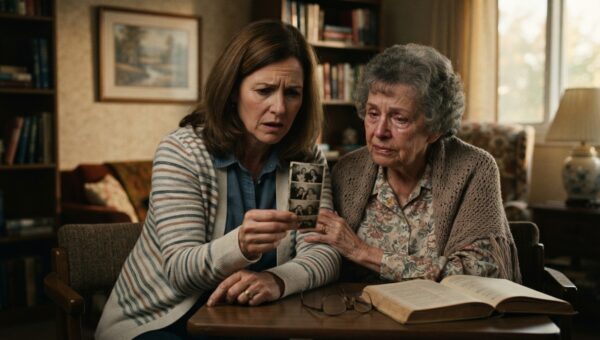
The rain had been tapping against the frosted glass of Mr. Vance’s office window for twenty minutes, a dull, steady rhythm that sounded an awful lot like a clock ticking down to something you couldn’t stop. I remember the smell of that room more than anything else. It smelled like old paper, damp wool coats, and mints that had been sitting in a glass dish since the Reagan administration.
My sister Clara was sitting beside me on the green vinyl sofa, her knee bouncing a steady, impatient tattoo against the table leg. She had her winter coat draped over the back of the chair even though the radiator was hissing like a cornered cat. Clara had spent the entire drive over talking about what she was going to do with the kitchen cabinets in the house on Maple Street. Not if she got them, but when.
Arthur Vance cleared his throat, a dry, papery sound, and adjusted his bifocals before turning the heavy brass lamp on his desk. He didn’t look at either of us when he opened the leather-bound folder. He just stared down at the cream-colored pages like he was reading a medical report he didn’t want to deliver.
“As of January twelfth, 2026,” Mr. Vance began, his voice flat and practiced, “the last will and testament of our late father, Thomas, and mother, Evelyn, has been filed and executed in full probate court.”
Clara leaned forward, her eyes bright and narrow with that familiar hunger she’d carried since we were kids sharing a bathroom.
She was the one who stayed in town, who showed up for Sunday dinners with casseroles from the specialty shop, who played the devoted daughter while I lived three states away working seventy-hour weeks in logistics. She thought she had the ledger balanced down to the penny.
“The primary estate,” Mr. Vance continued, turning a page, “consisting of the residential property located at 742 Oak Ridge Lane, valued at six hundred and twenty-five thousand dollars clear of primary mortgage, along with the consolidated savings accounts, municipal bonds, and secondary investment portfolios totaling four hundred and seventy-two thousand, five hundred dollars, is bequeathed in its entirety to our surviving daughter, Clara Jean Miller.”
Clara let out a sharp, theatrical breath that sounded like a laugh trying to disguise itself as a gasp. She reached over and squeezed my wrist, her fingers cold and tight.
“And for our elder daughter, Beatrice Mae Miller,” Mr. Vance said, pausing just long enough for the grandfather clock in the corner to chime twice, “the estate assigns zero financial claim, zero liquid distribution, and zero physical artifacts from the primary residence.”
The silence in that room was heavy, the kind of quiet that drops over a forest right before a tree comes down.
Mr. Vance looked up then, his old eyes fixing on mine with a strange, searching weight. He didn’t look sorry. He looked tired. Like a man who had tried to deliver a message and gave up halfway through.
Clara didn’t wait. She couldn’t help herself. She leaned back against the vinyl cushions, crossing her arms with a smug, heavy-lidded smile that reached right up to her temples.
“Well,” Clara said, her voice dripping with that honeyed sweetness she used whenever she wanted to twist the knife without leaving a mark. “Looks like Mom and Dad finally showed who they loved more.”
I didn’t blink. I didn’t feel my chest tighten the way I used to when we were kids and she took the better bedroom or the bigger slice of cake. I just looked at the way her knuckles were white against her sleeve.
“I’m happy for you, Clara,” I said. My voice didn’t shake. It sounded like someone reading a weather report.
I stood up, smoothed down the front of my wool skirt, and walked toward the heavy oak door. Mr. Vance called my name once, half-rising from his leather swivel chair, but I didn’t turn around. I just pulled the latch, stepped out into the cold drizzle of the parking lot, and got into my car. I turned my phone off before I even put the key in the ignition.
For the next seventeen days, my world was quiet. The kind of quiet you only get when you finally put down a heavy suitcase you’ve been carrying up a mountain for forty years.
I went to work, came home to my small rented duplex, drank my tea while watching the headlights sweep across the living room wall, and didn’t check my voicemail once. My sister’s number blinked on the screen of my old landline twice during the first week, and then the house phone stopped ringing altogether. Clara was too busy. She was too busy taking possession of the six-hundred-and-twenty-five-thousand-dollar house, too busy calling contractors about those kitchen cabinets, too busy posting photographs of herself standing on the front porch holding the keys like she’d just climbed Everest.
She thought she’d won the game. She thought Mom and Dad’s lifetime of quiet frugality was her personal lottery ticket.
The seventeenth day broke gray and damp, the sort of northern Ohio morning where the fog sits right on top of the plowed fields and doesn’t lift until noon. I was sitting at the kitchen table with a cup of black coffee when the cell phone on the counter let out that sharp, double-toned chirp.
It was 2:18 in the morning.
I stared at the screen for three seconds. The caller ID said *Clara*.
When I slid my thumb across the glass and put the phone to my ear, I didn’t even have to say hello. There was no greeting. Just a ragged, high-pitched sound that took me a second to recognize as human breathing.
“Beatrice,” she gasped. Her voice wasn’t smug anymore. It was thin, torn at the edges like paper left out in the rain. “Beatrice, you have to answer me. Please. God.”
“Clara,” I said, keeping my voice low and level. “It’s two in the morning.”
“Why didn’t you tell me?!” she screamed, the sound cracking halfway through into a dry, jagged sob. “Why didn’t you say anything? You knew! You had to have known!”
“I didn’t know anything about the will until Vance read it, just like you,” I said, taking a slow sip of my coffee. “What are you talking about?”
“The papers,” she wailed, and I heard the sound of a plastic folder hitting the floor, followed by the clatter of loose pages scattering across hardwood. “The secondary box. The one behind the deed binder in the bottom of Dad’s cherry desk. I was looking for the title transfer for the riding mower and I found the rest of it. Beatrice, the tax liens. The commercial judgments. There’s forty pages of them.”
I didn’t say anything. I just watched the steam rise from my mug.
“They aren’t just savings, Bea,” she cried, her words tumbling over each other in a frantic, rising panic. “It’s a twelve-hundred-page audit from the federal court and two private lenders in Youngstown. The house isn’t clear. The accounts aren’t clear. By taking the primary executorship and signing the sole-beneficiary transfer without contest, I… I took the whole thing.”
“You took the whole thing,” I repeated quietly.
“One million three hundred thousand dollars,” she whispered, the number coming out like air leaking from a punctured tire. “That’s what the total balance due is. They’re garnishing the accounts already. The bank froze the savings this afternoon. They’re talking about foreclosure on Oak Ridge Lane by Friday if the first lump-sum payment isn’t wired. Beatrice, I don’t have that kind of money. I spent twelve thousand on the new kitchen counters yesterday morning!”
The irony of those counters hung in the dark kitchen like a cold shadow.
“Well,” I said, echoing her own words from seventeen days ago back at her. “Looks like Mom and Dad finally showed who they trusted more.”
“Don’t do that!” she shrieked, her voice spiking into something feral. “You have to help me! We’re sisters! If we split the estate, we split the liability, right? Mr. Vance said something about an amendment if both heirs, “
“Mr. Vance read the distribution exactly the way Dad wrote it,” I interrupted, my voice dropping an octave until it was steady as stone. “You wanted the whole crown, Clara. You stood in that office and told the world you were the favorite. You don’t get to hand back the anchor just because you didn’t check the weight before you jumped off the boat.”
“I’ll lose everything,” she sobbed. “The house, my car, my savings, they’re going to take my personal accounts to satisfy the corporate default judgments. I’m going to be bankrupt by the end of the month.”
“Then I suggest you call a lawyer who specializes in corporate debt,” I said. “Because I don’t have a law degree, and I certainly don’t have four hundred and seventy thousand dollars sitting in my kitchen.”
“Beatrice, “
I tapped the red button on the screen, cutting her off mid-sentence.
The kitchen went dead silent. The hum of the refrigerator was the only sound left in the room. I walked over to the kitchen sink, poured the rest of my cold coffee down the drain, and rinsed the ceramic mug under the tap.
My phone buzzed three more times within the next five minutes. Then a text came through from an unknown number, Mr. Vance’s direct line. *She was in my office at 8:00 a.m.,* the message read. *She tried to disclaim the inheritance retroactively. The probate judge threw it out. The sole liability clause is binding under Ohio statute. She’s fully exposed.*
I put the phone on the kitchen counter, screen face down, and walked over to the front door.
I threw the deadbolt, listening to the heavy brass tongue slide home with a clean, solid click. For the first time in my life, the silence in my house didn’t feel like an absence. It felt like mine.
I turned off the kitchen light, walked down the narrow hallway to my bedroom, and pulled the quilt up to my chin. Outside, the gray light of dawn was just starting to stain the edge of the window frame, pale and steady and clear.