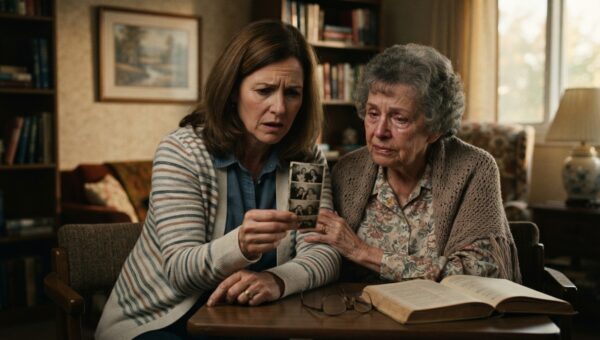
The carpet in Lucas’s old room had this one frayed spot near the radiator that always caught on my slipper if I wasn’t paying attention. I must have stepped over it a hundred times during those seven weeks while he was fading away, but that afternoon, with the afternoon sun hitting the bare baseboards, it just looked like another piece of trash left behind in an empty house.
Clara didn’t wait for the funeral flowers to wilt before she brought in the three-part folding table and the stack of U-Haul boxes from the garage. She had her car keys jangling in her hand the whole time I was clearing out the medicine bottles from the bathroom shelf.
“The probate lawyer is coming by on Thursday morning,” she had said, not even looking up from her phone while I wiped down the counter. “I need this place cleared out so the painters can get in before the listing goes live. You can take whatever fits in your trunk, but the rest goes to the dump.”
I didn’t argue with her. You don’t argue with someone when your bones are too tired to carry the weight of your own grief. My son Lucas was only thirty-three when his heart finally gave out on that hospital bed, and I had spent the last nine months of my life living in a folding chair beside him, watching him shrink down to nothing until he didn’t even look like the boy who used to fix bicycles in our driveway.
Back when Clara first walked out, things had been different, or at least I thought they had been. It was a Tuesday morning back in November when the frost was still thick on the grass. Lucas had been bedbound for three weeks, his breathing sounding like dry paper rubbing together every time the heat kicked on in the hallway.
Clara had come down the stairs with her coat already buttoned up over a silk blouse, her overnight bag sitting by the front door like she was just heading off to a weekend seminar in Des Moines. Lucas had tried to lift his head off the pillow, his knuckles white where he was gripping the quilt I had knitted him back when he got his first real job at the grain elevator.
“You can’t just leave him here like this,” I had said, blocking the doorway to the kitchen with a mug of lukewarm coffee still in my hand. “The doctor said he needs someone here around the clock to manage the IV and check his fever.”
She had looked right through me, her eyes as flat and gray as a slate roof in the rain. “I won’t waste my life watching him turn into a vegetable,” she said.
Those were the exact words. No tears, no hesitation, just a cold calculation in her voice like she was returning a pair of shoes that didn’t fit right. Then she stepped around me, let the front door click shut behind her, and didn’t look back once through the sidelight windows.
I had called my sister Martha that very afternoon, packed my winter coat and two changes of clothes into the trunk of my Buick, and driven the four hours down to Lucas’s house. I became his nurse, his cook, and his only shield against the quiet emptiness of that place. I learned how to adjust the oxygen tank at three in the morning when the little metal ball started bouncing too low. I learned how to spoon broth past lips that were too cracked and dry to hold a word.
And when he finally let go on a rainy Thursday just before dawn, my hand was the only one he was holding.
Clara didn’t show up at the hospice room until twenty minutes after the nurse had finished the paperwork, and even then, she only asked if the life insurance paperwork had been finalized yet.
Now, a week after we buried him in the churchyard beside his father, she was standing in the hallway checking her watch while I worked my way through his bedroom.
The room smelled of stale lemon polish and the cedar chest where Clara had already packed away his good wool sweaters to sell online. I was down to the last cardboard box, the small one I was filling with his old baseball trophies and a stack of school pictures I couldn’t bear to leave behind for the estate sale. My knees were aching from the hard maple flooring, so I leaned down to slide the box across the space beneath the bed frame.
The corner of the box caught on something solid and heavy hidden deep in the dark dust near the back wall.
At first I thought it was just an old shoe box Clara had shoved back there to get it out of sight. But when I reached my arm all the way in, stretching until my shoulder hit the box spring, my fingers brushed against the familiar ribbed cardboard of an old store-bought container with a faded green lid. It was tied around the middle with a piece of heavy nylon twine, the kind Lucas used to keep in his tackle box.
I pulled it out into the pale strip of sunlight coming through the window. The lid was held down tight, and when I blew the gray dust off the top, I saw my son’s handwriting right there in black marker. Not his shaky, dying scrawl from the hospital, but his clean, steady printing from back when he still had his strength.
*For Mom.*
I didn’t hear Clara’s footsteps on the stairs until she was already standing in the doorway, her arms crossed over her chest and her mouth set in that familiar thin line that always meant trouble.
“What is that?” she asked, taking a step into the room and pointing a polished fingernail at the box in my lap. “If there’s any cash or jewelry in there, that belongs to the estate. My lawyer made it very clear that everything under this roof is part of the probate settlement.”
I didn’t answer her. My fingers were already working at the nylon knot, the twine biting into my skin because my hands wouldn’t stop shaking. It took three tries just to slip the loop off the corner.
“I mean it,” Clara said, her voice rising a little as she took another step closer, her heels clicking sharp against the bare boards. “Leave that box right there and get out to your car. You’ve had three hours to clear your things out, and I’m calling the sheriff if you’re still here by five.”
I lifted the green cardboard lid.
Inside weren’t old baseball cards or childhood pictures. There was a thick leather-bound journal with the elastic band stretched out, three pharmacy receipt books bound together with a rubber band, and a heavy white business envelope addressed to me in Lucas’s own hand, dated just six weeks before he lost the ability to sit up on his own.
I pulled the envelope out first. Clara lunged forward then, her hand darting out to grab the box, but I jerked it back against my chest so hard I knocked the corner of the ledger onto the floor.
“Give me that!” she snapped, her face flushing a dark, ugly red that went all the way up to her hairline. “You have no right to go through his personal things. This is breaking and entering into my property!”
“It’s my son’s room, Clara,” I said, and my own voice sounded stranger to me than it had in months, quiet, flat, and entirely empty of the fear she usually inspired in people. “And he addressed this to me.”
She stopped dead three feet away from me, her chest rising under her silk blouse. For a second she looked less like a grieving widow and more like someone who had just realized the ice underneath her feet was about to crack all the way through.
“He wasn’t in his right mind during those last months,” she muttered, her eyes darting toward the hallway like she was calculating the distance to her car keys. “The medication made him paranoid. He imagined things about me. Everyone at the clinic knows he wasn’t thinking straight.”
I didn’t look at her again. I opened the heavy white envelope and pulled out two folded sheets of yellow legal paper covered in that neat, careful printing.
*Mom,* it began, *if you’re reading this, it means Clara finally got what she wanted and I didn’t make it out of this bed.*
The silence in the room after I read that first line felt heavier than the boxes piled by the door. Clara didn’t say another word. I could hear her breathing though, short, shallow gasps like someone who had just run up three flights of stairs in the dark.
I started reading the journal right there on the floor with the dust motes floating around my knees. It wasn’t a diary about his feelings or how much pain he was in. It was a logbook. Lucas had kept track of every single time Clara brought him his evening water or his specialized nutrition shakes after the nurses went home for the night.
*October 14,* one entry read in his sharp, careful hand. *My throat burned for six hours after the ginger tea Clara made me. The bottom of the mug had a white powder that wouldn’t dissolve. Same thing happened Thursday.*
Then I opened the pharmacy receipt book. There were purchases listed that didn’t match anything the hospice doctor had ever prescribed, heavy-duty sedatives and heart-rate suppressants bought under cash accounts at a pharmacy forty miles away in the next county, all signed for with Clara’s initials in the margin.
The letter spelled out the rest in terms so clear there was no room left for doubt. Lucas had found out about the second life insurance policy, the one his grandfather had set up in a private trust years ago that was supposed to go to me if anything happened before he turned thirty-five. Clara had been named the primary beneficiary on his newer policy through the lumber yard, but the trust was separate, ironclad, and worth nearly three hundred thousand dollars, unless he died intestate while she remained his legal next of kin.
*She told me last night while you were at the grocery store that she’d rather see me in the ground than split the estate with family,* Lucas had written on the second page. *I can’t lift my arms enough to push the call button, Mom. And she watches every time you leave the room. Hide this box under the floorboards if you can reach them. Don’t let her bury me without you knowing.*
I folded the papers very slowly and placed them back inside the white envelope. My hands weren’t shaking anymore. They felt cold, steady, and hard as river stones.
Clara was backing toward the door now, her hand clamped tight around her car keys like a weapon. “He was sick,” she whispered, her voice dropping down into something small and desperate that didn’t sound like her at all. “He was out of his head with the fever. You can’t prove anything with a bunch of old notebooks. The death certificate says natural causes. The county doctor signed it.”
“The county doctor didn’t know about the pharmacy forty miles away,” I said, standing up slowly from the floor and brushing the dust off the knees of my slacks. I tucked the envelope securely into the inside pocket of my coat and picked up the green shoebox by its edges.
“What are you doing?” she asked, her voice cracking as I walked past her toward the stairs. “You can’t just take that. That’s mine. Everything in this house is mine!”
“You can talk to Detective Vance about that,” I told her, not even turning around as I headed down the narrow hallway. “I passed his cruiser parked at the diner three blocks over on my way in here. I imagine he’ll be real interested to see what Lucas kept under his bed.”
By the time I reached the front porch, the autumn air hit me like cold water, sharp and clean and smelling of woodsmoke from somewhere down the block. I didn’t look back at the big picture window by the front door where the lace curtain was twitching. I just walked down the concrete steps, opened the door of my old Buick, and laid the shoebox carefully across the passenger seat where the sun could hit the lid.
The probate court froze the estate three days later before Clara even had time to list the furniture. They found the receipts, they pulled the pharmacy logs from the county over, and the state medical examiner opened an inquiry into the exact composition of the fluids found in Lucas’s system during his final week. Clara didn’t get to sell the house, and she didn’t get a single cent of the trust fund that had been meant to bury him in peace.
I moved into a small two-room apartment on the north side of town where the maple trees line the street and nobody locks their screen doors during the day. It took me a month to get the smell of that big empty house out of my clothes, but I kept the shoebox on the top shelf of my bedroom closet, right next to the framed picture of Lucas smiling on the porch before any of this started.
When the sun comes through the kitchen window in the morning and hits that picture just right, the room is quiet in a way that doesn’t feel heavy anymore. The truth was finally out in the open where it belonged, and for the first time since he took his last breath with my hand in his, the silence in my home felt like my own.