PART 1
The hospital called at two in the morning. A nurse had a flat, tired voice that made my stomach drop before she even finished her sentence. She told me Chloe had been brought in by ambulance from somewhere near the university district. They said she was unconscious, battered badly around the head and ribs, and left outside the emergency doors like an unwanted piece of trash.
I dropped the phone on the linoleum floor, pulled my heavy winter coat over my nightgown, and drove the twenty minutes to county general through a freezing November mist. My hands shook so hard on the steering wheel that I had to pull over twice just to breathe. People in town knew me as Martha, the quiet woman who ran the little flower shop on Elm Street. They knew I sold carnations for funerals and tulips for anniversaries. They did not know about the eighteen years before I bought the shop, when my world operated under entirely different rules.
When I got to the trauma waiting room, two police officers were standing by the vending machines. They looked at me with that professional, guarded pity that hurts worse than anger. They told me Chloe was in surgery for internal bleeding and a severe concussion. Four young men had jumped her behind a campus pub after an argument about money she had lent to one of their girlfriends.
Those boys belonged to families who owned half the county. Their fathers sat on the hospital board, the town council, and the appellate court.
By sunrise, the waiting room looked like a corporate boardroom. Two men in expensive charcoal suits walked in with an air of absolute ownership, accompanied by a woman whose wool coat probably cost more than my inventory for a month. They were the parents of the boy who threw the first punch, a kid named Bradley whose face I had seen in the local paper smiling next to a golf trophy.
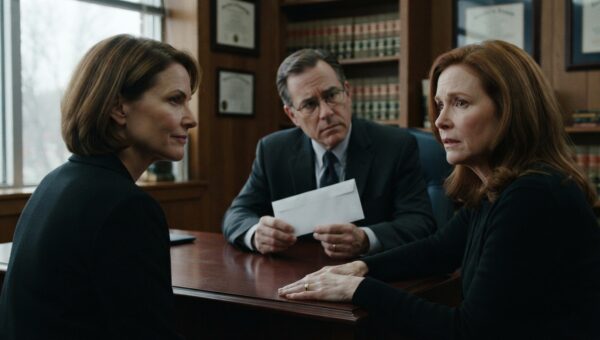
They did not ask how Chloe was doing. The lead man, a lawyer named Vance whose firm handled every zoning dispute in the county, sat down across from me with a black leather folder. He placed a cashier check on the folding table between us.
The figures written on the paper were exact. One million dollars.
Vance looked at me with practiced sympathy, his voice smooth and low.
He told me that kids make mistakes under pressure, that college futures are fragile, and that a public scandal would ruin young lives that had barely begun. He slid the check closer, along with a thick non-disclosure agreement that bound my tongue forever and cleared all four boys of criminal liability.
They looked at me and saw a tired, single mother who owned a struggling flower shop, someone they could buy off with a number that would make her disappear.
They had no idea who I had been before I became a florist, or why my old military personnel file was still classified under a black seal that required specific clearance to open.
I looked at the check, then up at Vance’s confident face. I did not yell. I did not cry. I picked up the check, folded it neatly into quarters, and tucked it into the pocket of my coat.
Vance smiled, thinking he had won. Then I reached into my bag, pulled out my old flip phone, and made one phone call I had not made in eleven years.
PART 2
The phone rang twice before a raspy, familiar voice answered on the secure line. It was Colonel Vance, though not the one sitting across from me in the waiting room. This was Marcus, my old commanding officer from a unit that officially did not exist on organizational charts. We spoke in short, clipped sentences, the kind of shorthand we used when operating in grey zones where local authorities had no jurisdiction.
I told him the exact location, the names of the boys, and the fact that local law enforcement had already visited the hospital and quietly filed the incident under a minor disturbance report.
Across the table, Vance frowned, sensing the shift in the room. He reached for his briefcase. “Mrs. Hayes, let us not complicate matters. That paper is valid, but it has a window. If you walk out of here, things get difficult for everyone.”
I didn’t answer him. I kept my eyes on Marcus on the other end of the line, giving him the license plate numbers of the SUVs parked outside in the ambulance bay. Within twenty minutes, the atmosphere in the hospital lobby changed. Two state troopers walked in, but they didn’t go to the front desk. They bypassed the administrative offices entirely and walked straight toward the trauma wing, carrying federal transit warrants that superseded local county influence.
Vance stood up, his face losing its practiced calm. “What is this? You cannot do this. We have an agreement pending.”
“We never had an agreement,” I said, finally standing up to face him. My voice was quiet, steady, and entirely devoid of the trembling fear he had expected from a florist. “You assumed I was someone you could silence. That was your first mistake.”
The next forty-eight hours were a blur of federal investigators, confiscated security footage from the campus pub, and frantic midnight phone calls from city council members who suddenly realized their sons’ trust funds could not bail them out of a federal conspiracy charge involving interstate flight and organized assault. The local police chief, who had tried to bury the initial report under a pile of routine paperwork, was placed on administrative leave before noon on Tuesday.
Chloe remained in the ICU, stable but bruised, her hand bandaged from where she had tried to defend herself against boots and heavy rings. Every time I looked at her pale face against the hospital pillow, the cold anger inside me solidified. They thought they could buy her life with a check because they thought nobody was watching the ledger.
PART 3
By Thursday morning, the story had broken through the local media blackout. A reporter from the state capital, tipped off by a secure transmission from my old network, published the unedited police dispatch logs along with the names of the four heirs and the initial hush-money attempt at the hospital.
The fallout was immediate and absolute. Bradley and his friends were expelled from the university before breakfast. Their fathers resigned from the hospital board by the afternoon, driven out not by public shame, but by the sudden, terrifying realization that federal investigators were auditing every property, tax shelter, and municipal contract their families had touched in the last decade.
Vance called my cell phone twenty times that day, his smooth voice now cracked with panic, asking to meet off the record to discuss terms. I let every call go to voicemail.
On Friday evening, I sat in the hard plastic chair beside Chloe’s bed as she finally opened her eyes. The room was quiet except for the steady hum of the heart monitor. She looked around, disoriented, her gaze resting on the bruised knuckles of her own hand before moving to my face.
“Mom,” she whispered, her voice rough from the breathing tube she had worn for two days. “They said… they said the police wouldn’t do anything. They said their families own the town.”
I reached out and took her uninjured hand, holding it tight. “This town isn’t as big as they thought it was, sweetheart.”
She blinked, tears welling in her eyes. “Did you take their money? Someone said there was a lawyer…”
I reached into my coat pocket, pulled out the folded check Vance had given me, and dropped it into the small metal trash can beside the hospital bed.
“No,” I said softly. “I didn’t take their money.”
ENDING
The florist shop stayed closed all weekend. When I finally unlocked the front glass doors on Monday morning, the bell above the lintel chimed just like it always did, greeting the familiar smell of damp eucalyptus and fresh soil.
The local paper was lying on the front step with a front-page headline about federal indictments and ruined dynasties. I picked it up, folded it without reading the article, and tossed it straight into the recycling bin behind the counter.
I set my travel mug on the workbench, tied my green canvas apron around my waist, and reached for the pruning shears to trim the thorns off a dozen red roses. Outside, the morning traffic on Elm Street moved past the window in a steady, ordinary rhythm. The world had not ended, and neither had we.