PART 1
I told my son’s wife she’d never be good enough for him. Shelby was kind, but she came from nothing, and I made sure she felt it. I picked at her cooking, her clothes. I griped about their $9,000 wedding, calling it cheap. One spring she stopped coming. Then Aaron stopped calling. That was nine years ago.
The truth is I drove her out, a little at a time.
I didn’t yell or throw plates. I just used a quiet, steady kind of disdain that wears people down until they leave on their own. I thought I was protecting my only son from a lifetime of settling for less. I thought a mother’s standards were supposed to be high. Aaron tried to bridge the gap for the first year, calling me from his truck on his lunch breaks, his voice tight and tired, asking me to just give her a chance, to just be polite. But I wouldn’t budge. I told him he was choosing a stranger over the woman who raised him. Eventually, the phone stopped ringing. When I drove by their little brick rental house across town, their car was gone, and a new family was mowing the lawn.
Last week a letter came in Aaron’s hand. The envelope was heavy ivory paper, the kind of stationery you use for important things.
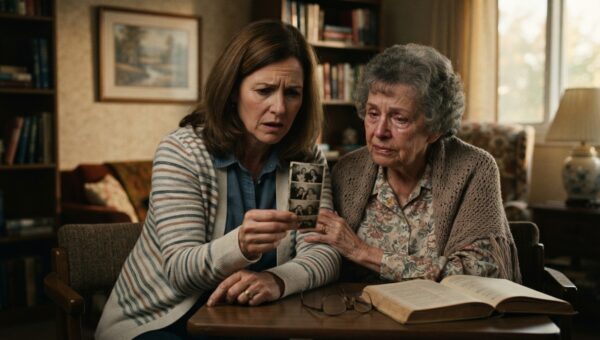
Inside was a photo of two boys I’ve never met, maybe seven and nine years old, standing in front of a blue sandbox with dirt smeared on their knees. Behind them was one line in Aaron’s sharp, familiar handwriting: Shelby passed in March. The kids keep asking about their grandmother.
I sat down hard on the stairs, the wood groaning under my weight. My kitchen was too quiet, the hum of the refrigerator the only sound in the house. A phone number was written at the bottom of the note in a trembling hand. I’ve dialed and hung up four times, staring at the little green call button on my screen like it’s loaded with glass.
I set the photo on the hall table, right next to the brass bowl where I drop my keys, but my eyes kept drifting back to it. The older boy has Aaron’s chin, that stubborn square set that used to drive me crazy when he was ten.
The younger one has wide, dark eyes that don’t look like anyone in our family. Shelby’s eyes, probably. I never looked close enough at her face to remember.
This morning I dialed again, and when a small voice answered, I didn’t hang up.
A child answered on the second ring, his voice high and bright.
Hello, he said.
I opened my mouth, but my throat felt dry, like I’d swallowed dust. I couldn’t find my name. I couldn’t find anything to say that wouldn’t sound like a lie.
PART 2
Who is it, a man’s voice called out in the background, muffled by distance.
For a second I thought it was Aaron, but the voice was deeper, rougher around the edges than my son used to be. My heart gave a strange, heavy thud against my ribs. I wanted to speak, to say I was their grandmother, to say I was the woman who had lived three miles away for nine years while they grew up without a Sunday roast or a Christmas card from my side of the family.
It is just a hang-up, the boy shouted back into the hallway. Nobody’s there.
I didn’t hang up this time. I held the receiver hard against my ear, listening to the small shuffling sounds of sneakers on linoleum, the faint clatter of a spoon hitting a cereal bowl.
Wait, I whispered. Please. Don’t hang up.
The line went silent for three long seconds. I could hear breathing, shallow and suspicious.
Who is this? the boy asked, his voice dropping an octave, trying to sound older than he was.
Is your father there? I asked. My voice sounded thin, like an old woman’s voice, which I suppose I am now.
Dad is at the hardware store, the boy said. He said not to answer numbers we don’t know.
Tell him… tell him it’s his mother, I said.
The line clicked. Not a hang-up click, but the sound of the phone being laid down on a wooden table, footsteps running away down a hall, and then distant shouting. I stood in my hallway with the sun coming through the front window, turning the dust motes in the air into little golden flecks, waiting to find out what nine years of silence actually sounded like.
It took five minutes for the phone to be picked up again. Nobody said anything for a long time. I could hear heavy breathing on the other end, ragged and uneven, like someone trying to control a temper that had been buried a long time.
Why did you call? Aaron’s voice finally came through. It didn’t sound like the boy who used to call me from his truck. It sounded flat, hollow, like a door closing on an empty room.
I got your letter, I said.
Aaron let out a short, dry sound that wasn’t a laugh. It was worse than yelling.
Took you a week, he said.
I didn’t know what to say to that because it was true. I had spent six days looking at that photo on my hall table, trying to decide if the letter was some kind of trap or a late punishment for the things I’d said when he walked out the door with her.
She’s gone, Aaron said, and his voice cracked just a little on the word, a tiny break in the armor. In March. Cancer. We didn’t want to bother you while she was sick, and figured you wouldn’t want to be bothered after.
Aaron, I started.
Don’t, he said. Just don’t start with the apologies now. It’s too late for the performance, Mother. The boys don’t even know you exist. To them, I’m an only child with no family left on my side. That’s how we lived, and that’s how we got by.
He didn’t hang up, though. That was the only reason I didn’t drop the phone myself. He stayed on the line, breathing into the static, waiting to see if I had anything real to say or if I was just going to offer the same old complaints about how things turned out.
PART 3
I drove across town two days later, parked three houses down from the address on the back of the envelope, and sat in my Buick with the engine idling.
The house was small, painted a faded gray with white trim that was peeling around the porch posts. It looked nothing like the homes my friends live in, the ones with manicured lawns and three-car garages where retired women keep spare bedrooms for grandchildren who visit on holidays. There was a red plastic bicycle on the patch of dead grass by the driveway and a plastic basketball hoop with a net hanging by one thread.
I watched the front door for twenty minutes. I expected Aaron to look older, but when he came out carrying a sack of groceries, I wasn’t prepared for how much he looked like his father. He had the same stoop in the shoulders, the same slow way of walking that comes from standing on concrete floors all day. He wore a faded flannel shirt with the sleeves rolled up to his elbows, his forearms dusted with drywall mud.
He stopped by the trunk of his sedan, groceries in one hand, and looked straight down my street. He didn’t look surprised. He just stood there for a long moment, watching my car idle by the curb, the white smoke from the exhaust drifting up into the gray afternoon air.
I turned off the engine, opened the door, and got out. My knees clicked, a sharp little reminder of my seventy-two years, and I had to catch myself on the edge of the roof for a second before I could stand straight.
You shouldn’t have come, Aaron said when I reached the edge of their gravel driveway. He didn’t put the groceries down. He just held the paper bag against his chest like a shield.
They’re my grandchildren, Aaron, I said. My voice came out smaller than I wanted it to, raspy from the wind.
You didn’t want them when they were born, he said. You told Shelby she was trapping me with a baby she couldn’t afford. You remember that? You told her that in my own kitchen while she was holding him.
I do remember it. I had said it while she was standing by the sink washing a glass, her shoulders going rigid under her sweater. I had thought I was being honest. I had thought I was saving him from the kind of heavy, grinding poverty I had clawed my way out of after my husband died.
She worked three nights a week at the diner down on 4th so we could buy groceries while I finished my apprenticeship, Aaron said, his voice dropping into that quiet, terrible register that doesn’t need to shout to hurt. She never bought a new coat the whole time we were married. Not once. And every time she came home from seeing you, she sat on the edge of the bed and cried until she fell asleep, because she thought she wasn’t good enough for this family.
He set the grocery bag down on the hood of the car.
She was twice the person you’ll ever be, Mother. She was kind to people who didn’t deserve it. Like you.
I didn’t argue. I didn’t tell him about my standards or my intentions or the way I was raised to expect more from life. For the first time in nine years, I looked at the house, at the peeling paint, at the small red bicycle, and I realized what my pride had actually cost. It hadn’t protected anyone. It had just left me alone in a big house with my clean carpets and my bitter tongue, while my son built a life out of reach.
The front screen door creaked open behind him. The older boy poked his head out, his hair sticking up on one side like he’d just rolled out of bed.
Dad? Who’s that?
Aaron didn’t turn around right away. He looked at me, his eyes hard and gray like river stones, weighing whether to slam the door or let the light in.
ENDING
Aaron looked down at the gravel between us, his jaw working once before he spoke.
Go wait in the kitchen, Leo, he said without turning around. We’ll be in in a minute.
The boy didn’t move for a second, then let the screen door latch shut with a dull rattle.
Aaron reached down, picked up his bag of groceries, and walked past me toward the side door without another word. He didn’t invite me in, and he didn’t tell me to leave. He just left the gate unlatched behind him, swinging slowly in the autumn wind until it clicked against the wooden post.
I stood by my car for a long time, watching the gray house and the little red bicycle in the grass, before I reached into my pocket, found my keys, and walked up the gravel drive.