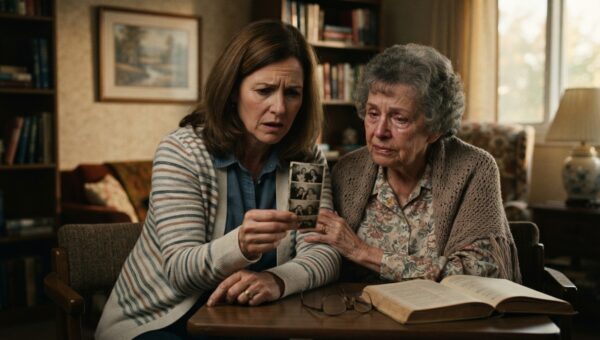
PART1
My husband Wilbur had a stroke in March and lost his words. Fifty-one years of talking, gone in one afternoon. The doctors said he understood me, but he couldn’t answer. So I filled the quiet myself, reading him the paper, narrating supper. Every evening at seven he would reach over and tap the back of my hand three times.
The nurse thought it was a tremor. I scheduled tests, terrified it was seizures. Then one night, half asleep, I tapped his hand back, four times, the way I used to in 1971 when we couldn’t talk in church. He went still. His eyes widened. And I understood that three taps had been saying, all these months, the only thing he had left to tell me.
Wilbur was seventy-four. Before the stroke, he handled everything about our home and our savings. He was a quiet man who kept our ledgers in black notebooks with thick leather covers, stored in the bottom drawer of our oak desk. I never looked inside them because Wilbur was meticulous. If he paid the taxes and balanced the checkbook, I didn’t ask questions. After the stroke, our son Dale moved into our spare room to help out. Dale is forty-eight, between jobs again, and very eager to be helpful.
He bought us groceries, drove Wilbur to physical therapy, and told me not to worry about money.
The trouble started quietly. A bill for our homeowner’s insurance arrived in the mail marked second notice, threatening cancellation. I thought it was strange because Wilbur always paid bills the day they arrived. I went to the desk to find our checkbook, and the bottom drawer was locked. Dale was in the kitchen frying eggs.
“Dale,” I called out, holding the bright red notice. “Where is the key to the bottom desk drawer? The insurance company says we are behind.”
Dale wiped his hands on a paper towel and walked into the office. He looked calm, perhaps a little too calm.
“Dad put the key somewhere safe before he got sick, Mom,” Dale said, leaning against the doorframe. “Don’t worry about it. I called the insurance agency yesterday and put it on my credit card. It is all handled.”
“Since when do you handle our insurance, Dale?” I asked.
“Since Dad lost his speech,” he said, smiling that easy, boyish smile he has used since he was ten. “You have enough on your plate taking care of him.”
I let it drop because I was tired. Wilbur was sitting in his wheelchair by the window, staring out at the yard with a flat, empty look that broke my heart every time I saw it. I walked over and rubbed his shoulder. He did not look at me, but his right hand twitched against the armrest. Three taps. Tap, tap, tap.
That night, after Dale went to sleep, I stayed awake listening to the old floorboards creak. Wilbur’s three taps played over and over in my head. It was not a tremor. A tremor is ragged. This was rhythmic, deliberate, and urgent. I got out of bed, crept into the office in my nightgown, and pulled a butter knife from the kitchen silverware drawer.
I had watched my father fix old locks with a thin blade, and after five minutes of gentle wiggling, the latch on the bottom desk drawer gave way with a small click.
The black leather ledgers were inside, but the top one looked different. The cover was newer. I opened it under the dim glow of the hallway light and turned the pages. The handwriting was not Wilbur’s neat, precise cursive. It was Dale’s hurried scrawl. And the numbers written across the pages had nothing to do with grocery bills or property taxes.
PART 2
I took the ledger to the kitchen table, pulled the small brass lamp closer, and turned the pages until my fingers began to shake. The book contained a detailed record of withdrawals from our home equity line of credit, totaling eighty-four thousand dollars over the last six months. There were signatures at the bottom of each withdrawal form. Some were Wilbur’s name, but the letters were cramped and misshapen, written by a man whose right side was paralyzed. Other pages bore Dale’s signature as power of attorney.
I sat there in the dark kitchen for a long time, listening to the hum of the refrigerator. Dale had not just taken over our bills. He had taken over our house.
The next morning, Dale was cheerful, whistling while he poured coffee.
“Good morning, Mom,” he said, sliding a mug across the counter. “I thought I would take Dad to his therapy appointment today. You look tired. You should rest.”
“Sit down, Dale,” I said.
My voice was too quiet. He stopped whistling, the coffee pot still in his hand. He looked at my face, saw the black ledger resting flat on the table between us, and the easy smile vanished from his mouth.
“Where did you get that?” Dale asked, his voice dropping an octave.
“You told me Wilbur hid the key,” I said. “He didn’t. He never locked that drawer in fifty years of marriage until you moved in here with your suitcases and your debts.”
“Dad agreed to help me,” Dale said, stepping back slightly. “He knew I was in trouble with the business loan. He wanted to help his son.”
“Look at me, Dale,” I said, standing up. “Your father had a severe stroke in March. He could not speak, he could not write with his right hand, and he was terrified. You made him sign papers while he was lying in that hospital bed, didn’t you?”
“That is not true,” Dale snapped, his face flushing red. “He knew what he was doing. And even if he didn’t, the house is in both our names now as co-signers on the line. Legally, I have every right to keep this place afloat.”
“Co-signers?” I whispered. “We owned this house free and clear since 1988.”
“Times change, Mom,” Dale said, turning toward the hallway. “You are making a big deal out of nothing. I am going to take Dad to therapy.”
“You are not taking him anywhere,” I said, stepping between him and the front door. “And you are going to pack your bags right now.”
PART 3
Dale stared at me for three long seconds, realizing for the first time that I was not going to fold just to keep the peace. He muttered something under his breath, slammed his coffee mug into the sink so hard the handle snapped off, and stormed down the hall to his room. I heard drawers slamming and hangers rattling against the closet rod.
While he was packing, I walked back to Wilbur’s room. My husband was sitting by the window, his head tilted toward the morning sun. I knelt beside his wheelchair and took his good hand in mine.
“I found the book, Wilbur,” I whispered. “I know what you were trying to tell me with those taps. You were trying to warn me, weren’t you?”
Wilbur turned his head slowly. A single tear tracked down his weathered cheek. He lifted his hand and pressed his index finger against my palm, tapping once, twice, three times. Then he squeezed my fingers as hard as his weak hand could manage.
Thirty minutes later, Dale dragged two large duffel bags out to his sedan. He did not say goodbye. He started the engine, backed out of the driveway without looking back, and sped down the street.
I called our lawyer, a sensible man named Mr. Henderson who had drawn up our wills forty years ago. He came out to the house that afternoon, examined the ledger, and looked over the county property filings online. Dale had indeed forged Wilbur’s signature on a home equity loan document while Wilbur was in the intensive care unit, using a notary public from a local shipping store who apparently asked very few questions.
“We can unwind this, Martha,” Mr. Henderson said, taking off his glasses and rubbing the bridge of his nose. “It will take time, and it will require a forensic handwriting expert to verify your husband’s medical incapacity at the time of the signing, but the bank will have to reverse the fraudulent liens once we file.”
“Do it,” I told him. “Every last bit of it.”
ENDING
That evening at seven, the house was finally quiet. No footsteps pacing the hall, no manufactured cheerfulness from the kitchen.
I sat in the armchair across from Wilbur with the evening paper across my lap, though I wasn’t reading a word. The sun was dipping below the fence line, casting long shadows across the hardwood floor. Wilbur reached out from his wheelchair, his fingers brushing against the armrest before finding mine.
He tapped the back of my hand once. Twice. Three times.
I smiled, leaned over, and tapped his knuckles back four times.
Wilbur closed his eyes, let out a long breath, and squeezed my hand until the room felt warm again.