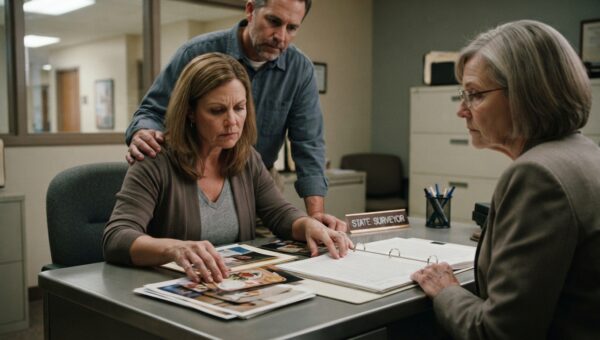
Arthur Pendelton didn’t even look up from his tablet when he told me the department was restructuring. He just kept swiping his finger across the glass, his desk smelling like expensive imported coffee and dry-cleaned wool.
“It’s just numbers, Vickie,” he said, using that smooth, practiced tone he reserved for board members and people he wanted to get rid of. “Corporate says we have to trim the fat. Your position is redundant.”
I sat across from him in that gray leather chair, my hands folded neatly over my purse. I had worked at Pendelton Logistics for four years, building every spreadsheet, auditing every vendor invoice, and fixing every mess Arthur’s lazy management style created. I was the one who stayed late when the winter storms knocked out the main servers, and I was the one who kept the accounts balanced down to the penny.
“Redundant,” I said, testing the word on my tongue. It felt hollow, like a cardboard box left out in the rain.
“We appreciate everything you’ve done,” Arthur replied, finally glancing up with a smile that didn’t reach his eyes. “HR has your severance packet ready downstairs. Two weeks of pay. Sign it on your way out.”
He didn’t mention Chloe Vance. He didn’t have to. I already knew Chloe spent more time in Arthur’s private office behind the frosted glass than she did at her own marketing desk. The whole floor knew, even if nobody said it out loud.
I didn’t yell. I didn’t beg. I just stood up, smoothed down the skirt of my gray dress, and walked out of his office without giving him the satisfaction of a tear.
The drive home to our little rental house on the south side of town took twenty minutes. The sky was that heavy, bruised shade of gray that usually meant snow was coming, and the heater in my old sedan made a rhythmic clicking sound that drove me crazy. My daughter Winnie was waiting on the front porch when I pulled into the gravel driveway, her little red backpack slung over one shoulder like she was ready for an expedition.
“Mom! You’re home early,” she called out, running down the steps as I cut the engine.
Winnie is seven, with eyes the exact color of my mother’s old amber brooch and a stubborn streak that could bend iron.
Her father walked out the morning I told him I was pregnant, leaving us with a stack of medical bills and a half-empty apartment. I had built our entire life on predictability, on steady paychecks and careful budgeting, and now the floor had dropped out from under us on a random Friday in November.
“I got laid off, sweetheart,” I said, kneeling down on the cold gravel to look her in the eye. “Just some corporate changes at the office. We’re going to be fine, okay? We’ve still got savings.”
“Did Mr. Pendelton do it?” she asked, her small brow furrowing in a way that looked far too much like my own worried reflection in the bathroom mirror.
“He did,” I whispered, pulling her close against my coat.
We went inside, and I spent the rest of the afternoon going over our bank statements with a fine-toothed comb while Winnie sat at the kitchen table drawing pictures of horses.
I had packed my personal belongings into a cardboard copy-paper box before leaving the office, sliding my desk organizer, my favorite ceramic mug, and a few family photos inside. Tucked safely at the bottom of the box, right underneath an old notepad, was my personal encrypted backup flash drive. I used it to store old templates and macros, but right before Arthur called me into his office, I had run a routine backup of the master vendor reconciliation files just to clear my local cache.
I didn’t think twice about it then. It was just digital clutter, standard procedure for an auditor who didn’t trust cloud servers.
Saturday morning arrived with a thin skin of frost over the lawn. The house was quiet, the kind of stillness that usually brought comfort, until the phone on the kitchen counter shrieked. It was 8:14 in the morning.
I picked it up, expecting it to be the pharmacy about Winnie’s refill.
“Vickie,” Arthur’s voice came howling through the speaker like a siren in a fog. He wasn’t using his smooth executive voice now. He sounded frantic, breathless, and dangerously angry. “Where is the external drive? The master ledger from the Q3 audit. Where is it?”
“Good morning to you too, Arthur,” I said, my voice dropping into that steady, flat register I used when dealing with recalcitrant suppliers.
“Don’t play games with me,” he yelled, and I could hear the rustle of paper in the background, the frantic shuffling of a man realizing too late that he left a door unlocked. “You cleared out your desk yesterday. You took a thumb drive. Bring it back to my office. Right now. COME TO MY OFFICE. IMMEDIATELY.”
“I’m off the clock, Arthur. In case you forgot, you fired me yesterday afternoon so Chloe could have my desk.”
“This isn’t a joke!” he screamed, his voice cracking slightly on the high notes. “That drive contains restricted corporate files. If you don’t return it within the hour, I’ll have HR withhold your severance and report you for corporate theft. You won’t find a job in this state for the next ten years.”
The threat hung in the air between us, heavy and sour. A normal person might have panicked. A week ago, I probably would have started shaking. But standing there in my kitchen while Winnie poured milk into her cereal bowl, something inside me clicked into place. Arthur wasn’t just mad about a lost template. He was terrified.
I hung up the phone without saying another word.
The screen went dark, but my curiosity was already awake. I walked over to the old laptop sitting on the corner of the counter, the one I used for home budgeting and freelance tax prep. I plugged the small black plastic flash drive into the side USB port and opened the directory.
I thought I knew every spreadsheet in our department. I built half of them. But there was a hidden partition on the drive, an archive folder labeled with a string of random numbers that my automated backup script had snagged right before my access permissions were revoked. I clicked it open.
Inside were two years of unedited transaction logs, cross-referenced with wire transfers to a shell company named Vancor Consulting. Chloe Vance’s maiden name, combined with Arthur’s middle name. Over $180,000 in diverted operational funds, disguised as vendor maintenance fees and software licensing, routed straight into accounts they controlled. My own careful accounting audits had flagged the discrepancies months ago, but Arthur had always waved them away with a casual remark about reallocating department surpluses.
He hadn’t fired me because of a budget cut. He fired me because I was the only person in the building who knew how to read the ledger, and he needed a vacant desk to hide the paper trail before the quarterly corporate compliance review on Monday morning.
My phone started buzzing again immediately. Arthur. Then a text message from an unknown number. Then another call. I muted the ringer, set the phone face down on the laminate counter, and walked over to the kitchen window.
Winnie was sitting at the table, swinging her legs slightly, humming a tune she learned at school. “Is it Mr. Pendelton?” she asked, not looking up from her cereal bowl.
“It is,” I said.
“Are we in trouble?”
“No, honey,” I said, walking over and smoothing her dark hair back from her forehead. “Not anymore. Not by a long shot.”
I didn’t call Arthur back. Instead, I opened my web browser and logged into the corporate whistleblower portal for Pendelton Logistics, the one buried three layers deep on the employee intranet that nobody ever used except during mandatory annual training videos. I attached three specific PDF ledger exports from the flash drive, highlighted the wire transfers to Vancor Consulting, and added a brief, professional note detailing my unjust termination less than twelve hours before the discovery of the fund diversion.
Then I found the direct email address for Marcus Vance, the regional compliance director who happened to be based in Chicago and had zero patience for Arthur’s downtown boys-club antics. I sent him a copy of the same files, along with a note stating that I would be happy to discuss the operational records in person on Monday morning, provided my severance was doubled and all legal threats from Arthur were permanently dropped.
By noon, my phone rang again. It wasn’t Arthur.
“Ms. Miller?” a crisp, professional voice asked. This was Marcus Vance’s executive assistant. “Mr. Vance has reviewed the documents you submitted. He would like you to join a secure conference call at 2:00 PM today. Mr. Pendelton and our lead corporate counsel will be on the line as well.”
“Tell Mr. Vance I’ll be there,” I said. “And tell him I’ll be recording the conversation from my end for my own protection.”
“That is entirely acceptable,” she replied.
The call at two o’clock was short, surgical, and entirely devastating for Arthur. I sat at the kitchen table with a fresh cup of black coffee, my laptop open, while Arthur’s voice came through the speakerphone, sounding small and hollow and desperate. He tried to claim the files were falsified, that I was a disgruntled former employee seeking revenge. But Marcus Vance cut him off with three words that ended his career.
“We audited the server logs ten minutes ago, Arthur,” Marcus said, his voice flat and cold. “The wire transfers match the shell accounts. Your office access is suspended effective immediately. Hand over your badge to the security detail currently walking up to your floor.”
“Vickie,” Arthur stammered, his arrogance completely evaporated, replaced by the pathetic whimper of a cornered man. “Vickie, please. We can talk about this. We’re professionals. Let’s not ruin things over a misunderstanding, “
“I was professional for four years, Arthur,” I said quietly. “You should have remembered that before you told me my desk was redundant.”
I hung up the phone before he could finish his sentence.
An hour later, a courier arrived at my front door with a revised severance agreement, signed by corporate HR, offering four months of full pay, accrued PTO, and a written acknowledgment that my termination was administrative error rather than performance-based. There was also a separate compliance bonus included for “exceptional record-keeping under extraordinary circumstances.”
By late afternoon, the sun finally broke through the gray clouds, throwing a warm, pale light across the front yard.
I carried the cardboard box of office memories out to the car and placed it carefully in the trunk, resting it right beside Winnie’s brightly colored school backpack. Winnie climbed into the back seat of the sedan, humming her little tune again, completely untbothered by the corporate wreckage we had just left behind us.
I closed the trunk with a solid, satisfying thud, got behind the steering wheel, and started the engine. The old sedan purred without a single strange rattle, and as we pulled out of the driveway and headed down the street into the bright Saturday sunlight, I knew exactly what I was going to do on Monday morning. I was going to open my own independent consulting firm, put my name on the door, and never work for a man like Arthur Pendelton again.