Five sign-outs since October on a yellow attendance sheet that my own hands never touched.
The school office called at 11:42 in the morning about Leo’s lunch balance, and the woman on the other end of the line had a breezy sort of tone to her voice. She told me not to worry about it too much because she could just check with his Uncle Ray since he was listed right there as an emergency contact.
I went quiet. I have raised that boy in my house since he was two years old, ever since his mama passed away, God rest her, and there is no Uncle Ray. There never has been an uncle on my side or hers.
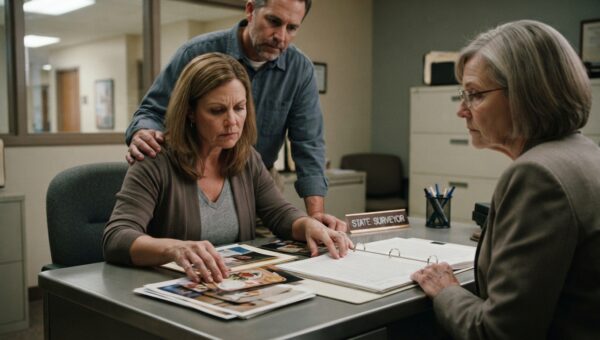
I drove up to that red-brick elementary school on the edge of Amarillo the next morning before the first bell even rang. The office smelled like floor wax and old paper, and when the secretary pulled the contact sheet, I saw the handwriting immediately. It wasn’t mine. It was Arthur’s. My son, the one who gets his boy every other Wednesday now by court order. And right there in the middle of the page was a name I had never heard in my life. Ray, uncle, with a ten-digit phone number scribbled underneath it.
I made them pull the early-dismissal logs too, going back to the first crisp weeks of autumn.
Wednesday. Wednesday. Wednesday. Five separate times since October, every single one of them falling on Arthur’s days, and every one of them pulling that seven-year-old boy right out of his third-row desk before the math lesson was even finished. Signed out by a phantom uncle who didn’t exist in our family tree.
That evening I made a pot of hot chocolate on the stove, letting the milk get just warm enough to melt real marshmallows the way Leo likes it. I set the mugs down on the laminate kitchen table and sat right next to my grandbaby, keeping my voice as steady as I could manage. I asked him real soft about his Wednesdays. Who picks him up from the side door. Where they go when the school bell rings.
Leo went quiet right away. He stirred his cocoa with a plastic spoon, watching the white sugar lumps dissolve into brown, and wouldn’t look up at my face.
Then his little chin started to shake, and his eyes filled up with heavy tears, and he whispered those words that have been ringing in my head ever since. Daddy said I’m not allowed to tell you, because…
He stopped right there, squeezing his eyes shut like he was trying to push the words back down his throat. I didn’t push him any further that night. I just pulled him close into my lap, smelling the laundry soap and playground dust in his hair, while my own mind raced through every dark possibility a grandmother can imagine.
The next afternoon, while Leo was at soccer practice down the road with his auntie, I took that ten-digit phone number from the school sheet and sat in my sedan in the driveway. I dialed it from my cell phone, letting it ring twice before a raspy voice answered with a curt hello, asking what I wanted.
I hung up without saying a word, but the area code and the street prefix placed the number right downtown, down near the old commercial district where the auto-body shops sit behind rusted chain-link fences.
I waited until the following Wednesday. It was Arthur’s day. I watched from two blocks away in my gray sedan as Arthur’s pickup truck pulled up to the curb near the side exit of the elementary school. I saw Leo climb into the passenger seat, his blue backpack slung over one shoulder. Instead of heading toward the park or our side of town, Arthur drove straight downtown, weaving through mid-afternoon traffic with the window rolled down.
I kept my distance, staying two cars back, watching the familiar truck turn down an alley behind a brick building that had a faded sign out front reading Henderson Auto Repair. Arthur killed the engine, got out, and walked around to open Leo’s door. He didn’t look like a proud father taking his son for an afternoon treat. He looked hunted, his shoulders hunched high against his jacket, his head swiveling left and right before he took Leo by the hand and led him through a heavy metal side door that had no business being on a mechanic shop.
I parked my car in a gravel lot three doors down, my hands gripping the steering wheel so tight my knuckles turned the color of chalk. I walked down that alley on foot, my boots crunching on stray bits of glass and gravel. The heavy side door was propped open just a fraction with a rubber wedge to let the stale air out.
I pushed it open an inch and looked inside. It wasn’t an auto shop at all. The grease bays were empty, but the back room had been knocked through to create a low-ceilinged parlor lit by green-shaded overhead lamps. There were card tables set up across the scarred concrete floor, surrounded by men in heavy winter coats holding plastic chips and sweating over small paper cups of whiskey.
And right there in the corner, sitting on a folding metal chair next to a stack of empty soda crates, was my seven-year-old grandson. He had a portable electronic game in his lap, but his eyes were wide and fixed on the floor, looking entirely too small for a room full of hard-faced men.
Standing ten feet away was a heavy-set man with slicked-back gray hair and a gold chain resting over his flannel shirt, leaning over Arthur and talking in a low, sharp murmur. Arthur was pulling a thick roll of bills out of his pocket, his face pale and slick with sweat.
I didn’t storm in there and start screaming. I knew that would only make things worse for the boy sitting in that corner. Instead, I backed away into the alley, my chest burning as if I’d swallowed hot coals, and I walked back to my car.
Arthur brought Leo home right around six o’clock, dropping him off at the front gate with a pat on the head and a quick promise to see him next week. Arthur stayed in the truck, his engine idling in our gravel drive, waiting to make sure the boy got inside safely before he sped off into the twilight.
I didn’t say a word to Leo until he was washed up and sitting at the kitchen table eating a bowl of plain noodles. I told him to go watch his cartoons in the front room for a few minutes, and then I waited by the window until Arthur’s truck headlights turned around in the cul-de-sac and came back toward our house.
Arthur walked through the back door with a tired smile plastered on his face, shrugging out of his jacket like nothing in the world was wrong. He dropped his keys on the counter right next to the mail basket.
“Everything go all right today, Mom?” he asked, not quite looking me in the eye.
I didn’t answer right away. I reached into my apron pocket, pulled out the printed school attendance log showing the five Wednesday sign-outs with Ray’s name scribbled at the bottom, and laid it flat on the laminate counter between us.
Arthur’s eyes dropped to the paper, and the false color drained right out of his cheeks. He opened his mouth to say something, but no sound came out.
“Henderson Auto Repair is a long way from the park, Arthur,” I said, my voice sounding quieter than I intended, but hard enough to cut glass. “And a seven-year-old boy has no business sitting in a backroom poker den while his father borrows money from men who break kneecaps for a living.”
Arthur slammed his hand down on the counter, the coffee mugs rattling against the ceramic tile. “I had to do something, Mom! You don’t understand how deep I’m in with Ray. He just wanted to see that I had a family, that I wasn’t running off. It was just a few hours. He wasn’t in any danger.”
“You used that baby as collateral,” I whispered, and the realization of it felt heavier than lead in my chest. “You used my grandbuyer as a human shield so some criminal would give you another week to pay your debts.”
“Keep your voice down,” Arthur hissed, stepping toward me with a flash of real anger in his eyes. “You’re going to ruin everything.”
“I already called my lawyer before I went down to that alley,” I said, looking right back at him without flinching. “And I have copies of every single early-dismissal log sitting in a file on her desk right now. Child services is already looped in on the emergency paperwork. Your unsupervised Wednesdays are over, Arthur. Finished. Effective right this second.”
Arthur stared at me for a long, heavy moment, his chest heaving as he realized there was no story left to tell, no excuse that would wash the gray dirt off his hands. The anger left him all at once, leaving behind only a broken, slumped man who looked like he had finally run out of roads.
“He’s my son too,” Arthur muttered, his voice cracking as he reached out a trembling hand toward the counter.
“He is my grandson, and I raised him while you were out digging your own grave,” I said, pointing straight toward the back door. “Get out of my house before I call the sheriff myself.”
He didn’t argue anymore. He grabbed his truck keys off the counter, his fingers shaking so badly he dropped them once before catching them against his palm, and he walked out into the dark without looking back.
The house was very quiet after he left. I walked into the front room where Leo was sitting on the rug with his plastic dinosaurs, completely unaware of how close the world had come to ending today. I knelt down beside him on the carpet and pulled him into my arms, holding him tighter than I had since the day his mother was taken from us.
“You don’t ever have to keep any secrets from me again, sweetheart,” I whispered into his hair. “Grandma’s got you. You’re safe now.”
The next morning, the locksmith came out before the sun was fully up over the Texas plains and installed a heavy deadbolt on our front door that only takes a key from the inside. I hung a brand-new kitchen calendar right beside the refrigerator, marking every single Wednesday with a thick stroke of bright green ink. No more phantoms. No more card rooms. Just a quiet house, a safe boy, and the school drawings pinned securely to the icebox door where they belong.