PART1
My daughter Chloe came home from school on a rainy Tuesday holding a folded slip of yellowed paper she had found tucked inside the pages of an old library book. She thought it was funny because the note looked ancient, its ink faded to a dull purple color. I almost told her to throw it straight into the kitchen trash can right along with her apple core and the flyers from her backpack.
We were both rushing to get dinner started before my shift at the clinic office, and I had a pile of laundry waiting on the sofa.
Then I happened to glance down at the bottom of the paper while she was setting her binder on the counter. The signature at the bottom was my mother’s name.
My mother, Eleanor, had worked as an administrative assistant at that very middle school for nearly fifteen years before retiring long before Chloe was even born. She knew that building inside and out, from the principal’s office down to the old boiler room. But she had never mentioned leaving anything tucked away in the library collection. When I turned the slip over, I saw the date written in the corner: October 14, 2001. That was the year I was a senior in high school, right before everything changed between my mother and me.
I asked my mother about it that evening when she came over to drop off some fresh bread.
She walked into the kitchen carrying her favorite floral tote bag, smiling at Chloe as usual. I didn’t make a big production out of it. I just laid the yellowed paper flat on the kitchen table between us and asked her what it was doing in an old copy of a historical novel.
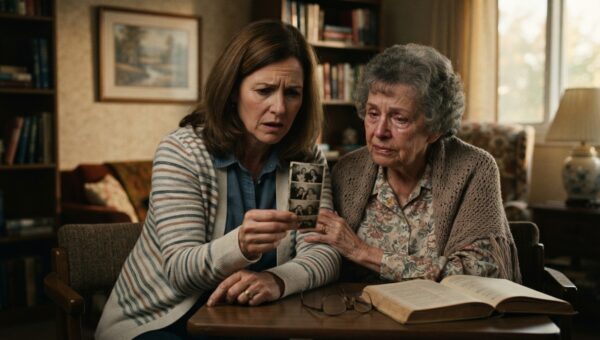
My mother looked at the paper for a long time. The smile didn’t vanish all at once, but it slowly drained out of her face until she looked tired and much older than her seventy-two years. She finally said, “I wondered when someone would find that.”
Her calm voice caught me off guard. I asked her what the note meant. It was just a short sentence about a key and a date, but it sounded cryptic, almost like a warning.
She wouldn’t answer me. Instead, she asked Chloe exactly which book she had found it in. When Chloe told her the title and the author, my mother nodded slowly, her fingers tightening around the strap of her tote bag.
“Put your coat back on, Chloe,” my mother said quietly. “We are going back to the school tomorrow morning.”
PART 2
The next morning was clear and cold. My mother arrived at our house before eight o’clock, her car idling in the driveway with the heater running. I had called off work, telling my supervisor I had a family emergency, which felt true enough even though I had no idea what we were walking into. Chloe stayed behind with a neighbor, her curiosity practically buzzing in the air, but my mother insisted this was strictly between the two of us.
We drove to the middle school in silence. The morning sun was just hitting the brick exterior of the building where my mother had spent so many years of her life. The parking lot was full of teachers’ cars, and the familiar bell rang out across the playground just as we walked through the front doors.
The smell of floor wax and old paper hit me instantly, taking me back to the days when I used to wait for her after my own classes ended.
My mother did not stop at the main office to sign in as a visitor. She walked with a steady, determined stride down the long hallway toward the library, her sensible walking shoes clicking softly against the linoleum. She didn’t ask for directions once. She bypassed the new computer stations and the updated paperback racks, heading straight toward the back corner where the older fiction and regional history sections were housed.
She stopped in front of a tall oak shelving unit filled with heavy, cloth-bound books. Without hesitating, she reached out her hand and pulled a thick volume from the middle shelf. It was a local history collection detailing the county’s founding families.
She opened the cover immediately. Tucked inside the binding was a second folded note.
My mother pulled it out and handed it to me without looking up. I unfolded the paper with trembling fingers. This time, my own name was written across the front in my mother’s neat, familiar handwriting from twenty years ago.
“Read it,” she whispered.
The note was brief. It listed a bank branch downtown, a specific safety deposit box number, and a string of numbers that looked like an account routing code. Below that, in handwriting that looked rushed and shaky, she had written: If anything happens to me, make sure she finds this before your father closes the estate.
I stared at the paper, the letters blurring slightly under the fluorescent lights of the school library. My father had passed away five years ago after a long illness, leaving behind a modest house and a stack of medical bills that had taken me years to help pay off. During his final months, my mother had acted exhausted, quiet, and entirely defeated, leaning on me for every little decision.
“What is this?” I asked, my voice echoing a little too loudly in the quiet library. A student aide passing by with a cart of books glanced at us sideways.
“Your father told everyone that the savings bonds from my parents were lost in the basement flood back in 1998,” my mother said, her voice barely audible over the hum of the overhead vents. “He told me they were ruined. He said he checked them himself.”
“And they weren’t?” I asked.
“No,” she said, looking straight into my eyes for the first time that morning. “He took them. He cashed them out to pay off his debts from the hardware store, and he made me swear never to speak of it so the family wouldn’t fracture. He told me you would never forgive him if you knew.”
PART 3
The drive downtown to the bank took less than twenty minutes, but it felt like hours. My mother sat in the passenger seat staring out the window, her hands folded tightly in her lap, looking as though she were carrying a weight she had secretly wanted to put down for decades.
We didn’t talk about my father during the drive. There was nothing left to say about a man who had built our entire family life on quiet omissions and controlled narratives. When we walked into the bank, the manager recognized my mother from her years of local volunteering and civic committee work.
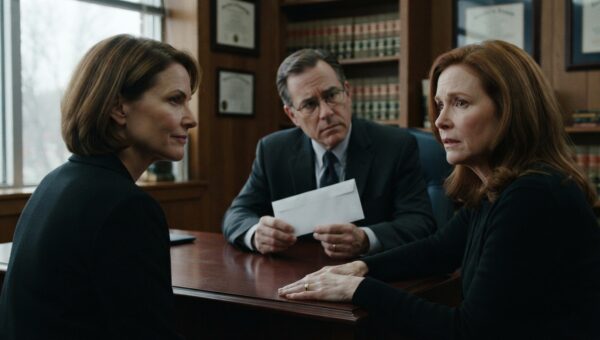
With the second note, the account numbers, and my mother’s identification, the process of opening the safe deposit box was surprisingly mundane. There was no dramatic music, no shouting, and no sudden police intervention. Just a polite young loan officer with a neat tie leading us into a small, private viewing room with a heavy steel door.
He left the metal box on the laminate table and closed the door behind him.
Inside the box were three heavy envelopes tied together with a faded rubber band. I lifted the top envelope and slid out the contents. They were not old savings bonds as I had half-expected. They were cashier’s checks and account statements from an investment fund I had never known existed, totaling exactly fifty-four thousand dollars, registered jointly in my mother’s name and an aunt who had passed away in Ohio years before.
My mother reached out and touched the corner of the topmost statement.
“Your father didn’t know about this account,” she said quietly. “My sister set it up for me before she passed, so I would always have something of my own. I hid the paperwork here in the school library because it was the only place he never visited, and I tucked that first note into the book hoping someone would find it if I ever lost the nerve to tell you myself.”
I looked at the statements, then at the worn face of the woman sitting across the table from me. For years, I had believed my parents had struggled through their retirement years because of bad luck and medical bills. I had spent my own savings helping them pay for prescriptions and groceries, feeling a heavy, grinding sense of obligation that kept me awake at night.
“Why didn’t you use this money when he was sick?” I asked, my throat tightening. “We lost so much trying to keep up.”
“Because I was afraid of what would happen if I opened the box,” she said simply. “And I was ashamed that I had let him convince me I had no right to my own life.”
We sat together in that small, quiet room for a long time, the steel door blocking out the hum of the city outside.
ENDING
We left the bank an hour later with the paperwork transferred into an account bearing only my mother’s name and mine. The afternoon sun was warm against the brick sidewalk as we walked back to the car. My mother stopped by a small bakery on the corner and bought a bag of cinnamon rolls, just like she used to do when I was a little girl walking home from that very same school.
We drove back to my house in silence, the kind of quiet that felt heavy at first, but slowly settled into something steady and clean. Chloe was waiting on the front porch, reading a book in the autumn air, looking up as soon as our car pulled into the gravel drive.
My mother got out of the car, walked up the steps, and handed Chloe the brown paper bag from the bakery. Then she turned to me, unlocked her front door key from her key ring, and dropped the small brass piece into my hand without a word.