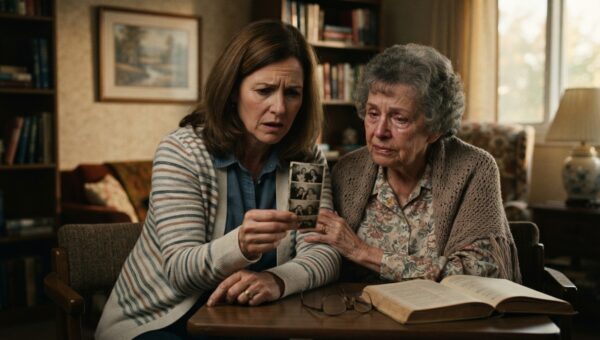
Why do we spend so much time believing the people who are supposed to protect us, even when our own bones are telling us a different story? Three months after my hip surgery, I was still asking myself that question every time I stared at the blank white ceiling of my second-floor bedroom. The radiator clanked against the baseboard with a dry, metallic rattle that I came to measure the hours by, each thud marking another thirty minutes of staring at dust motes dancing in the meager sliver of light coming through the mini-blinds.
My world had shrunk to the borders of a floral-print quilt that smelled faintly of old lavender and stale breath, a quarantine zone built out of good intentions and something a lot colder.
Ethan had been so attentive at first. When the surgeon rolled me out of recovery and handed over the discharge papers with their neat little checkmarks and bold instructions about early ambulation, my son had stood right beside the rolling tray with his hands folded neatly over his belt. He had smiled that wide, reassuring grin that always made people trust him before he even opened his mouth. He took charge of the discharge coordinator, signed the forms with a brisk, efficient stroke of his black ballpoint pen, and loaded me into the front seat of his sedan like I was a fragile piece of heirloom china.
“Don’t you worry about a single thing, Mom,” he had told me as he tucked the seatbelt across my chest with a neat, clinical click. “I’ve got the whole thing mapped out.
You just focus on staying off that leg until the bone knits solid.”
At the time, I believed him. You believe your only child when he tells you he is rearranging his entire life to keep you safe from yourself. I didn’t question why he placed my aluminum walker down in the dark of the basement instead of beside the bed. I just figured he knew best, that the hospital physical therapist had probably been too aggressive with those early mobilization targets anyway. I was seventy-one years old, my hip joint had been sawed into and bolted back together with titanium screws, and the mere thought of putting weight on that right side sent a hot flash of nausea straight up the back of my neck.
So I stayed put. I stayed put while the calendar pages turned from crisp October into gray, miserable November. I stayed put while the weekly checks from my $2,180 monthly Social Security pension arrived in the mailbox downstairs, checks that Ethan now collected, endorsed, and deposited into an account I never saw the statements for.
Whenever I asked about the physical therapy appointments we had discussed at the hospital, Ethan would pour a mug of lukewarm coffee, lean against the bedroom doorframe, and shake his head with a heavy, pained sigh.
“The insurance denied the home visits, Mom,” he would say, his voice dripping with synthetic regret. “They said your bone density test came back too low for active rehab. They want to avoid a refracture at all costs. If you push it too hard now, we’re looking at a full-time nursing facility, and you know what those places cost. We’d have to sell this house just to cover six months in a shared room.”
The word nursing home always hung in the air like a foul smell, shutting down every argument before it could even form in my throat. It was the anchor Ethan used to keep me nailed to the mattress. Every time I tried to wiggle my toes or slide my legs over the edge of the mattress, the memory of that phrase would freeze my muscles.
I didn’t want to lose my home. I didn’t want to become a burden that forced my son to liquidate the only place I had left of my late husband. So I lay there, letting my muscles turn to gray pudding, trusting the man who visited twice a day with a tray of saltine crackers and ginger ale.
Three weeks later. The routine had hardened into something suffocating. Ethan would arrive around eight in the morning, check my pulse with two fingers on my wrist like a doctor on a television show, empty the small plastic wastebasket by the sink, and check his phone three or four times before disappearing back down the stairs to take his work calls. He worked from home mostly, doing consulting work for some regional logistics firm, which meant he was always around, always hovering just on the other side of my closed door, managing my life with the efficiency of a prison warden who truly believed he was doing God’s work.
My world was the bed, the water pitcher, and the small digital clock blinking red numbers against the nightstand. I watched the autumn leaves outside my window turn from burnt orange to rotting black sludge under steady, freezing rain. My legs felt heavy, like they had been filled with wet sand, and the skin over my right hip was tight and shiny where the long, zipper-like scar ran down toward my thigh. I tried not to think about walking. Thinking about walking felt like looking directly at the sun.
Then came the afternoon that broke the pattern.
It was roughly two o’clock on a Tuesday. The house was dead quiet except for the low, muffled drone of Ethan’s voice coming from his office down the hall where he was arguing with a client about shipping delays. A sharp tap sounded against the bottom panel of my bedroom door, followed by the faint rustle of heavy paper sliding across the hardwood floor.
I didn’t think much of it at first. I assumed Ethan had dropped a circular or a medical bill while doing his rounds. But when he didn’t come back up to pick it up, and the house fell back into that thick, heavy silence, a strange sort of curiosity prickled at the base of my neck. I waited twenty minutes until his car engine finally turned over in the driveway and the gravel crunched as he backed out toward the main road.
Using both elbows to hoist my upper body upright, I swung my legs over the edge of the mattress and let my bare feet brush the cold floorboards for the first time in months. The shock of the chill shot straight up my shins. Grabbing the wooden bedpost for balance, I inched my way down on my hands and knees, crawling across the floral rug like an animal until my fingers brushed against a thick, folded piece of white cardstock lying just outside the threshold.
I pulled it back onto the rug, leaned my back against the bedside table, and unfolded the paper.
At the top, printed in bold black ink, was the letterhead of Valley Home Health Services. Below that, written in neat, precise handwriting, was a grid of dates, exercises, and progress notes spanning the last six weeks.
*Patient showing exceptional resilience,* the note dated November 4th read. *Assisted standing achieved for four minutes. Walker stabilization excellent. Cleared for unsupervised hallway pacing with staff standby.*
I stared at the name at the bottom of the form. Dr. Aris. That was the physical therapist Ethan had told me back in October was barred from visiting by the insurance company. That was the specialist whose absence Ethan had blamed on my failing bones and brittle hips. My eyes raced down the column of dates, tracking six full weeks of scheduled visits, physical therapy milestones, and recovery benchmarks that had all happened right here in this house while I was trapped upstairs believing I was an invalid.
The room seemed to tilt slightly on its axis. My heart didn’t shatter or do any of those dramatic things people talk about; it just felt like someone had reached inside my chest with a cold hand and squeezed the air right out of my lungs.
“He knew,” I whispered to the empty room, the words tasting like copper and old dust. “He knew the whole time.”
The following morning, the sun came up pale and hard through the frost-rimed glass of the bedroom window. Ethan didn’t come up at his usual time of eight o’clock. I heard him downstairs in the kitchen, clattering porcelain plates and running the garbage disposal with that aggressive, jerky rhythm he always had when a business deal was going sideways.
I didn’t wait for him. For the first time in ninety days, I didn’t care about the nursing home threats or the insurance rules or what the doctor in the hospital had said. The anger that had been pooling in my stomach all night long burned hot enough to melt the sand in my legs.
I stood up straight beside the mattress, ignoring the tearing sensation deep inside my right hip. My knees shook like dry reeds in a gale-force wind. Reaching out with both hands, I caught the edge of the heavy dresser and hauled my weight forward, taking one tentative, terrifying step across the braided rug onto the bare wood of the hallway.
Pain flared white-hot through my pelvis, a sharp reminder of the metal plates holding my bones together, but I kept going. I caught the corner of the hallway linen closet, then slid my palms along the cool, familiar surface of the kitchen counter as I worked my way toward the staircase. By the time I reached the landing, my breathing was coming in short, ragged gasps, and sweat was running down into the corners of my eyes, but I was standing. I was entirely, stubbornly standing on my own two feet.
The family meeting was scheduled for Saturday afternoon. Aunt Clara and Uncle David drove in from Cedar Rapids in their old Buick, bringing with them a foil-wrapped pan of lemon bars and that heavy, suffocating aura of pity that older relatives reserve for the sick and the dying. Ethan had set up the mahogany dining room table with three extra chairs, laying out printed financial summaries and copies of my power-of-attorney documents in neat, parallel piles beside a pitcher of iced tea.
“We need to be realistic about Mom’s long-term placement,” Ethan was saying as I pushed the swinging kitchen door open with my hip. He was leaning over the back of his chair, speaking in that low, steady tone of voice he used when he wanted everyone in the room to feel sorry for his heavy burden. “The physical therapist confirmed last week that the degeneration in the joint is permanent. She simply cannot bear weight anymore. We’re looking at facility admission before the first of the year.”
Aunt Clara dabbed at the corner of her eye with a corner of her floral napkin, nodding sympathetically. “You’ve been such a saint through all of this, Ethan. I don’t know how you manage her care and your work both.”
Nobody looked at me sitting back in the shadows of the doorway because nobody expected me to be anywhere else.
I didn’t use the walker. I didn’t need the aluminum frame that Ethan had spent three months keeping locked away behind the old lawnmower and the spare tires in the basement. I stepped out of the shadow of the pantry, my right leg dragging just a fraction of an inch, and walked straight down the length of the hardwood floor toward the center of the dining table.
The sound of my house shoes sliding against the wood made Uncle David look up first, his mouth dropping open halfway through a sentence about Medicaid brackets.
Ethan turned around sharply, his pleasant, caregiving mask slipping instantly off his face to reveal the pinched, panicked expression of a man caught with his hand in the cash drawer. “Mom? What are you doing out of bed? You’ll fall if you try to move without assistance.”
“I’m not going to fall, Ethan,” I said. My voice didn’t shake. It was dry, level, and harder than I ever knew I was capable of sounding.
I reached down and placed the folded physical therapy sheet squarely in the center of the mahogany table, right on top of his neat little piles of power-of-attorney forms. The paper hit the polished wood with a crisp, definite slap.
“Dr. Aris seems to think my bones are doing just fine,” I told the room, looking straight past my son’s white face at my sister and brother-in-law. “And I think it’s time we talk about where my Social Security checks have actually been going for the last twelve weeks.”
Ethan opened his mouth to say something, his hands hovering uselessly over the edge of the table, but the words wouldn’t come. Aunt Clara picked up the paper with trembling fingers, her eyes scanning the dates and the signatures while the silence in the room grew so heavy you could hear the refrigerator humming down the hall.
I turned my back on the table, leaving Ethan stammering behind his chairs, and took my first unassisted steps toward the front door. The morning sunlight was streaming straight through the living room window, hitting the polished hardwood of the hallway in a long, bright streak that reached all the way out to the porch. My legs held. Every step was my own.