The smell of damp wool and cold linoleum always stays with you when you spend eight years watching a house slowly get carved up by someone who thinks nobody else is paying attention. The old water heater in the basement of our place in southern Illinois has this high, tinny rattle that kicks on every time somebody washes dishes, and I can tell you the exact hour of the morning it starts.
It starts at 5:15. Rachel never heard it because Rachel didn’t wake up until the sun was clearing the top of the sycamore tree out by the driveway.
By the time Rachel came downstairs in her plush slippers, she already had that sharp, pinched look around her mouth that meant she was going to find something to break. Mama was sitting at the kitchen table with her oatmeal getting cold, stirring the same spot in the bowl over and over because Mama’s hands weren’t what they used to be after the small strokes. Rachel walked right past Mama without even a good morning and dropped her car keys on the counter with a loud, deliberate clack.
“You left the back hall light on all night again,” Rachel said. She didn’t look at me when she said it. She never looked at me unless she wanted something or unless she had somebody else to impress. “Electricity isn’t free, Janice.
Or did you forget how bills work while you’ve been sitting around doing nothing?”
I didn’t answer her. Answering Rachel was like throwing kindling on a stove that was already spitting sparks. I just wiped the counter with the damp rag and kept my eyes on the linoleum where the blue pattern had worn down to gray near the pantry door. Three years of this. Three years of small digs and raised eyebrows and Mama sitting right there in the middle of it all, completely blind to the way Rachel’s voice turned thin and sharp the second Mama’s attention drifted toward the window.
Mama looked up from her bowl with that soft, foggy smile she always had these days. “Let your sister be, Rachel. She helps around the house.”
“She helps herself, you mean,” Rachel muttered, loud enough for Mama to catch half of it but soft enough to pretend she didn’t.
Then she turned on her heel and went to the refrigerator, yanking the door open so hard the magnet letters on the front rattled.
That was the rhythm of our life for a long time. Mama lived in this comfortable haze where Rachel was her savior, the dutiful daughter who drove her to the eye doctor in Effingham and brought home those little lemon tarts from the bakery on Main Street. Mama didn’t see the way Rachel would shove past my shoulder in the narrow hallway when nobody else was looking. She didn’t see the way Rachel would hide my little plastic pill organizer behind the flour canister just to watch me sweat out three hours of shaky nerves until my hands stopped twitching enough to find them.
The turning point didn’t start with a bang. It started with a quiet Tuesday morning when Clara walked through the back door with her canvas bag over her shoulder.
Clara had been coming by three days a week to help Mama with her physical therapy and keep track of her blood pressure. She wasn’t the talkative type. She had short, dark hair, wire-rimmed glasses that always slipped down the bridge of her nose, and a habit of carrying a small, black-bound leather notebook tucked right into the side pocket of her scrub top.
I remember Clara standing by the kitchen sink, washing her hands with that orange pumice soap we kept by the faucet, while Rachel was upstairs making a racket in the master bedroom. Rachel had been spending a lot of time going through Mama’s old cedar chests lately, looking for deeds, insurance papers, and anything else with a signature line on it.
Clara turned off the water, dried her hands on a paper towel, and looked right at me with those steady, gray eyes. “She was in the desk again yesterday after you went to the grocery store,” Clara said low, keeping her voice under the hum of the refrigerator.
I didn’t look up from peeling the potatoes. “She’s just looking for the old photo albums,” I said, though my stomach gave that familiar, heavy drop.
“She wasn’t looking at pictures,” Clara said. She reached into her pocket and tapped the corner of that leather notebook. “She was checking the date on the property tax assessment. She thinks Mama hasn’t updated the title. She thinks when the time comes, she’s going to walk into the courthouse with that pre-printed quitclaim deed she printed off the internet and have Mama sign it over a cup of coffee.”
I dropped the potato knife into the sink. It hit the porcelain with a dull clatter. “How do you know that?”
“Because she left the page open on the kitchen tablet before she went out to warm up her car last Thursday,” Clara said simply. “And because I’ve been writing things down for fourteen months, Janice. Every time she tells you she’s going to put you out on the street. Every time she hides your medication. Every time she makes your mother cry by telling her she’s going into a nursing home if she doesn’t hand over the checkbook.”
I stared at Clara. The kitchen was so quiet I could hear the grandfather clock in the hall ticking off the seconds like small drops of water in a cave. “Why are you doing this, Clara? It’s not your family.”
“It’s about right and wrong,” Clara said, and her voice didn’t waver an inch. “I’ve seen nurses look the other way until it’s too late. I’m not doing that here.”
The escalation came two weeks later on a Friday night when the wind was howling down off the flat fields and rattling the loose panes in the back porch door. Rachel had been drinking a glass of boxed Chardonnay while going through a stack of mail at the kitchen table. Mama had already gone upstairs to bed around eight, complaining about her hip acting up in the damp weather.
Rachel slammed the folder shut so hard the coffee mugs jumped in their saucers. “I am sick of this,” she said, her voice dropping into that ugly, gravelly register she used when she thought nobody could hear her. “You think you’re clever, don’t you? Hiding in the corners like some kind of stray dog.”
I was standing by the counter rinsing out a glass. “I don’t know what you’re talking about, Rachel.”
She stood up so fast her chair screeched across the floorboards. Before I could take a step back, her fingers dug into my bruised flesh as she violently slammed me against the wall, shattering glass across the hardwood floor. The sharp bite of the broken pieces against my ankles was nothing compared to the weight of her forearm pressing into my windpipe.
“You’re going to sign the deed over,” Rachel hissed right into my ear, her breath smelling stale and sour. “You and Mama both. If you don’t, I swear to God I’ll make sure your medication disappears for good and I’ll tell Mama you’re losing your mind so fast she won’t even let you stay in the guest room. You’ll be out on the highway by morning.”
She held me there for three long seconds, her fingers tightening until my vision blurred at the edges, entirely unaware that the papers were already signed and locked away in a safety deposit box at the bank down in town three months prior. Rachel thought my silence was a weakness. She thought no one was watching her abuse.
She let go abruptly, giving me one last shove that sent me stumbling against the kitchen island. She smoothed down the front of her cardigan with a smug little twitch of her fingers, gave me a triumphant smirk, and turned toward the hallway stairs. “Think about it,” she said over her shoulder. “You don’t have a choice.”
She didn’t hear the back door click open. Clara stepped out of the laundry room with her coat still on, her face like carved stone. She didn’t say a word to Rachel as Rachel brushed past her on the stairs, thinking Clara was just arriving for her morning shift early or coming back from checking her car.
Clara walked straight over to me, her eyes tracking the broken glass around my shoes. She reached into her scrub pocket, pulled out the hidden leather notebook, and laid it flat on the wooden table under the amber glow of the pendant light.
“That’s enough,” Clara said softly.
We spent the next two hours sitting at that kitchen table with the house dark around us except for the single lamp. Clara opened the leather notebook page by page. The paper was filled with neat, cramped handwriting, dated down to the minute. Every threat, every time Rachel had screamed at Mama about the grocery budget, every missing bottle of heart pills logged with the exact date I had to go without.
“She thinks she has all the leverage because of the house,” I whispered, rubbing my neck where the skin still burned.
“Let her think it,” Clara said, turning a page. “Pride makes people sloppy. Does your mother know what she tried tonight?”
“Mama was upstairs.”
“Then we’re going to make sure she knows tomorrow morning,” Clara said. “Not by yelling. Not by arguing. We’re going to sit her down at this very table, and we’re going to show her every single line in this book while you lay the paperwork out right beside it.”
The next morning came with a pale, flat winter sun that didn’t do much to warm the frost off the kitchen windows. Mama came down the stairs around seven, shuffling in her fleece slippers, wrapped in her old blue quilt because the furnace always acted up when the wind shifted out of the north.
Rachel was already at the table pouring herself a cup of black coffee from the pot. She looked relaxed, almost cheerful, like a woman who had just finished a good night’s work. She looked up as Mama sat down, her face immediately shifting into that sweet, concerned mask she wore whenever outsiders were around.
“Morning, Mama,” Rachel said, setting a plate of toast in front of her. “How’s the hip today? It’s awfully cold out there. I was just telling Janice we need to get these property papers sorted out this week so you don’t have to worry about probate when the time comes.”
Mama picked up her spoon, looking tired. “I don’t know anything about legal papers, Rachel. Just let me have my tea.”
“No, Mama,” I said. My voice didn’t shake. It felt cold and steady, like water out of a deep well. “You need to look at this.”
I didn’t yell. I walked over to the sideboard, picked up the manila folder that had been sitting in the drawer since November, and laid it right on top of the table next to Rachel’s coffee mug. Inside was the official, stamped copy of the trust deed, showing that the house and all twenty acres had been signed over to an independent family trust managed by the bank three months ago, completely bypassing Rachel’s name.
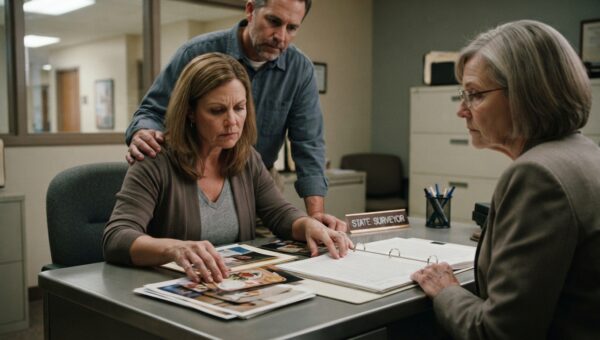
At the same time, Clara stepped out from the pantry holding the open leather notebook. She didn’t wait for Rachel to speak. Clara just set the book down beside the folder, right in front of Mama’s toast, and began to read.
She didn’t read loud. She read in that flat, professional nurse’s voice that brooks no argument. She read the entry from October fourth when Rachel threw Mama’s sewing basket across the room. She read the entry from November twelfth when Rachel told Mama that nobody else in the family cared whether she lived or died. And then she read the entry from last night, word for word, including the sound of the glass breaking on the hardwood and the exact threat about my medication.
Rachel’s face went completely slack, her coffee mug hovering halfway to her mouth. “What is this? What is she talking about, Mama? She’s making this up. Janice is losing her mind, you know she has those spells, “
“Shut up, Rachel,” Mama said.
It wasn’t a loud voice. It was the quiet voice Mama used back when we were kids and we’d crossed a line so far past the fence line there wasn’t even an apology left that would cover it. Mama didn’t look at Rachel. She looked down at the leather notebook, her finger trembling slightly as she touched the edge of the paper where Clara’s pen had pressed through.
“You took my sewing basket?” Mama asked softly, looking up at Rachel with eyes that suddenly looked twenty years older. “The one your grandmother left me?”
“Mama, don’t listen to her, she’s trying to take the house away from us, she’s working with this woman, “
“Look at the folder, Rachel,” I said, pointing down at the blue stamp from the county recorder’s office. “You spent three years trying to scare me into signing something that doesn’t even belong to you anymore. The trust was filed in October. You don’t own this house. You never did.”
Rachel lunged for the folder, her hand clawing across the table, but Clara stepped in between them with a quiet, immovable block, her hand resting flat on the cover.
“You’re done here, Rachel,” Clara said. “Pack your bags before I call the sheriff and read him these entries about the medication tampering. I think the state police take a special interest in elderly care interference.”
Rachel stood there for a long moment, her chest heaving under her wool sweater, her eyes darting from Mama’s blank, cold stare to the leather notebook and back to the signed deed. All that rage, all that three-year campaign of whispers and locked doors and midnight threats, and it had all come down to a nurse with a black pen and a piece of paper she couldn’t touch.
She didn’t scream. People like Rachel don’t scream when they lose; they just turn hard and small. She grabbed her leather purse off the chair, knocked her coffee mug over so a dark stain spread across the Formica table, and walked out the back door without looking back. The screen door slammed once, hard, and then the latch clicked home.
Nobody moved for a long time. The kitchen was so quiet we could hear the water heater kicking on in the basement, its steady, tinny rattle starting up right on schedule at 6:00 in the morning.
Mama let out a long, shaky breath that sounded like air leaving an old tire. She reached across the table, her fingers brushing the corner of Clara’s notebook, before she looked up at me with tears standing clear in the corners of her eyes. “Why didn’t you tell me, Janice?”
“Because you wouldn’t have believed me yet,” I said, pulling out the chair beside her and sitting down. “Not until you saw it all in one place.”
Mama didn’t say anything else. She just reached out and took my hand, her skin dry and cool against mine, while Clara picked up her empty coffee mug and quietly went to the sink to wash it out.
Later that afternoon, after the sheriff’s deputy had come and gone with a copy of the notebook pages for the file, the house felt different. The air didn’t feel thin anymore. It felt heavy and still, like the way the woods look right after a hard rain stops and the leaves are too wet to move.
I sat by the sunlit living room window with my shawl around my shoulders, watching the dust motes drift through theslant of light coming off the porch roof. Clara walked in softly, setting the black leather notebook on the low wooden bookshelf by the fireplace before placing a warm, steady cup of peppermint tea on the small round table beside my chair. The signed deed rested safely in its gray manila folder inside the mahogany desk across the room, tucked away where nobody would ever have to look for it again.