The envelope from the junior high school sat on the kitchen counter right beside the mail-in rebate form and a stack of bills that had been sitting there since Tuesday. It was a pale manila rectangle with the school district logo stamped in purple ink in the upper left corner. I picked it up while the coffee maker was still spitting out the last few dark drops into the glass pot, not thinking much of it.
Teachers sent home permission slips and fund-raiser brochures all the time, and usually, I just signed them without reading every single line of fine print.
Mark was still upstairs shaving, the water pipes groaning inside the plaster walls the way they always did when the old house woke up for the day. My son Leo was sitting at the laminate table with a brand-new box of colored markers spread out around his cereal bowl, clicking the caps on and off with a sharp little rhythm that usually set my teeth on edge. Leo had turned ten back in March, and we had stretched the grocery money to get him those sneakers he wanted for track season, the ones with the neon green swoosh on the side that all the boys in his fourth-grade class were wearing.
Lily was already gone. She caught the 7:15 bus down at the corner by the brick mailbox every single morning, walking briskly with her head down against the damp Alabama air.
At eleven years old, Lily had this habit of making herself as small as humanly possible, like a stray cat that had learned to stay out from underfoot. She carried her books in a nylon backpack that had a small tear near the zipper, one I kept meaning to mend with heavy-duty thread but somehow always pushed to the bottom of the mending basket.
I pulled the folded white paper out of the manila envelope and laid it flat on the counter next to the sugar bowl. It was a piece of standard drawing paper, the kind with the rough texture that kids use for art class when they are painting with watercolors or heavy crayons. At the top of the page, someone had written Lily’s name in neat block letters, and right beneath that was a family portrait rendered in clumsy strokes of colored pencil.
I stood there for a long moment, my coffee mug cooling in my palm, and stared at the four figures drawn inside the lines.
There was Mark, tall and broad-shouldered with his trademark blue work shirt. There was Leo, grinning with an oversized mouth holding a soccer ball. There was me, standing right beside Mark with my hair pulled back into my usual clip. And then, standing completely separate from the three of us, was a small figure behind a series of dark vertical lines that looked unmistakably like a chain-link fence.
Across the bottom of the page, written in Lily’s careful, rounded cursive, were the words that stopped my breathing cold. My family. I stand behind the fence because that’s where I watch from when Karen takes family photos.
The coffee maker clicked off with a sharp hiss. Upstairs, the water stopped running, and Mark’s heavy footsteps crossed the hardwood floor toward the stairs. I didn’t move. I just kept staring at the little girl behind the fence, at the way the blue pencil had shaded the wire so heavily that you could hardly see her face through the gaps.
I take family photos without her. I do that. When we went down to the lake park for the town jubilee back in July, I told Lily to hold the cooler while I lined Mark and Leo up by the wooden pier. When we went to my sister’s place for Thanksgiving, I asked Lily to watch the coats in the back bedroom while the rest of us gathered on the front porch for the group shot. I had always told myself it was just easier that way, that blended families were complicated, and sometimes you had to manage the logistics so nobody felt awkward.
A sticky note was paper-clipped to the corner of the drawing with a brief message from Mrs. Gable, the guidance counselor. We would like to discuss this during our scheduled conference next Thursday, it read in neat cursive. Please let us know if this time still works for your schedule.
When Mark came down the stairs, smelling of Old Spice and clean cotton, I folded the paper quickly and shoved it beneath the mail-in rebate form. He kissed the top of my head on his way to the coffee pot, asking if I had seen his blue insulated travel mug anywhere in the clutter. I told him it was on the counter, my voice sounding entirely normal, entirely hollow, while my chest felt like someone had dropped a heavy sack of gravel right on top of my ribs.
The rest of the day dragged on with that slow, heavy drag that only happens when you are carrying something you cannot put down. I dropped Leo off at soccer practice, stopped by the hardware store to pick up a replacement washer for the upstairs bathroom faucet, and walked through the grocery store aisles trying to convince myself that I was a good mother. I bought ground beef on sale and a box of fancy toaster pastries that Leo liked, but I didn’t look at the shoe aisle once. I knew what was on the bottom shelf for eleven-year-old girls, and for the first time in six years, the thought of those dusty cardboard boxes made my stomach turn over.
By evening, the house had settled into its usual routine, the television murmuring softly in the den while Mark caught the tail end of the local news. I was standing in the upstairs hallway, folding a load of warm laundry from the dryer, when I heard the water running in the second-floor bathroom.
The door was cracked open about two inches. Through the gap, I saw the pale blue glow of the nightlight reflecting off the tiles. Lily was standing at the sink, her small frame bent slightly over the porcelain as she worked her toothbrush back and forth with slow, methodical strokes. Her hair was pulled back into a loose, lopsided ponytail that had been slipping since dinner.
I didn’t knock. I just pushed the door open the rest of the way and stood there in the frame, my arms full of folded pillowcases.
Lily stopped brushing immediately. She didn’t turn around, but her eyes caught mine in the medicine cabinet mirror, wide and watchful and completely devoid of surprise. She rinsed her mouth out with a small cup of water, wiped her chin with the back of her hand, and finally turned to face me.
Karen, do you want me to go live somewhere else? she asked. Her voice didn’t shake at all. It was the quiet, steady tone of a child who had already rehearsed the words a dozen times in her own head. I can ask Dad. I don’t want to not make your family hard.
She got the words slightly tangled at the end, the way kids do when they are trying to be brave, but the meaning hit me with the force of a physical blow. She was eleven years old, offering to pack her bags and disappear because she thought her mere existence was an inconvenience to the life I had built with Mark and Leo.
She didn’t wait for me to answer right away. She just looked down at the linoleum floor, her small fingers twisting the hem of her faded cotton t-shirt until the fabric was white at the knuckles.
I just need to know one thing, she whispered, her voice dropping so low I had to strain to catch it over the hum of the refrigerator downstairs. Do you not love me because of something I did, or is it because I look too much like…
She didn’t finish the sentence. She didn’t have to.
The name Clara was never spoken in this house, not because Mark had forbidden it, but because I had made sure it stayed buried under the floorboards of our daily life. Clara had been Mark’s first wife, the young woman who had died of a sudden brain aneurysm when Lily was only four years old, leaving Mark a stunned widower with a toddler in a drafty rental house. When I met Mark three years after that, he was tired and quiet, and I had poured myself into his life like mortar into dry brick, filling every crack, smoothing every rough edge, making myself indispensable.
I had convinced myself that I was the one who held the family together, the one who made things work when the money was tight and the days were long. But looking at Lily’s face in the bathroom mirror under the harsh yellow light, the terrible truth finally broke through the walls I had spent years building.
It wasn’t about the grocery budget. It wasn’t about the thrift store clothes or the logistics of family portraits at the park. Every single time I looked at Lily, I saw the exact slope of Clara’s nose, the stubborn arch of her dark eyebrows, and the quiet, watchful way she held her shoulders when things got tense. I had been punishing an innocent child for the invisible ghost of a woman who had died before she even had time to leave a mark on the walls. I had resented Lily simply because she was the living, breathing proof that Mark had loved someone else fiercely before I ever walked through his front door.
I dropped the stack of pillowcases right onto the bathmat. They hit the floor with a soft, muffled thud.
Lily flinched, taking a half-step backward toward the bathtub as if she expected me to yell, the way people do when they are caught off guard by their own ugliness.
I crossed the small bathroom in two strides and dropped right down onto my knees on the cold tile, right in front of her. I didn’t care that my knees hit hard against the linoleum. I grabbed both of her small, cold hands before she could pull away.
No, I whispered, and my voice cracked so badly I barely recognized it as my own. Listen to me, Lily. Look at me right now.
She stared down at me, her eyes brimming with unshed tears that she was trying desperately to blink back.
It was never you, I said, and the words felt like hot glass in my throat. It was all me. I was a coward, Lily. I looked at you and I let my own stupid, jealous heart make up rules that were never supposed to exist. You are not standing behind any fence in this house. You hear me? Never again.
She didn’t say anything for a long, quiet second. The house hummed around us, the old pipes settling in the walls. Then, slowly, her fingers uncurled from her shirt and she let me pull her forward into my arms, her small chin resting on my shoulder while the dam finally broke and she started to cry.
Three days later, Mark and I sat at the kitchen table long after Leo had gone up to bed, the house dark except for the single overhead light swinging low over the butcher block. I had laid the school drawing right in front of him, alongside an open ledger book where I had spent the afternoon scratching out years of lopsided math. I didn’t make excuses. I didn’t talk about the cost of living or the price of track shoes or the stress of running a household on a single income. I told him everything, from the way I kept Lily out of the pictures to the way I had let my own secret resentment curdle into something cold and ugly.
Mark listened without interrupting once. He didn’t yell, and he didn’t try to smooth it over the way he usually did when things got uncomfortable. When I was finished, he just reached across the table, took my hand in his calloused palm, and wiped a stray tear off my cheek with his thumb.
We have a lot of work to do, he said quietly, and his voice was thick with a grief I hadn’t let him feel in years. But we are going to start tomorrow.
The change didn’t happen overnight, but it happened where it mattered, right down in the daily rhythm of our lives. On Saturday morning, I didn’t send Lily to the back of the car when we drove into town. I walked right beside her into the sporting goods store on Main Street, picked out a pair of brand-new running shoes in her exact size, and insisted we pay for them at the front counter before we bought a single thing for Leo.
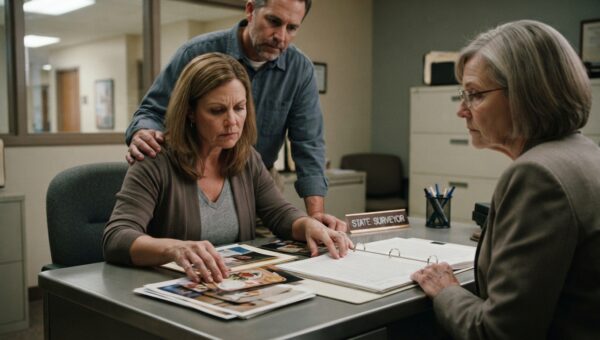
When the guidance conference came around on Thursday afternoon, I didn’t let Mark go alone, and I didn’t try to hide behind a polite smile. I sat across from Mrs. Gable in the small, carpeted office, looked her right in the eye, and told her that the drawing was going to change, because the fence was already gone.
Two months later, the photographer from the local studio came out to the house for our annual fall portraits, the ones we usually took down by the old oak tree near the property line. When he asked us to gather on the front steps, I didn’t hesitate. I pulled Lily right into the center between Mark and me, wrapping my arm firmly around her shoulders and tucking her close against my side while Leo leaned in from the other end.
The resulting photograph now sits in a heavy wooden frame right on the mantelpiece in the den, right where anyone who walks through our front door can see it first. There is no fence in the background, no empty space at the edges, and no one standing behind. Just the four of us, crowded together on the steps, looking straight ahead into the light.