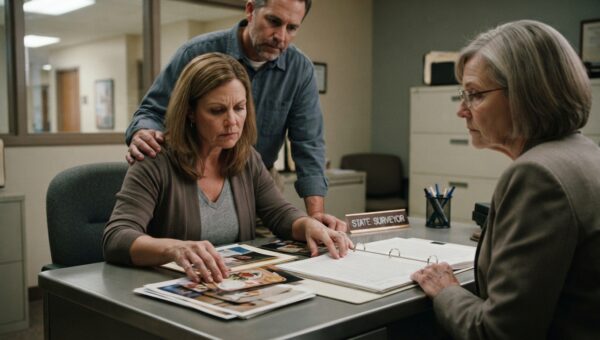
The green canvas folio sat on the passenger seat of my truck for three days before I finally opened it, stiff and smelling faintly of old coffee and bunker dust. Inside were four sheets of cheap printer paper folded twice, covered in Chloe’s small, rounded handwriting that I used to watch her practice at the kitchen table when she was nine years old.
It was not a diary, exactly. It was a log. Dates, times, bank routing numbers, and notes about what Julian said when he locked the deadbolt on the guest wing door for the third weekend in a row. When the hospital nurse called my landline at 6:14 in the morning, I didn’t ask questions. I just pulled on my trousers, reached into the hall closet for my service cap, and drove forty miles through the county fog without turning on the radio.
The room at Saint Jude’s smelled of floor wax and oranges that someone had left to rot in a plastic bag on the windowsill. Chloe lay against the thin white pillows with her knees pulled up toward her chest under a scratchy blanket that didn’t look like it had been washed since the previous Tuesday. Her arms were mottled with dark, purplish bruises that looked like thumbprints where someone had grabbed her hard enough to break the skin.
She didn’t cry when I walked in, which scared me worse than if she had been screaming. She just watched the door with that hollow, animal look she used to get during thunderstorms when she was little, before she grew up and married a man who built brick-and-mortar monuments to his own ego on the north side of the river.
Before I could pull the plastic chair close enough to touch her hand, the heavy fire door swung open and hit the wall with a hollow thud that made her flinch. Eleanor Vance walked in first, smelling of expensive perfume and damp wool, followed by Julian with his hands shoved deep into the pockets of an overcoat that probably cost more than my first truck. Eleanor didn’t look at Chloe once. She looked at me, standing there in my old Class A uniform with the ribbons tarnished just enough to show they had seen some weather, and her mouth tightened into a thin, bloodless line.
She had that smooth, country-club confidence of people who had never once in their lives had to wait for a traffic light to change or a bank teller to approve a check.
“You’re making a scene over nothing, Arthur,” Eleanor said, her voice dropping into that smooth, condescending register she used whenever she was talking down to the county extension agents or the local plumbers who kept her estate’s boilers running. “She slipped on the terrace. Girls from your side of the county have always been clumsy with their footing. Don’t be dramatic. We own the local authorities. Your rank means nothing here.”
Julian stayed by the door, jingling his car keys against his brass belt buckle with a rhythmic little click that set my teeth on edge. He looked at my uniform with that slow, rolling smirk he always wore when he was about to foreclose on a storefront or buy out a municipal councilman with three terms under his belt.
He thought the shiny buttons and the collar brass were just old metal worn by a man who had missed his chance to make real money in the private sector. Neither of them understood what a logistics commander does when his supply lines are cut. They thought the county sheriff, who ate Sunday potluck at Eleanor’s farm twice a month, was the highest authority on God’s green earth.
I didn’t yell. I didn’t raise my voice the way I used to do on the parade grounds when some twenty-year-old private left his rifle bolt open in the rain. I just looked at the two of them standing there in their expensive coats, completely blind to the perimeter they had just stepped inside. I pulled my phone from my breast pocket, tapped the screen twice to clear the screen saver, a small photograph of Chloe when she still laughed at my terrible jokes, and dialed a twelve-digit direct routing number that doesn’t exist on any commercial exchange in this state.
“Get me General Holloway’s duty desk,” I said into the black plastic as soon as the secure tone clicked. “Tell him Command Sergeant Major Miller is calling from the field. Tell him the Vance holding group has active municipal contracts on federal infrastructure, and we have an unverified containment situation at Saint Jude’s in District Four. I want the interagency financial strike force and the regional DOJ liaison notified immediately.”
Julian stopped jingling his keys. The smirk on his face didn’t vanish all at once; it kind of cracked across the middle like dry mud under a boot heel as he realized I wasn’t calling the town constable or a local divorce lawyer. Eleanor took half a step forward, her handbag swinging against her knee. “You can’t do that,” she said, and for the first time her voice lost that glassy, untouchable polish. “We contribute forty thousand dollars a year to the county commissioner’s reelection fund. We own this district.”
“You own the county commissioners, Eleanor,” I told her, keeping my eyes fixed on the way Chloe’s fingers were still trembling against the blanket. “You never owned the ledger.”
The next thirty minutes didn’t look like a movie where glass shatters and sirens scream through the streets. It looked like nothing at all, which is how federal paperwork always moves when it’s been sitting in a drawer for eighteen months waiting for a signature. At 7:02, two dark-blue utility trucks with government plates pulled into the ambulance bay downstairs, and six men in plain gray suits walked through the swinging doors without showing badges to the front desk clerk. They didn’t go to the administration office. They walked straight up the linoleum stairs to the second floor, past the vending machines and the stack of folded wheelchairs, and took up positions on either side of Chloe’s door like they were guarding an ammunition dump.
Julian tried to step into the hallway to make a call on his own phone, but the taller of the two investigators, a man with graying temples and a cheap leather briefcase, simply put one hand flat against Julian’s chest. It wasn’t a shove. It was just an immovable wall that didn’t give an inch when Julian leaned into it. “Mr. Vance,” the man said, his voice level and flat as a concrete slab. “Federal Marshals Service. Pursuant to emergency anti-corruption injunction 88-B, your corporate accounts, personal trusts, and subsidiary holdings are frozen effective six minutes ago. Please step back inside the room.”
The color left Julian’s face so fast it looked like someone had pulled a bedsheet over a window. He pulled his phone out of his pocket, his thumb sliding twice across the glass before he dropped it on the floor where it cracked against the tile. “This is a mistake,” he stammered, looking back at Eleanor for the kind of rescue she had been handing him his entire life. “Call Judge Miller. Call the mayor. Tell them who we are.”
Eleanor didn’t call anyone. She sat down hard on the green vinyl visitor’s chair by the window, her hands clutching her handbag until her knuckles turned the color of lard. She stared out the glass at the parking lot where three more federal vehicles had just blocked in her black Mercedes SUV, their hazard lights blinking in the cold morning drizzle. The local sheriff’s cruiser pulled into the lot three minutes later, the deputy driving it looking like he wanted to put his car in reverse and drive straight back to the county line when he saw the federal plates on the marshals’ trucks. He didn’t even get out of his car. He just sat behind the steering wheel with his hands on the top of the steering rim, watching the ground like he was waiting for a bus that wasn’t coming.
The nurse who had called me that morning came back down the hall about ten minutes after the marshals arrived, pushing a metal supply cart with one hand while she clutched a heavy manila folder to her chest with the other. She stopped outside the doorway, looked at the two federal agents standing at attention, and then looked at me with her eyes wide and wet behind her wire-rimmed glasses. She didn’t say anything out loud, but she reached into the top of the folder and slid a yellow legal pad across the small table near the door. On it was a handwritten inventory of every time Chloe had been locked in the estate’s east wing during the past four months, signed by the housemaid who had finally smuggled the key out in her apron pocket two nights ago.
“She didn’t fall,” the nurse whispered, her voice barely louder than the hum of the refrigerator in the corner. “They kept her in the storage room behind the indoor pool because she told the bank auditor about the missing municipal funds. I told the intake desk it was a domestic accident because Dr. Hayes was afraid of losing his hospital admitting privileges.”
I took the legal pad from her hand and laid it on the edge of the rolling tray. Then I walked over to the bed where Chloe was finally starting to relax her shoulders against the pillows. She looked up at me with those big, tired eyes, and for the first time since I walked into the room, she reached out and took hold of my thumb with her fingers. They were cold, but the shaking had stopped.
“You’re not going back there, honey,” I told her, my voice dropping down into the quiet register I used when we were sitting in the kitchen after her mother passed away. “The road is open now.”
Julian and Eleanor were still standing by the window, surrounded by three men in gray suits who were reading them their rights off small plastic cards without looking up. The billionaire empire they had spent forty years building on local favors and county-seat payoffs didn’t collapse with a grand explosion or a dramatic speech on the courthouse steps. It dissolved the way dry salt dissolves in a bucket of water when someone turns the hose on. By noon, the federal receivers would take over the construction yards, the municipal supply contracts would be nullified for fraud, and the bank accounts that funded their summer homes in Newport would be locked tight behind twenty-four-digit federal encryption codes that no local judge could touch with a ten-foot pole.
I didn’t watch them lead Julian out into the hall in handcuffs. I didn’t care about the look on Eleanor’s face when the female marshal told her to leave her handbag on the chair. I sat down in the vinyl chair they had vacated, reached up to the brim of my cap, and lifted it off my head. I set my old, worn Army service cap down on the small bedside table right beside Chloe’s hand, its brass emblem catching the pale winter light coming through the dirty hospital window. Outside, down in the courtyard, the federal audit teams were already carrying three heavy cardboard boxes out of the main entrance of the Vance regional office across the street, their boots crunching on the wet gravel as they loaded them into the back of a gray van. Chloe closed her eyes, her breathing finally deep and even, and for the first time in two years, the house felt quiet.