The envelope hit the scarred laminate of my kitchen table with a dry, heavy sound that stayed in the room long after it landed. It was thick paper, the kind with a raised edge you can feel if you run your thumb across it. My name was typed across the front in neat, black letters, but I knew the handwriting inside before I even slit the flap with my pocketknife.
Twenty-two years of double shifts at the plant will teach you a man’s handwriting the way a sailor learns the stars. You just know it by heart because it is all you have left to look at when the shift ends at midnight.
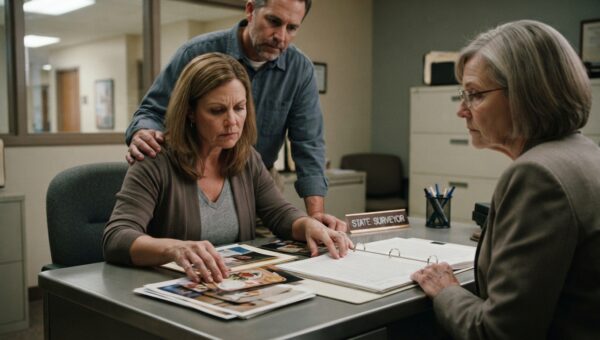
I sat there with my work boots still on, caked in dried gray rubber dust from the third press line. Aunt Martha had called me ten minutes before the mail carrier hit the box, her voice shaking with that small-town pity that feels like salt in an open cut. She was the one who told me about the budget. Thirty thousand dollars for a Saturday afternoon down by the lake. Not a single person in the family had asked me for a dime, which was supposed to be a kindness, I guess. Martha told me the florist had flown in white roses from somewhere down south and the caterer was serving prime rib to two hundred people.
I pulled the heavy card out and opened it slow, the paper stiff like cardboard. My thumb caught on the embossed lettering right away. It named the bride and groom, and right beneath them, it named the man walking her down the aisle. Kirk. The guy who lived two houses down from us on Maple Street, the one who kept a spare set of our garage keys back when Katie was twelve and I was working the swing shift. Kirk, who had coached her little league softball team while I was standing over the vulcanizer pulling sixty-hour weeks. Kirk, who fixed her first flat tire in our driveway while I was sleeping off a double on the cot in the breakroom.
My name wasn’t on the invitation. Not as a father, not as a contributor, not even as an afterthought down in the corner. There was just a blank space where a dad belongs, filled instead by a stranger who had simply been there when I wasn’t.
At the very bottom of the card, squeezed into the white margin below the reception details, was a short block of handwriting. Katie always did write small when she was nervous or trying to keep herself from crying. I had to squint under the harsh yellow kitchen light to make out the words. Dad, I’m only telling you so you’re not surprised when you hear about it from someone else. I love you, but you were never really here.
I sat there for a long time staring at those twelve words until the letters started to blur together into a dark smudge on the paper. The house was dead quiet except for the old refrigerator clicking on and off in the corner. I thought about her high school graduation night back in nineteen-ninety-nine. I remember standing by the cooling tanks at the plant, wiping sweat off my forehead with a dirty rag, when the shift supervisor told me I had a phone call in the office.
Katie’s voice on the other end had sounded thin and small over the hum of the compressors. She asked if I could make it by seven for the auditorium doors closing.
It’s just a ceremony, Katie, I said. I got bills to pay and this double covers the new brakes for your car.
She stopped asking me to things after that. She didn’t call when she got her first office job, she didn’t call when she bought her little blue Honda, and she sure didn’t call when she moved in with Kirk’s family over on the east side of town after high school finished. She just quietly built a life out of reach, brick by brick, while I kept my head down and kept feeding the machine.
The next morning I didn’t clock in for the six a.m. start. I called foreman Ray and told him I was taking my first personal day in six years, and I didn’t care if it cost me the attendance bonus. The plant floor sounded different when you weren’t standing on it. I walked up the wooden stairs to the attic with a flashlight in my hand, pushing aside old boxes of winter clothes until I found the cardboard crate marked Katie.
Inside were old school papers, broken hair clips, and a stack of photograph albums I hadn’t opened since she was ten. I sat on the floorboards with the dust thick in the air and started turning the pages. There I was in some of them, young and tired with grease under my fingernails, but mostly it was just Kirk. Kirk standing behind her at the plate with a baseball glove on his knee. Kirk sitting in the bleachers under a yellow umbrella while it poured rain during her eighth-grade track meet. Kirk handing her an ice cream cone outside the Dairy Queen with a grin on his face.
I shut the album and put my forehead against my knees. The house felt huge and empty around me. Twenty-two years of overtime money sitting in a savings account that nobody was ever going to spend, while the real life had happened two streets over in a house with a green door.
By Wednesday I knew what I had to do. I didn’t call Katie. I didn’t call Martha to complain or fish for more details about the guest list. I went down to Miller’s Men’s Wear on Main Street and bought a simple navy suit off the rack. Mr. Miller had to take up the cuffs with his little pins while I stood on a low wooden stool looking at myself in the three-way mirror. You look sharp, Arthur, Mr. Miller said, adjusting his glasses. Going to a wedding?
My daughter’s, I told him.
He didn’t ask which church or why I looked like I was walking to the gallows. Small towns keep secrets for you if you’ve lived in them long enough.
On the Saturday of the wedding, the sky over the lake was that pale, washed-out blue you only get in late September. I drove my old truck three miles past the turnoff for the plant and parked it down the road from the chapel, right behind a clump of cedar trees where nobody would notice the dent in the fender. I put on my suit jacket and walked up the gravel path, the stones crunching under my soles like broken glass.
The chapel was full of white flowers and people in fancy clothes talking in low, polite whispers. I didn’t go inside the main doors. I slipped in through the side entrance near the vestry and stood right at the very back, behind the last row of folding chairs where the ushers kept the spare hymnals. My hands were shaking inside my coat pockets.
The organ music started up, a heavy, slow sound that made the floor vibrate. People stood up and turned around in their seats to look toward the double doors at the front. I stayed back in the shadow of the heavy velvet curtain, my heart beating hard against my ribs.
Then the doors opened and Katie walked in.
She looked different than she did the last time I saw her across the grocery store parking lot. She was wearing a dress that caught the light from the stained-glass windows, her hair pinned back with little pearl flowers that glittered every time she moved. And right beside her, holding her hand tucked into the crook of his elbow, was Kirk. He had on a dark gray suit and a pink rose pinned to his lapel, walking steady and slow, looking down at her every few steps with that same quiet pride I should have been showing her every single day of her life.
My throat tightened up so hard I couldn’t swallow. I watched them walk down that long aisle, step by step, past aunts and cousins and neighbors who had watched her grow up while I was wrestling heavy rubber sheets on the second shift. For a second, a hot, bitter wave of anger rose up in my chest, wanting to step out from behind that curtain and claim my spot. But then I looked at her face. She wasn’t smiling like she was trapped. She looked peaceful. She looked safe.
When they reached the front, right before she handed her bouquet to the bridesmaid, Katie turned her head just an inch and looked straight down the center aisle toward the back doors.
Her eyes met mine through the dim light of the chapel.
She didn’t jump. She didn’t look mad. For one long second, her face went completely still, and then her chin gave a tiny, almost invisible nod. Just a little dip of her head, acknowledging I was there, keeping my distance the way she needed me to.
I didn’t wait for the vows. I didn’t walk down to the reception hall by the lake where the prime rib was waiting and the band was tuning up their horns. I turned around right there in the shadows, slipped back out the side door into the cool autumn air, and walked back to my truck.
I laid the heavy silver-framed photograph of her as a little girl back down on the mantelpiece when I got home. My work boots sat by the back door, clean of rubber dust for once, lined up side by side in the quiet house. Martha called later that night to say the ceremony went off without a hitch and that the food was wonderful.
I just listened, told her it sounded like a fine day, and hung up the phone without asking a single question about who sat where.