Chloe held the worn brown teddy bear by its one remaining ear while the fluorescent lights hummed overhead in the school counselor’s office. The room smelled faintly of old pine cleaner and warm paper from the copier down the hall. I sat on the edge of a plastic chair that felt too small for me, my CVS name tag still pinned crookedly to the chest of my blue polo shirt.
My hands wouldn’t stop shaking. I kept trying to press them flat against my knees to make them stop, but the tremor just lived under my skin like a live wire.
Mrs. Gable, the kindergarten teacher, stood by the window with her arms crossed tight over her cardigan. She was the one who had called me at the register ten minutes before my lunch break. She was the one who heard Chloe say the thing that made my world split right down the middle.
“She described it as a game,” the counselor said. Her voice was too soft, the kind of professional quiet that makes your ears ring. “He turns off the lights and presses on her ribs. She said it hurts but he tells her good girls don’t carry… good girls don’t cry.”
My legs didn’t work anymore. I tried to stand up to reach for Chloe, to pull her into my lap and check every square inch of her little body, but my knees just gave out.
I slid right down the slick linoleum until I was sitting on the floor with my back against the filing cabinet. It was cold enough to bite right through my work pants. Four years. We had been married for four years. Marcus had built us a life, or so I thought. He was the kind of man who remembered to take out the trash before I even had to ask. He fixed the squeak in the back screen door with a dab of machine oil and a steady hand. He kissed the top of my head when I came home from a double shift smelling like floor wax and stale cigarette smoke from the breakroom.
“I need to call somebody,” I whispered to the floorboards. My throat felt like it was lined with dry sand.
“I already have,” Mrs. Gable said gently, her shoes shifting on the tiles.
The police officer arrived eight minutes later. Officer Vance was tall and moved with that heavy, unhurried tread of a man who spent his life dealing with the worst parts of a small town.
He didn’t wear a hat, and his short brown hair had a patch of gray right above his left ear. He knelt down on one knee right in front of Chloe, making himself small so he didn’t look like a threat. He spoke to her using a calm, steady voice that made me want to cry with relief. He asked her ten simple questions about her room, about her bedtime routines, about the way the dark felt when the hallway light was off.
Chloe answered him without hesitation, her small fingers picking at the frayed threads of the teddy bear’s paw. She wasn’t scared of the officer. She was just tired. That broke me worse than if she had been screaming.
Officer Vance stood up, his belt creaking under the weight of his radio and gear, and walked over to where I was still slumped against the filing cabinet. He looked down at me with an expression that had all the pity stripped out of it, leaving only cold, professional certainty.
“Ma’am, based on what your daughter described, your husband has been systematically grooming and abusing her under the cover of a bedtime routine,” he said, and his words dropped into the quiet room like heavy stones in a well.
The rest of that morning moved in a blur of gray motion. Officer Vance radioed for backup units to secure our small rental house on Maple Street before Marcus could get back from his morning shift at the lumber yard. I signed three different papers on the back of a clipboard while sitting in the school nurse’s office, the ink of my ballpoint pen scratching loudly against the cheap paper. They wanted me to take Chloe to the county clinic for a forensic pediatric exam. They told me I couldn’t go home. They told me Marcus’s truck might already be in the driveway.
The drive to the clinic took twenty minutes through the midday traffic of our paper-mill town. Every red light felt like a trap. I kept glancing in the rearview mirror to check on Chloe, but she had curled up across the back seat with her head resting on a rolled-up hoodie, fast asleep. Exhaustion had finally taken her. I gripped the steering wheel until my knuckles turned yellow, the memory of Marcus smiling over the kitchen counter last night flashing behind my eyes with sickening clarity.
“Did you make sure she drank her water today, honey?” he had asked me while wiping down the laminate with a damp rag. His voice had been so warm, so normal. He had reached out and tucked a stray piece of hair behind my ear.
I had leaned into his hand, tired from standing on my feet for six hours at the register. I had thanked God for him. That was the part that made me want to throw up right there on the steering column. I had loved him for being steady while I worked myself ragged to help pay down our grocery bills. All the while, the dark bedroom down the hall had been a theater for his sickness. He used my absence. He knew I wouldn’t be home until six o’clock on Tuesdays and Thursdays because of inventory. He turned my own necessity against us.
At the clinic, a nurse with kind eyes and a silver badge pinned to her lavender scrubs met us at the side entrance so we didn’t have to walk through the waiting room. Her name was Brenda. She had a basket of small plastic toys and a cup of apple juice waiting in the examination room. She treated Chloe like she was made of spun glass.
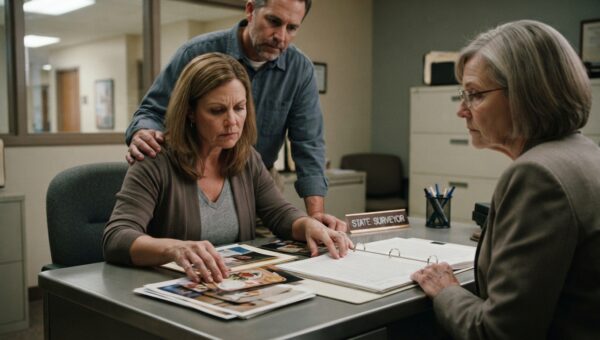
While Brenda worked with Chloe in the back, Officer Vance came back to find me in the small consultation room. He pulled a heavy manila folder out from under his arm and laid it on the laminate table.
“We secured the house,” he said, keeping his voice low so it wouldn’t carry down the hall. “He wasn’t there yet. We found his truck pulled up by the woodpile.”
“Did you find anything else?” I asked. My voice sounded thin, like paper tearing.
“A locked drawer in the master closet,” Officer Vance said, tapping a corner of the folder with a thick finger. “We had to open it. Inside was a ledger. Hand-drawn charts, dates, measurements of her ribs and waistline, alongside notes about compliance. He kept track of every single night like it was an inventory sheet.”
The blood rushed out of my head. An inventory sheet. The same words I used at CVS when I checked the stock on aisle four. He had treated my five-year-old daughter like stock on a shelf, calculating her body in the dark while I was ringing up milk and bread three miles away.
“Is he in jail?” I asked.
“He’s in holding down at the station,” Vance said. “And he’s not coming back to that house, ma’am. Not ever. Child Protective Services has already filed the emergency orders. You and your daughter are going to need a place to stay tonight because that house is a crime scene now.”
I didn’t have anywhere else to go. My mother had passed away three years ago down in Bangor, and our savings account had forty-two dollars in it after last week’s electric bill. But none of that mattered anymore. The only thing that mattered was that small pair of pink sneakers sitting under the examination room chair.
When Brenda brought Chloe back out, she was holding a brand-new coloring book with crayons taped to the cover. Chloe looked tired, her eyelids heavy, but she gave me a small, brave smile that nearly broke my ribs from the inside out.
“Mommy, can we go to a hotel?” she asked quietly. “I don’t want to go back to our bed.”
“We aren’t going back there, baby,” I said, kneeling down and pulling her into my arms so hard she let out a little squeak. I buried my face in her hair, breathing in the smell of baby shampoo and school paste, vowing right then and there that nobody would ever touch her again while there was breath left in my body. “We’re going somewhere safe. Just you and me.”
The motel room on the north side of town smelled faintly of bleach and stale carpet cleaner, but the door had three separate locks, including a heavy brass swing-bar at the top. I threw every single one of them into place as soon as we stepped inside.
The sun went down behind the pine trees across the highway, casting long, slanting bars of orange light through the cheap vinyl blinds. Chloe fell asleep almost instantly on the narrow double bed closest to the wall, her thumb tucked softly against her cheek, still clutching the worn brown teddy bear.
I didn’t turn on the overhead light. I sat down in the stiff vinyl armchair by the window, my coat still zipped up against the evening chill coming through the single-pane glass. Outside, the headlights of transport trucks on the highway swept across the asphalt parking lot, throwing moving shadows against the cream-colored wall above my daughter’s head. I sat there in the dark with my hands locked tight in my lap, watching the streetlamp light stretch across the floorboards, waiting for the sun to come up so I could figure out how to rebuild the world from the ashes.