PART 1
The municipal engineering office was quiet at seven in the morning, save for the hum of the fluorescent lights above my drafting table and the smell of stale black coffee in my favorite chipped ceramic mug. As a senior structural engineer for the county, my job usually involves load calculations for bridge expansions and drainage assessments for suburban housing tracts, straightforward math that leaves little room for ambiguity.
But the commercial plaza application sitting in my inbox was not straightforward at all, and the name at the top of the applicant roster made my stomach tighten. Brenda Vance, my older sister, was the lead development consultant for the project.
Brenda and I had spent our childhoods trailing after our father, a retired civil engineer who spent his final decades fighting the city council to preserve the historic community green space on the east riverfront. When he passed away five years ago, he left that parcel of land to a local heritage trust, specifically zoned to protect the mature oak groves and the old stone waterhouse he had helped build in the nineteen-seventies. Now, Brenda was spearheading a multi-million-dollar commercial rezoning proposal that would clear-cut the entire tract for a sprawling retail complex.
My phone buzzed on the drafting table, the screen lighting up with Brenda’s direct line. I stared at it for a second before sliding my thumb across the glass.
“Marcus, tell me the zoning clearance papers are on my desk,” she said without a greeting, her tone brisk and carrying that familiar edge of absolute expectation that had governed our family dynamics since we were kids. “The developer’s financial backers in Seattle are wiring the final escrow tranche this afternoon, but they need your municipal engineering stamp on the grading exemption before they release funds.”
“Brenda, I’ve been looking over the preliminary grading plats,” I said, leaning back in my office chair. “The retention basin calculations don’t match the historical floodplain boundaries. If we remove the old stone waterhouse and pave over that acreage, runoff during the spring rains is going to flood three blocks of residential housing downstream.”
“The floodplain data was updated last month by an independent consultant,” Brenda lied smoothly, her voice dropping into that persuasive register she used when she wanted to smooth over administrative hurdles. “Look, Marcus, I didn’t want to bring family into this, but you know how tight things have been since dad passed.
The developer carved out a four hundred seventeen thousand dollar facilitation fee specifically for the primary municipal sign-off. Half of that comes to me for managing local approvals, and I’ve already earmarked a generous portion to help clear out the remaining debts on the estate. All you have to do is apply the expedited stamp. No one down at the county board is going to dig into a routine grading waiver.”
Four hundred seventeen thousand dollars. The exact figure hung in the air between us, heavy and loud. I looked down at my desk, where a framed photograph of our father sat beside my calculator. He was wearing his faded flannel work shirt, his calloused hand resting on one of the stone blocks of the riverfront waterhouse.
“I can’t sign off on an expedited waiver for a protected historical trust property, Brenda,” I said, my voice steady despite the sudden spike of adrenaline in my chest. “Dad’s deed restriction is explicitly registered with the county clerk. You know that parcel cannot be commercially developed.”
“Dad’s deed restriction was amended last year under a municipal hardship clause,” Brenda snapped, her professional charm evaporating instantly, leaving behind the shrill, demanding tone of an older sister who refused to be contradicted by her younger sibling. “If you refuse to sign, you are not just holding up a standard commercial investment. You are costing us a fortune, and you are throwing away a once-in-a-lifetime payday that could secure our futures. Think about what you’re doing, Marcus. Don’t make this personal.”
The line went dead before I could reply. I set the phone down on the blueprints and stared at the digital timestamp on the municipal project portal. The submission date listed on the application was stamped three days prior, yet the supporting geotechnical report referenced boring logs dated two weeks in the future. Something was fundamentally wrong with the paperwork, and Brenda’s desperation had just confirmed my worst suspicion.
PART 2
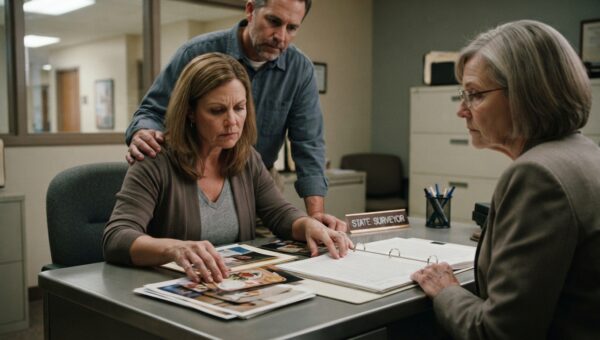
I didn’t touch the engineering stamp on my desk. Instead, I locked my office door, walked down the carpeted hallway of the municipal administration building, and took the elevator down to the county records basement. The air down there always smelled of aging paper, floor wax, and decades of municipal history. Mrs. Higgins, the head archivist who had been working in the records department since before my father retired, looked up from behind a towering stack of property ledgers as I approached the counter.
“Looking for historical plats again, Marcus?” she asked, adjusting her reading glasses.
“I need to pull the original file on the East Riverfront Heritage Trust, parcel four-zero-two,” I said, leaning against the counter. “Specifically the master deed restriction filed by Arthur Vance back in nineteen-eighty-two.”
Mrs. Higgins tapped away on her terminal for a moment, her brow furrowing. “That file is restricted under permanent municipal preservation status. Only authorized family executors or the director of engineering can pull the physical jacket.”
“I’m the primary municipal structural engineer for the district, and my father was the grantor,” I said quietly. “I need to see the unamended instrument.”
She hesitated, then nodded and walked back into the climate-controlled vault. A few minutes later, she returned carrying a thick manila folder tied with faded red cotton string. She placed it on the counter and stepped back to let me examine the contents.
I untied the string and opened the folder. Inside lay the crisp, yellowed parchment of the original deed restriction, bearing my father’s firm, deliberate signature in blue fountain pen ink. I turned the pages carefully, reading through the covenants that bound the land to perpetual public use as an environmental green space. There was no hardship clause. There was no municipal amendment.
At the bottom of the stack, however, was a document that made my breath catch. It was a duplicate copy of an executed developer escrow agreement dated three weeks ago, bearing a signature purporting to be our father’s, authorizing a preliminary site variance. But the signature was completely wrong. The slant of the letters was too steady, the loop of the ‘V’ in Vance flattened out in a way my father’s arthritic hand had never produced after his stroke in two thousand eighteen. It was a clumsy forgery, executed on a standard digital tablet pad and printed out to look like an old administrative addendum.
Brenda hadn’t just pressured me to sign a routine form. She had fabricated an entire legal trail behind my back, using a forged signature to bypass the trust board entirely, all to secure the four hundred seventeen thousand dollar developer fee that would bail her out of her failing real estate investments.
My phone buzzed in my coat pocket. It was an email notification from the municipal engineering director’s office, forwarding an urgent inquiry from the developer’s legal counsel demanding to know why the grading exemption stamp had not yet been applied to the portal. The deadline they had given was five o’clock that evening.
PART 3
I walked back upstairs to my office, my boots feeling heavy against the linoleum floor. The silence of the room felt different now, no longer peaceful, but charged with the inevitable weight of what I had to do. I sat down at my drafting table, pulled out the official municipal stop-work order form, and began filling out the fields with precise, methodical strokes.
I cited the structural discrepancies in the drainage calculations, the invalidity of the submitted geotechnical logs, and most importantly, the discovery of the unamended county deed restriction. I attached digital copies of the original archive documents I had photographed in the basement.
Before I could hit submit on the electronic filing portal, my office door swung open without a knock. Brenda stood in the doorway, her tailored wool coat unbuttoned, her face flushed from the brisk autumn wind outside. She looked older than her forty-four years, the skin around her eyes tight with panic.
“What are you playing at, Marcus?” she demanded, closing the door firmly behind her and stepping up to my desk. “The developer’s attorneys just called my cell. They said our municipal portal hasn’t cleared the grading waiver, and they’re threatening to pull out of the escrow agreement entirely. Do you have any idea what that means for me? My creditors are lined up outside my office.”
“I know what it means, Brenda,” I said, not looking up from my monitor as I finished typing the final paragraph of the stop-work order. “It means you forged dad’s signature on a municipal trust amendment to get your hands on four hundred seventeen thousand dollars in developer kickbacks.”
The color drained entirely from her face, leaving her staring at me as if she were seeing a stranger. For a second, she tried to maintain her defensive posture, her shoulders stiffening.
“You don’t have proof of that,” she whispered, her voice cracking slightly. “It was an administrative oversight. The county clerk misfiled the updated variance.”
“I pulled the original jacket from the basement archives an hour ago,” I said, finally looking up and meeting her eyes. “The signature on that variance is a digital trace of dad’s old tax return signature. I’ve already attached the original unamended deed and the forgery analysis to a formal ethics complaint and an engineering stop-work order. It’s routed to the county commissioner’s desk.”
Brenda stared at me, her mouth opening slightly as the reality of what she had done settled over her. All the bluster, the professional confidence, and the bullying family authority evaporated in an instant, replaced by the bitter panic of someone who had gambled everything on a shortcut and lost.
“You can’t do that to your own sister,” she said, her voice dropping to a desperate plea as she stepped closer to the desk. “They’ll pull my contractor’s license. They might even open a criminal fraud investigation. Think about our family name, Marcus. Think about what dad would say if he saw you turning me over to the county ethics board.”
“Dad left that land to the city so people like us wouldn’t pave over our history for a quick paycheck,” I said, my voice steady and cold. “You didn’t care about his legacy when you signed that escrow agreement, and you certainly didn’t care about my professional license when you tried to make me an accomplice to your forgery.”
She stood there for a long moment, trembling slightly, before she realized there were no more arguments left to make. Without another word, she turned around, pulled the office door open, and walked out into the hallway, her footsteps echoing sharply against the tile until they faded away entirely.
ENDING
By late afternoon, the county ethics board had officially acknowledged the stop-work order, freezing all commercial development on the east riverfront parcel pending a full forensic audit of the application files. The municipal engineering director called me into his office just before five to confirm that my professional license and integrity were entirely protected, commending me for catching the discrepancy before the escrow funds cleared.
I walked out of the municipal building just as the sun was beginning to dip below the Pacific Northwest skyline, casting long, golden shadows across the streets. The air was crisp and smelled of damp pine and autumn rain. I drove out to the east riverfront park, parking my truck near the edge of the mature oak groves where the old stone waterhouse stood silent and undisturbed against the fading light.
I walked along the gravel path, my hands buried deep in my jacket pockets, listening to the quiet rush of the river against the bank. My phone remained silent in my pocket, free of Brenda’s demanding calls and frantic text messages. I stopped beside the low stone wall our father had helped build forty years ago, placing my palm flat against the cool, weathered granite. The stone was solid, enduring, and exactly where it was supposed to be.