Twenty-two years of night shifts, double-booked overtime hours, and quiet breakfasts eaten over cold coffee all came down to a single plastic folding chair on the edge of the university football field.
Arthur sat there with his shoulders slightly rounded, wearing his best button-down shirt that was a little too loose around the collar. He kept turning his old, frayed high-school graduation cap over and over in his palm, his thumb tracing the frayed yellow tassel like it was a worry stone.
He was thirty-nine years old, but the deep lines around his eyes made him look fifty, carved into his face by two decades of scrubbing floors, stocking warehouse shelves at midnight, and learning how to braid fine hair with trembling teenage fingers.
The crowd around us was loud, full of flashing cameras and plastic cowbells, but my father was staring down at his worn-out work boots. He never asked for any of this attention, and I could tell he felt out of place among the professors and wealthy parents.
“You don’t need to keep holding that old thing, Dad,” I whispered, leaning over to touch his sleeve.
“I just want to remember where we started,” he muttered, offering me that small, tired smile that always meant he was trying to be strong for me. “Besides, your mother isn’t here to see it, so I have to be enough for both seats.”
That was the lie we had lived with since I was three months old.
The story was carved into our bones: a seventeen-year-old boy walking out to his old bicycle by the backyard fence, finding a shivering infant in the wire basket with a crude note tucked into the blanket. *She’s yours. I can’t do this.* Arthur didn’t even know my mother was pregnant, and she had vanished into thin air before the morning sun ever hit the grass. He gave up his scholarship, dropped out of community college classes, and raised me alone without a single penny of support or a word of explanation.
The university chancellor stepped up to the microphone, calling out my name to the roaring stadium. I stood up, smoothing down my black gown, and walked across the wooden stage to accept my diploma. When my hand touched the heavy leather folder, I looked out into the blinding midday sun and scanned the front row of the bleachers for my father.
He was standing on his tiptoes, clapping so hard his palms were red, his eyes shining with tears he wasn’t even trying to hide.
That was when the woman stood up in the third row.
She wasn’t wearing graduation colors. She wore a sharp, expensive charcoal coat that looked entirely out of place in our humid Tennessee foothills, and her silver-streaked hair was pulled back into a severe knot. She didn’t clap. She didn’t smile. She just stepped out into the concrete aisle, raised her hand toward the stage, and spoke with a voice that cut straight through the brass band.
“Before you celebrate,” she called out, her voice cracking slightly over the public address system, “there’s something about your father you don’t know.”
The stadium noise didn’t stop all at once; it died away in a confused wave as heads turned and whispers rippled down the metal benches. Arthur froze, his hands still half-raised in applause, his face draining of all color as he stared up at the stranger in the aisle.
“Who are you?” Arthur shouted back, his voice shaking with a sudden, violent panic that made my stomach drop. “Sit down!”
“I’m Elena,” the woman said, holding her ground as campus security guards began jogging down the stairs toward her. “And I have the papers your grandfather spent twenty-two years trying to bury.”
The next twenty minutes were a blur of cold folding chairs behind the stadium bleachers while the brass band played off-key pop tunes in the distance. Security wanted to escort Elena off the grounds, but I stood between them with my diploma still clutched in my fist, telling them we weren’t going anywhere until she explained herself.
Elena’s hands were trembling as she unzipped a heavy leather briefcase and pulled out a stack of yellowed, brittle papers held together by rusted paperclips. She looked at Arthur with deep, sorrowful eyes that looked hauntingly familiar when the afternoon light hit her cheekbones.
“You don’t recognize me, do you, Arthur?” she asked softly. “I didn’t expect you to. You only saw me once, through the window of a parked sedan behind your high school, the night before you found her in your bike basket.”
Arthur stepped back, his hands clenching into fists at his sides. “I don’t know what game you’re playing, lady. If you’re her mother, you’re twenty-two years too late. She didn’t want her. She left her in a wire basket with twenty dollars and a dirty blanket.”
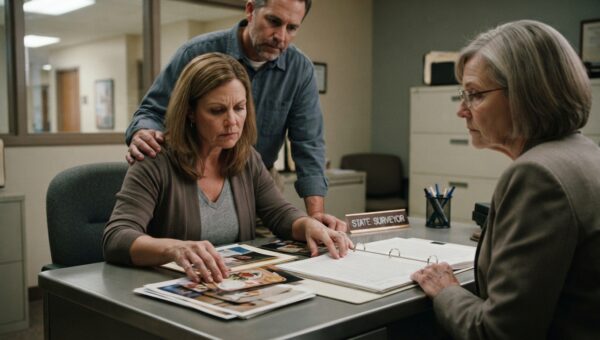
“She didn’t leave her by choice,” Elena said, her voice breaking as she pulled a damp, folded letter from the file and slid it across the metal table between us. “My sister Claire was seventeen, just like you. But our father was Judge Miller. To him, an unwed pregnancy in a prominent family was a career-ending scandal. He locked her in her bedroom for four months, Arthur. The night you found her in that basket, Claire didn’t run away. Our father had her dragged out of the house by private security and put on a bus to Nashville. He was the one who put her in your basket. He paid a driver fifty dollars to drop her off at the poorest boy’s house on the other side of town, hoping the shame of it would force you to give her up to the state.”
I looked at Arthur. His chest was rising and falling in shallow, ragged breaths, his eyes fixed on the letter on the table.
“That’s a lie,” Arthur whispered, though the fight had completely gone out of his voice. “The note… the note was in her handwriting. I compared it to her old school yearbook.”
“Our father forced her to write it at gunpoint before they drove her away,” Elena said, tears finally spilling down her cheeks. “She fought them until she bruised her wrists. She begged them to let her keep her baby, but our father told her that if she ever came near you or the child, he would destroy you both legally and financially before the week was out. Claire died of pneumonia in a clinic in Ohio three years later, Arthur. She never stopped talking about you. She never stopped looking for you in every face she saw on the street.”
The silence that settled over us was heavy, broken only by the distant cheering of students tossing their caps into the air on the main lawn. Arthur didn’t cry. He just reached out with one trembling hand and touched the edge of the old letter, his fingers tracing the faint, smudged ink of a girl who had lost everything before she even turned eighteen.
“She thought I didn’t want her,” Arthur muttered, his voice barely a breath. “For twenty-two years, I thought she just dropped her off and walked away like we meant nothing.”
“She knew you were the only good thing in that whole county,” Elena said, opening another folder filled with thick legal briefs and court stamps. “And when you turned nineteen and refused to give her up to the adoption agencies, our father tried to destroy you another way.”
Elena laid out a second set of documents, pointing a manicured finger at a court seal dated twenty years back.
“When you were a toddler, Arthur,” Elena explained, looking directly at me, “my father filed a secret emergency custody petition claiming your father was an unfit, destitute minor who couldn’t provide a stable home. He spent thousands of dollars trying to strip you away from him through the county courts.”
Arthur looked down at the papers, a strange, hollow expression crossing his face. “I remember that,” he said slowly, the memory dragging up from some dark corner of his past. “I got a notice in the mail. A lawyer in a gray suit showed up at my door telling me I had forty-eight hours to hand you over or face a judge who owed my landlord favors. I thought my life was over.”
“You didn’t lose,” Elena whispered. “Do you remember the young public defender who took your case pro bono on a Tuesday morning?”
Arthur frowned, squinting at the name at the bottom of the legal brief. “Mr. Vance. He died of a heart attack a few years later. He told me he just believed in me.”
“He didn’t just believe in you,” Elena said quietly, her voice dropping to a near-whisper. “I went through our family’s ledgers after my father passed away last year. I found the receipts. Vance didn’t take your case for free. I paid him. I stole my father’s checkbook and funded your entire legal defense from the inside, funneling every dollar I could scrape together to keep you from losing her. I couldn’t stop them from taking Claire, Arthur. But I swore to God I wouldn’t let them take you.”
None of us spoke for a long time. The afternoon sun had started dipping behind the stadium lights, casting long, cool shadows across the asphalt parking lot. Arthur sat there with his head bowed, his shoulders shaking slightly as the immense, invisible weight he had carried since he was seventeen finally began to slip away.
He had spent twenty-two years believing he was a victim of abandonment, a scared kid who got lucky on a doorstep. He had carried the guilt of not being able to give me a mother, working himself to exhaustion to make up for a void that wasn’t his fault.
“You kept us safe,” Arthur finally whispered, looking up at Elena with red, swollen eyes. “All these years… I thought I was entirely alone.”
“You were never alone, Arthur,” Elena said, reaching across the table to lay her hand over his calloused knuckles. “You just had a guardian angel working graveyard shifts right alongside you.”
When we finally drove back to our small, faded house on the edge of town, the sun was sinking low behind the hills, painting the sky in shades of deep amber and bruised purple. We didn’t talk much on the ride home. The air between us felt different, lighter somehow, stripped of the old ghosts that had haunted our hallway for two decades.
Arthur walked into the living room, still holding his high-school graduation cap in one hand. He didn’t turn on the overhead light. Instead, he walked straight over to the mantelpiece where my new university diploma sat propped up against a framed photograph of the two of us at my kindergarten promotion.
He stood there for a long moment in the quiet room, breathing out a long, shuddering sigh that seemed to release twenty-two years of accumulated grief.
Then he reached out and placed his old, worn-out high-school graduation cap, with its frayed, sun-bleached yellow tassel, right beside my gleaming university diploma, leaving them there to rest together in the fading evening light.